About half of the world’s population is raised to see contradictions as normal—while many of us are trained to treat them as mistakes. You’re in a meeting: your boss says, “Move fast, but don’t miss a single detail.” Do you freeze, pick a side, or lean into that tension?
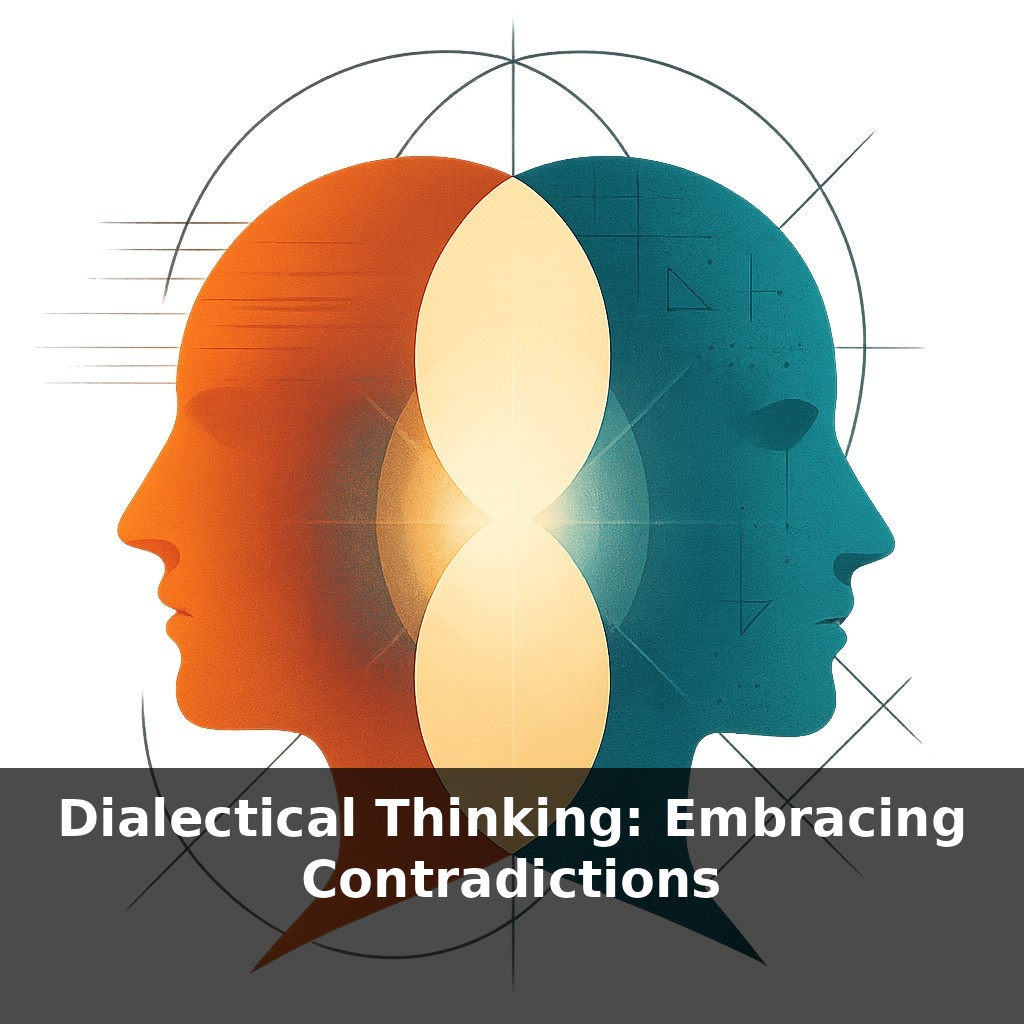
Here’s the twist: the people who handle that tension best aren’t necessarily smarter—they’re thinking *differently*. Dialectical thinkers don’t rush to choose sides; they ask, “How might both be true, but in different ways?” Cognitive scientists find that this habit quietly upgrades three things you probably care about: how creatively you solve problems, how well you navigate conflict, and how resilient you stay when life pulls you in opposite directions.
In East Asia, this style of thinking is more common; in many Western contexts, we’re trained to hunt for the one “correct” answer and discard the rest. That’s like walking through a city and only noticing one street: efficient, but you miss the back alleys where innovation—and better options—often hide.
In this episode, we’ll look at how to practice that broader, more flexible way of seeing, without becoming indecisive or vague.
In practice, this shows up in places you might not label “philosophical” at all. Designers wrestle with making products both simple and powerful. Leaders try to keep standards high while giving people room to fail and learn. Even friendships often hinge on balancing honesty with kindness. Across fields, the people who consistently outperform aren’t the ones who escape these pulls, but those who turn them into a kind of mental workshop—treating each clash of values as raw material to be shaped, rather than a flaw to be erased or a battle to be won.
Start with this: dialectical thinking isn’t about being “so open‑minded your brain falls out.” It’s a disciplined way of stretching your perspective *without* losing structure.
Researchers often break it into three trainable moves:
**1. Step back from either/or framing.** When you hit a mental snag—“I should prioritize my career” vs. “I should be there for family”—notice the hidden assumption: *only one can matter right now*. Dialectical thinkers ask, “On what *time scale* or in which *contexts* is each one more valid?” That shift from *which side is right?* to *when is each side right?* is small linguistically, but large cognitively. East‑Asian participants in Spencer‑Rodgers’ work, for example, more often predicted that apparent opposites (like traits of a friend) could both show up across situations and time.
**2. Treat contradictions as information, not errors.** Your frustration when a plan “doesn’t add up” usually makes you shut down or double down. Training studies show that when people are cued to see that discomfort as a *signal to explore*, they generate more original solutions on subsequent tasks. That 0.42 SD creativity boost from dialectical training isn’t about random brainstorming; it’s about staying with the dissonance long enough to see structure you’d normally edit out.
**3. Look for a third pattern, not a middle point.** This is where many people get it wrong. Synthesis isn’t “splitting the difference.” It’s discovering a configuration where each side changes shape. Toyota didn’t simply “average” productivity targets with concern for workers; it redesigned workflows so that people stopping the production line when they saw a defect *increased* long‑term efficiency. The initial opposition—speed vs. care—became a loop that reinforced both.
You can apply the same move to internal states: Dialectical Behavior Therapy doesn’t tell clients, “Stop being emotional, be rational.” It helps them build ways of acting that *honor* intense feelings while still moving toward chosen goals, which is why those self‑harm reductions are so striking.
Across domains, the habit is the same: zoom out, reinterpret friction as data, and hunt systematically for a configuration where the “opposites” become mutually useful rather than mutually destructive.
Think about a designer asked to build an app that feels “calm” but also “high‑energy.” A non‑dialectical approach picks one vibe and waters down the other. A dialectical designer might separate *where* each quality lives: muted colors and whitespace for the base screens, sharp motion only at key decision points. Calm and energy stop competing and start coordinating.
Or take a manager told to “trust your team” and “maintain strict quality.” One common reaction is micromanagement dressed up as support. A more dialectical move is to set *clear*, non‑negotiable standards—then let people choose their own methods, review only the outcomes, and use misses as co‑diagnosed learning problems rather than blame.
Even personally: you might want stability *and* novelty in your week. Instead of vague compromise, you could protect a few non‑moving routines, then deliberately schedule “experiments” in small, low‑risk windows, so each side safely stretches the other.
A society that practices this more widely might redesign debates, not to crown winners, but to map where opposing views illuminate blind spots. Classrooms could grade students partly on how well they steel‑man views they dislike. In teams, reviews might ask: “Which tension surprised us this quarter, and what did it reveal?” Over time, leaders start to treat stubborn disagreements like fault lines on a map—places you study carefully because that’s where new terrain is still forming.
Treat this as a muscle you’re just starting to train: the goal isn’t instant clarity, but staying curious when your mind wants to shut a door. Over time, tensions you’d normally dodge become starting points—like trailheads on a map—guiding you toward questions no one around you is asking yet, and options that didn’t exist before you sat with the friction.
To go deeper, here are 3 next steps: 1) Pick one “both-and” conflict you’re currently sitting with (e.g., craving change but fearing instability) and work through the DBT “Dialectical Dilemmas” worksheet from TherapistAid.com or the DBT Skills Training Handouts by Marsha Linehan (start with the “Dialectics” handout) to actually map out both sides. 2) Queue up the “Dialectical Behavior Therapy” episode of The Psychology Podcast with Scott Barry Kaufman or search “dialectical thinking Robert Kegan” on YouTube, then pause once to jot the *exact* sentence that best describes how you usually think in either/or terms. 3) Grab a short book or chapter that explicitly models dialectical thinking—try the chapter on “paradox” in “The Wise Heart” by Jack Kornfield or a summary of “Thinking in Bets” by Annie Duke—and highlight every place the author holds two truths at once; then mark just *one* sentence you want to try using in your own self-talk today (for example, “This is hard, and I can handle it”).