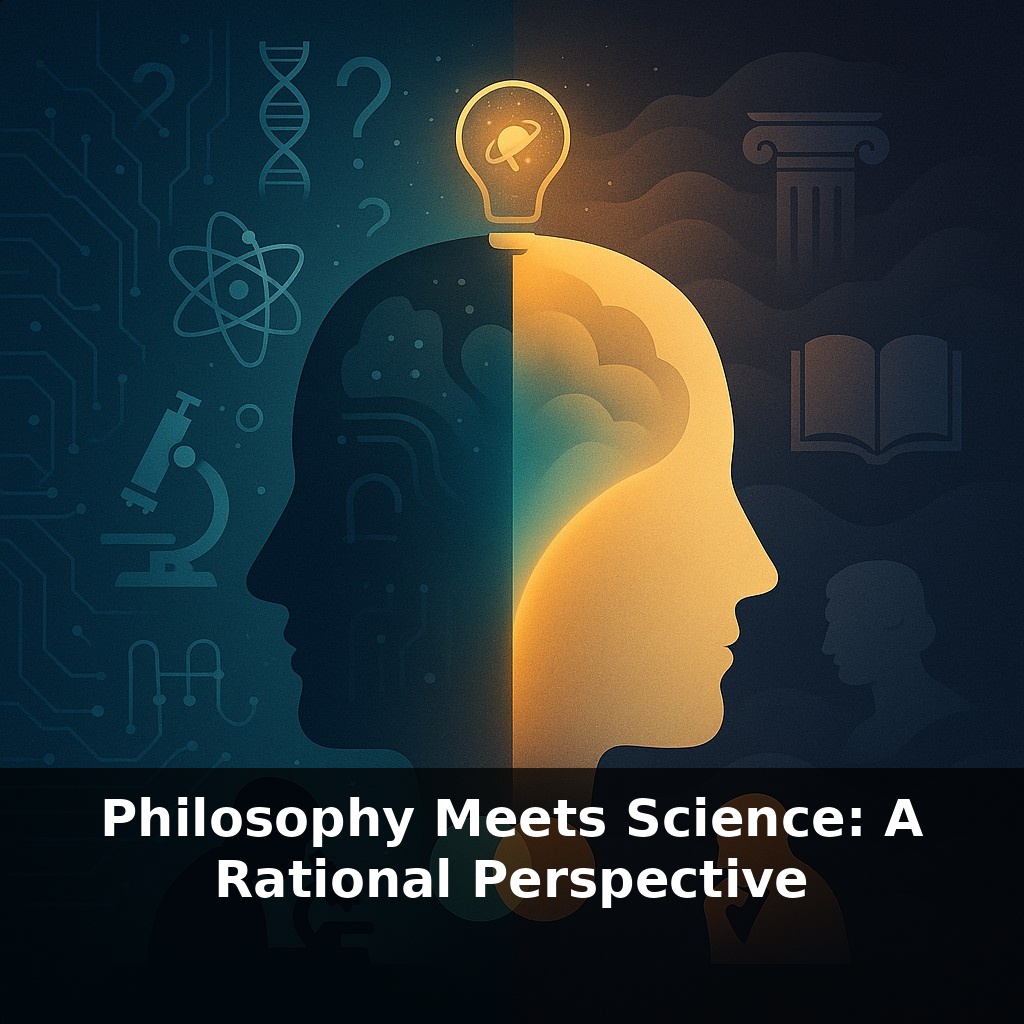
“Science without philosophy is blind; philosophy without science is empty.”
A biologist debates gene editing. An AI engineer worries about consciousness. A doctor weighs data against dignity. In each case, the lab results are clear—yet the real battle is over what those results *mean*.
Einstein once remarked that “it is the theory which decides what we can observe.” That line quietly explodes a myth: that science is just “reading off” facts from nature. In practice, scientists move through the world with philosophical lenses already on—assumptions about what counts as evidence, what makes an explanation good, even what kind of thing a “cause” is.
When AI researchers argue over whether large models “understand,” they are not missing data; they’re clashing over concepts. When climate scientists defend specific emissions targets, they lean on views about justice and risk, not just temperature graphs. Philosophy doesn’t float above this; it presses on the definitions, the logic, the hidden value-choices that steer whole research programs—and sometimes, entire futures.
So when people say “science will replace philosophy,” they miss a quiet dependency. Every experiment hides answers to prior, untested questions: What counts as a reliable method? Which possibilities are even worth ruling out? Popper turned this into a standard—falsifiability—that now shapes how entire fields judge whether a claim is “scientific” at all. Kuhn then showed that even this standard can shift, as paradigms change. Ethical debates over genome editing or AI sentience inherit these battles, extending them from lab practice into law, policy, and everyday responsibility.
Call a truce, for a moment, in the “team science” vs “team philosophy” culture war and look at how real breakthroughs actually happen. They rarely come from pure data or pure reflection alone, but from friction between the two.
Start with the most basic step in any study: framing a question. “Does X work?” sounds simple, but buried inside are assumptions about what “works” means, what time-scale matters, which side effects count, and for whom. That’s conceptual engineering—philosophy done with a scalpel instead of a slogan. Clarifying terms is not word games; it changes what gets measured, funded, and regulated.
Method comes next. Statistical models don’t drop from the sky; they encode views about causality, probability, and rational belief. When researchers debate p‑values, Bayesian priors, or the replication crisis, they’re doing philosophy of science in practice. They’re arguing about what should rationally update our confidence, not just how big a number looks on a graph.
Then there’s interpretation. The same dataset can support rival conclusions, depending on background assumptions: Are we realists about unobservable entities, or instrumentalists who only care about predictive success? That dispute shapes how seriously we take things like multiverse theories or certain interpretations of quantum mechanics. The equations stay the same; the worldview doesn’t.
And when scientific power scales up—vaccines, surveillance, predictive policing, climate engineering—questions of legitimacy explode. Who gets to decide acceptable risk? How do we weigh individual liberty against collective safety? Those are ethical and political theories made concrete, whether or not anyone uses philosophical jargon.
The WHO summit on genome editing didn’t pause because new pipettes failed; it paused because old concepts—personhood, responsibility, consent—hit their limits. Something similar is playing out now in AI labs, where technical teams quietly import ideas from philosophy of mind and ethics to decide which experiments are even thinkable.
One way to see the pattern is to notice how often paradigm shifts arrive when someone revises both the empirical picture and the underlying conceptual map at once—like a traveler who updates not only their route, but their sense of what counts as a destination at all.
When epidemiologists argued over whether COVID case counts or excess deaths were the “real” signal, they weren’t just crunching numbers; they were negotiating what, exactly, we’re measuring when we track a “pandemic’s impact.” Shift the concept, and policy thresholds move with it.
You see the same pattern in AI safety. Some labs model risk in purely probabilistic terms; others insist on including political misuse, labor disruption, or long‑term autonomy. The math sits on top of a prior choice: what kinds of harm *count* as central, and which are treated as background noise.
Philosophy also shapes what never makes it into a spreadsheet. Clinical trials once routinely excluded pregnant people; that wasn’t a discovery, but a value‑laden decision about whose outcomes mattered. Revising the concept of a “standard patient” suddenly reveals missing data as an ethical failure, not a mere gap. Like a landscape painter deciding which features belong in the frame, our concepts silently dictate which parts of reality become scientifically visible.
As tools like AI and quantum tech spill into courts, hospitals, and markets, the deepest disputes may shift from “what can we do?” to “what should count as progress?” Battles over metrics—efficiency, well‑being, autonomy, resilience—will quietly steer which projects thrive. Like hikers choosing a trail by what they call “beautiful,” our standards for a good future will filter which innovations feel obvious, urgent, or unthinkable. The risk isn’t ignorance, but letting those standards ossify before we notice.
So the live project is not “science vs philosophy” but how well we let them cross‑examine each other. Next time you see a headline about AI, climate, or medicine, notice the quiet questions in the background: Which futures are we treating as real options, and which are we erasing? A more rational worldview starts where those hidden choices are dragged into daylight.
Start with this tiny habit: When you catch yourself scrolling or about to open a new tab, pause and whisper to yourself, “What’s the claim here?” and then name just **one** assumption you’re making (like “I’m assuming this headline isn’t exaggerating” or “I’m assuming my memory of this event is accurate”). For the rest of the day, whenever someone (including you) states something as a fact, simply add, “according to what evidence?” in your head, without trying to answer it fully. This keeps you in that sweet spot where philosophy (questioning assumptions) and science (demanding evidence) quietly team up in your everyday thinking.