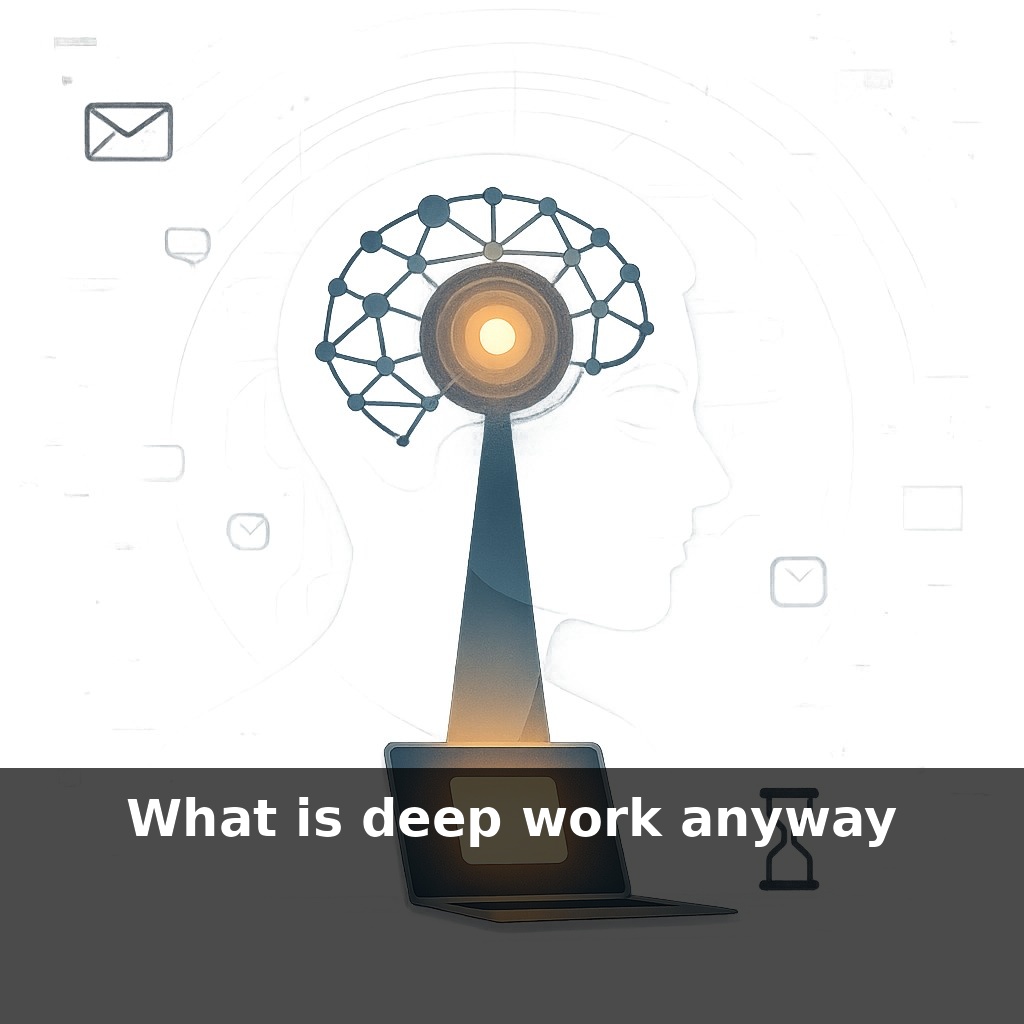
What is deep work anyway
📝 Transcript
Right now, the average office worker checks email so often it adds up to dozens of tiny interruptions an hour—yet most people still feel strangely busy and strangely unproductive. In this episode, we’ll explore the hidden state of focus your brain is built for, but rarely reaches.
Most people assume productivity is about doing more things; deep work quietly insists it’s about doing fewer things, better. It’s not a buzzword, and it’s not just “concentration with a fancy name.” Deep work is a specific, deliberate mode of working where your brain is fully loaded on one hard problem at a time—no background mental tabs, no low-level scanning for the next ping.
In that mode, your brain behaves differently. Hard tasks that usually feel like dragging a suitcase with a broken wheel suddenly roll. Concepts that normally slip away start to connect. Instead of skimming across the surface of your day, you get traction.
In modern knowledge work—coding, strategy, design, research—this is where actual breakthroughs come from. Not during status meetings. Not while half-reading chat. The challenge is that our tools, offices, and habits are mostly engineered for the opposite.
Deep work sounds attractive in theory, but it only becomes real when it collides with your actual day: calendar invites, Slack threads, Jira tickets, family messages, that article you meant to read. Underneath all of this, your brain is running a quiet calculation: “Is anything here important enough to give my full bandwidth to?” The neuroscience says when you answer yes and protect that choice, your brain literally rewires around the problem at hand. That’s why people who regularly defend focus blocks often look “less busy” hour to hour, but rack up disproportionate progress over months.
Deep work also has edges and contours—it’s not a mystical on/off switch. There’s a spectrum from shallow to deep, and most days are an unexamined blend of both.
At the shallow end: reactive tasks that are easy to start and easy to resume—status updates, simple emails, minor tweaks to existing work. They’re not useless; teams need coordination, systems need maintenance. But these tasks don’t ask your brain to construct anything fundamentally new. They don’t stretch your skills or force you into that slightly uncomfortable zone where you’re unsure you can do the thing.
At the other end is work that quietly scares you a bit: designing an architecture from scratch, writing the core argument of a paper, debugging a failure you don’t yet understand, drafting a strategy that could change a team’s direction. This kind of work has two properties: it’s cognitively expensive, and it’s easy to avoid. Your brain will happily trade it for a burst of quick wins and notifications that feel like progress.
This is where deep work starts to look less like a productivity tactic and more like a career choice. Knowledge workers who consistently choose the hard, high-leverage problems—then give those problems their full mental bandwidth—tend to create artifacts that compound: reusable libraries, clear frameworks, documented insights, robust systems. Over time, those artifacts quietly separate them from peers who are equally “busy” but mostly cycling shallow tasks.
There’s also a surprisingly emotional layer. Deep sessions often begin with friction: vague anxiety, the urge to “just check one thing,” the sense that you’re not quite ready. That resistance is a signal you’re near the frontier of your ability, not that you’re doing it wrong. People who practice deep work don’t eliminate that feeling; they learn not to negotiate with it.
One useful lens: treat deep work like a finite daily resource, closer to physical strength than to willpower in the abstract. You probably have a few high-intensity hours in you, not ten—and that’s normal. The game is not to flood every minute with effort, but to spend those peak hours on work that actually moves the needle, then protect the recovery that lets you come back and do it again.
Think of a day where you moved a project meaningfully forward. Odds are it wasn’t because you cleared your inbox; it was because, for some stretch, everything else went quiet around a single, stubborn problem. That stretch has a texture: time passes oddly, external chatter fades, and small decisions suddenly feel obvious instead of draining.
For a developer, this might be the three hours where a messy module becomes a clean, testable component. For a researcher, it’s the afternoon where scattered notes cohere into a publishable argument. Designers feel it when a vague brief hardens into a concrete system of constraints and patterns. The visible output varies, but the inner pattern is the same: one hard target, repeatedly engaged, with no easy escape hatch.
Musicians know this well. Running a difficult passage slowly, again and again, until fingers find the pattern on their own isn’t glamorous—but later, on stage, that invisible grind shows up as “effortless” performance.
As deep work becomes rarer, it also becomes a sharper filter. Teams that normalize long, quiet stretches of thinking will ship fewer features but better systems—like a band that plays fewer gigs yet refines a signature sound. Hiring might shift from “can you handle chaos?” to “can you protect and use your best three hours?” Even networking could change: the most valuable introductions may be to people who defend your focus as fiercely as their own.
Treat this kind of focus less like a rare mood and more like a craft you can train. Start tiny: one meeting-free hour where notifications stay dark and you tackle the thing you’ve been circling. Over weeks, those hours stack like bricks in a wall, quietly separating work that merely fills days from work that defines them.
Before next week, ask yourself: 1) “Looking at my calendar for tomorrow, which 60–90 minute block could I turn into true ‘deep work’ by shutting off Slack/email, silencing my phone, and working on one clearly defined task that actually moves the needle (like drafting that report, designing that feature, or outlining that presentation)?” 2) “What’s the single most distracting behavior I keep slipping into during focused work (tab-switching, checking messages, ‘just a quick scroll’), and what specific barrier can I put in place today to make that behavior harder (website blocker, phone in another room, closing the office door)?” 3) “If deep work is mentally demanding, what small pre-work ritual could I try this week—like a 5‑minute review of my goal, clearing my desk, or a short walk—that would signal to my brain, ‘this is focus time,’ and how will I know if it’s actually helping?”
From this course
The Art of Deep Work
7 episodesUnlock all episodes
Full access to 7 episodes and everything on OwlUp.
Subscribe — $1.99/monthLess than a coffee ☕ · Cancel anytime

