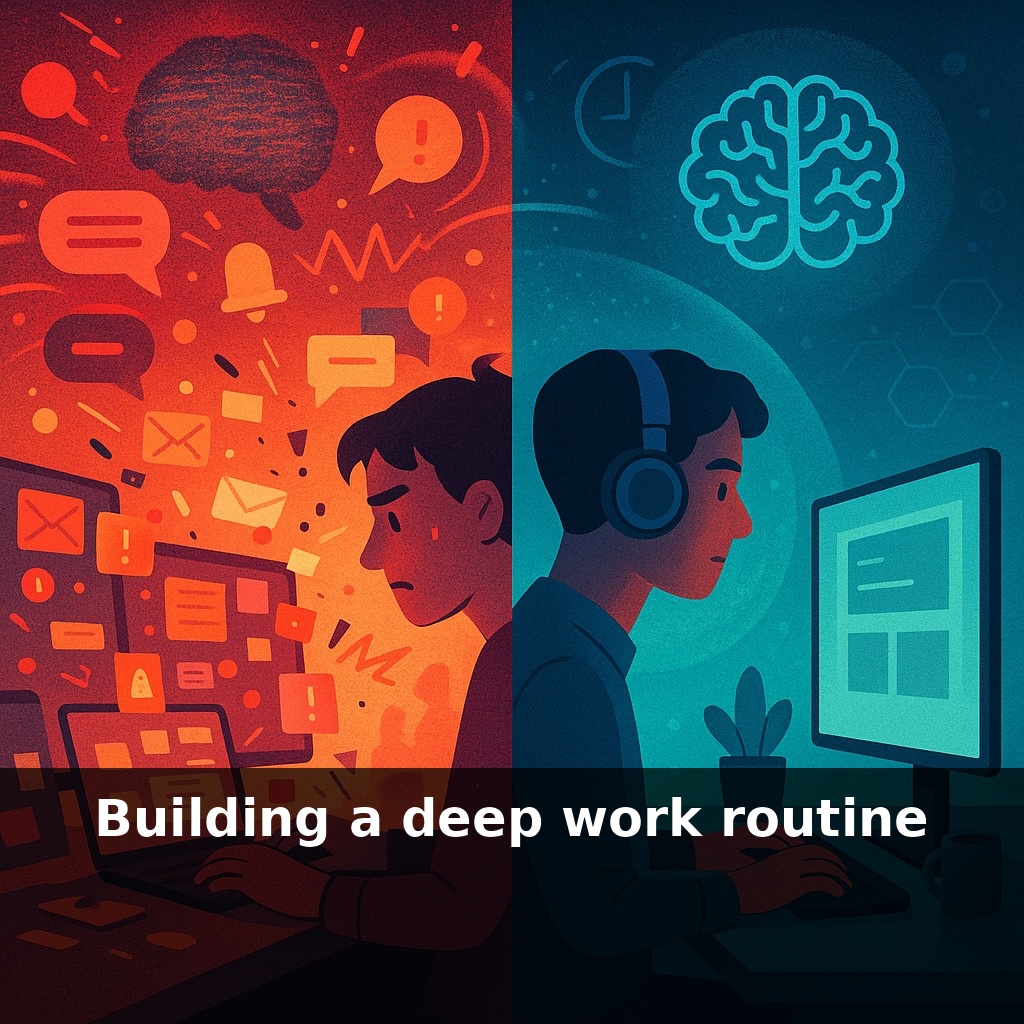
A Stanford study found top programmers get about ten times more done mostly by working in long, quiet stretches. Now, picture two mornings: one spent hopping between pings and tabs… and one spent fully locked onto a single hard problem. Same hours, completely different brain output.
Noise above 85 decibels—the level of a loud cafe—cuts information retention by two thirds. Yet many developers, designers, and founders routinely attempt “focus” work in exactly that environment, then blame themselves for being slow. The bottleneck often isn’t willpower; it’s architecture: when you work, where you work, and what’s allowed to reach your attention.
In this episode, we’ll make deep work less of a vague ideal and more of a repeatable protocol. You’ll map your personal peak-focus window, convert it into 2–4 protected blocks per day, and design simple guardrails: device rules, notification rules, and entry/exit rituals. The target isn’t monk-like isolation; it’s 3–5 hours of high-grade concentration, consistently, inside a normal day with meetings, messages, and life.
Most people never test how far their attention can actually go. They stop at the first hint of boredom or friction, then assume “I’m just not a deep focus person.” Yet researchers tracking high performers across law, chess, and academia keep finding the same pattern: a small number of hours—often 2 to 4—done at full cognitive tilt outperforms 10 to 12 scattered ones. In practical terms, that might mean solving one gnarly architecture problem in a 90-minute sprint, then shipping a clean draft of a 1,200-word spec in the next. The constraint is not talent; it’s learning to deliberately enter, sustain, and exit that deeper mode on a normal workday.
A 2014 study found that task-switching can drop your effective IQ by about 15 points—comparable to pulling an all-nighter. Translate that into your day: if your “deep work” hour contains five Slack checks, three email refreshes, and two quick news glances, you’ve quietly turned it into shallow work, no matter how hard it feels.
Designing a deep work routine starts with two levers you can actually control: *when* the hard thinking happens and *what* is allowed to touch your attention during it.
First, decide your daily *quota*. Most people can sustain about 180–240 minutes of real depth. Turn that into specific blocks: for example, 2 × 90 minutes, or 3 × 60 minutes. Commit on paper: “On weekdays, I do 2 × 90-minute deep sessions.” This is now a hard budget, not a vague hope.
Next, layer in *granularity*. Inside a 90-minute block, pre-define the one outcome that makes it a win. Not “work on backend,” but “implement and test the new auth middleware,” or “draft sections 2–4 of the design doc (~800 words).” You’re aiming for tasks that are (a) mentally heavy and (b) small enough to finish or clearly advance in one sitting.
Now engineer your *entry*. Use the same 3–4 steps before every session so your brain recognizes the mode shift. For instance:
1) Close all applications except editor + docs (takes ~30 seconds) 2) Put phone in another room, face-down (10 seconds) 3) Open today’s deep-work task list and highlight the one target (60 seconds) 4) Start a visible timer for 50 minutes on your screen (5 seconds)
That’s under two minutes, but done consistently, it becomes a cue that narrows your attentional field.
During the block, treat *context switches* as your primary enemy. Each one can cost 5–20 minutes of full-focus ramp-up. A simple rule: any input that isn’t life-or-death waits until the timer ends. If a thought appears—“check the error logs,” “reply to Alex”—capture it in a tiny “later” list, then immediately return to the cursor or code line you were on.
Finally, plan your *exit*. Spend the last 3–5 minutes writing a short status note: what you completed (concrete numbers help: “14 failing tests fixed,” “1,050 words drafted”) and the very next step for tomorrow. This reduces the re-entry cost for your next session and keeps your routine compounding instead of resetting each day.
A senior ML engineer I coached ran an experiment: for 10 workdays, he treated deep work like a non‑negotiable meeting. He blocked 09:00–10:30 and 14:00–15:00, used a physical “do not disturb” card on his desk, and pre‑loaded exactly one task per block in his editor before leaving each evening. In 2 weeks, his average “time to first useful commit” on complex tickets dropped from 4.2 hours to 2.7, and he cleared a backlog of 7 aging issues without working a single late night.
You can do something similar with writing or product work. For instance, reserve 08:30–09:45 for new feature specs and 15:30–16:15 for architecture thinking. Quantify output: number of words, number of design decisions, number of failing tests removed. If you usually ship 1 substantial spec per week, aim for 2 by clustering the hard thinking into 3 × 60‑minute blocks and tracking progress daily.
One useful check: if you can’t describe what “done” looks like for the next 60 minutes in a single sentence, the task is probably too vague for a deep block.
Teams that normalize deep work can redesign process, not just calendars. For example, a squad of 6 engineers might agree on 10:00–12:00 as a shared deep block, then move stand‑up to 9:40 and batch status questions into a single 15‑minute slot at 12:05. Over a quarter, that’s roughly 100+ hours of reclaimed focus per person. Extend the same logic to product reviews or incident postmortems and you get fewer meetings, clearer specs, and faster, more confident technical decisions.
Deep work routines only stick when they’re measured. Over the next 14 days, log start/end times, interruptions, and a 1–10 depth score for each block. After 20–28 sessions, compare: which hour gave you 30–50% more progress? Which environment cut interruptions below 2 per block? Keep the top 3 patterns, discard the rest, and your routine will evolve instead of decay.
Here’s your challenge this week: For the next five workdays, block a single 90-minute Deep Work session on your calendar at the same time each day, with your phone in another room and all browser tabs closed except what’s needed for one clearly defined task. Before each session, choose one “high‑leverage” project (not email, not Slack) and write the exact outcome for that block in a single sentence at the top of a blank page or document. Start each session with a 2‑minute transition routine (stand up, stretch, one deep breath, then sit and hit “start” on a visible timer) and do not switch tasks until the timer ends. At the end of the week, count how many of the five deep work sessions you completed as planned and whether you hit the outcome you wrote for each one.