Right now, most knowledge workers check email or chat about every 6 minutes—yet end many days unsure what they actually accomplished. In this episode, we’ll explore why the easiest, most “productive-looking” work might be quietly stealing your best thinking.
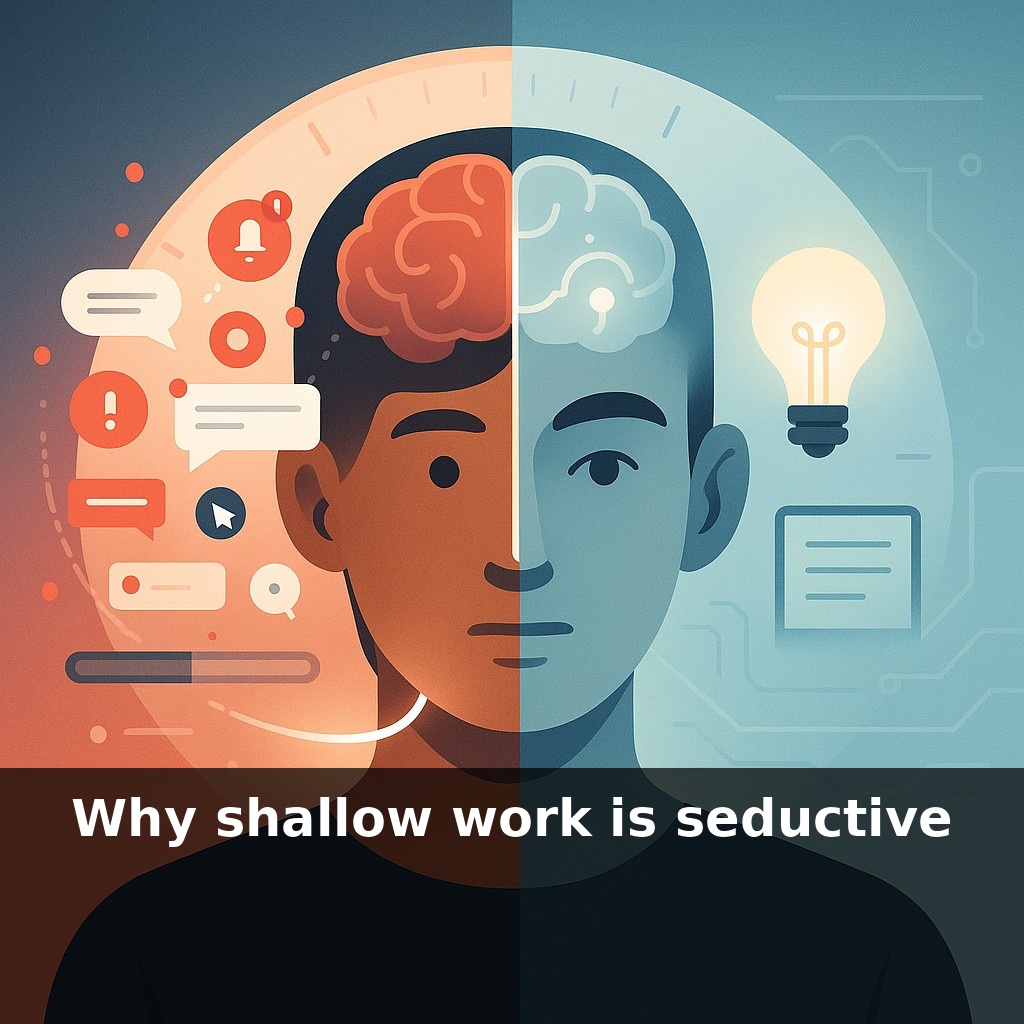
If shallow work leaves us strangely unsatisfied, why do we keep drifting back to it? Part of the answer is that modern tools are engineered to reward exactly the behaviors that undermine serious progress. Each small action—replying to a message, dropping into a quick call, updating a ticket—comes packaged with instant feedback: a ping, a “thanks,” a green checkmark. These signals are tiny, but they stack up fast, giving your brain a steady stream of proof that you’re “doing well,” even when nothing important has actually moved.
Meanwhile, deep efforts often look unproductive from the outside. An hour of wrestling with a hard concept can produce nothing more visible than a few messy notes. In cultures that celebrate responsiveness and visible busyness, the low-friction path wins: it feels safer to stay where success is obvious, countable, and constantly refreshed.
The trap gets tighter when you add uncertainty. Hard, strategic work rarely comes with a clear scoreboard. You might spend a week exploring a new architecture, debugging a subtle performance issue, or drafting a vision doc with no guarantee it’ll “work.” In that ambiguity, shallow tasks offer a comforting sense of closure: tickets closed, messages answered, meetings attended. It’s the difference between noodling on a new melody with no deadline and practicing scales where progress is obvious. Under pressure, most teams default to scales—because they’re easy to measure and hard to question.
Here’s the quieter truth underneath all this: your brain is not optimized for meaningful work; it’s optimized for staying comfortable and conserving energy. Shallow tasks win not because they’re important, but because they’re neurologically cheap.
Every time you knock out a quick response or clear a small notification, your brain registers a completed loop. That completion triggers a tiny reward signal, and over time your nervous system learns a simple rule: “These small loops feel good. Do more of this.” The cost—in fragmented attention and stalled initiatives—accrues slowly and invisibly, so the tradeoff feels rational in the moment.
The environment amplifies this bias. Most digital tools are designed around visibility: green dots, unread badges, activity feeds, presence indicators. Each of these is a proxy scoreboard that’s easy to optimize for. If your manager, your peers, and your tools are all reflecting back “active, available, responsive,” it takes deliberate effort to prioritize work whose payoffs are delayed, subtle, or hard to measure.
There’s also a social gravity at play. When a team or organization equates responsiveness with reliability, shallow work becomes a form of reputational insurance. Being “always on” signals that you care, that you’re a team player, that you’re not the bottleneck. Declining a recurring meeting or going heads-down for three hours can feel like a social risk, even when it’s the only way to make progress on what actually matters.
Over time, that risk aversion reshapes your habits. You begin structuring your day around avoiding discomfort: no awkward delays, no unanswered messages, no blank page staring back. The calendar fills with low-stakes commitments. Status updates crowd out problem-solving. You end most days pleasantly exhausted—but oddly interchangeable, because none of the work required your unique judgment.
The seduction of shallow work, then, is less about laziness and more about misaligned incentives. Your biology, your tools, and your culture are all pushing you toward what is immediately legible, safe, and rewarded. Unless you design explicit counterforces, the path of least resistance will quietly become the path of least impact.
A useful way to see this is in the rhythms of a real workday. A senior engineer sits down to refactor a brittle subsystem. Ten minutes in, a ping: “Quick question?” She answers. Another: “Got a sec to review this PR?” She hops over. By noon she’s touched ten threads, joined two ad‑hoc calls, and feels pleasantly “caught up”—yet the subsystem is untouched. No single choice was irrational; together, they formed a current that quietly pulled her away from anything that required sustained tension.
You can also watch this play out in team rituals. A product group at a mid‑size SaaS company once had 18 recurring meetings a week “to stay aligned.” Attendance became the main visible contribution. People prepared slides, status bullets, polished talking points. When leadership finally cancelled half those meetings for a month, something odd happened: output rose, but so did anxiety. Without the constant public stage, some felt invisible, even if they were finally shipping work that actually moved metrics.
As AI quietly takes over more routine updates, the “noise floor” at work could actually rise. You might send fewer messages, yet swim in more threads generated on your behalf. Attention, not time, becomes the scarcest resource. Teams that treat focus like a budget—protecting it with async norms, quiet hours, and clear ownership—will ship bolder work. Schools and companies may start training “attention fitness,” much like physical conditioning, making sustained focus a differentiator rather than a default.
Treat your attention like limited studio time: reserve sessions for pieces that actually deserve a full recording, not just warm‑ups. The more you notice which tasks leave a trace a month later, the easier it becomes to decline the rest. Over time, this isn’t about working harder, but training your environment to surface work only you can uniquely do.
Before next week, ask yourself: “Looking at yesterday’s calendar and inbox, what percentage of my time actually required deep focus, and where did I ‘hide’ in easy tasks like checking email, Slack, or dashboards?” Then ask: “If I protected just one 60–90 minute block tomorrow for real deep work on my most important project, what shallow commitments (status updates, quick replies, low‑stakes meetings) would I be willing to postpone or let go of?” Finally: “When I feel the itch to ‘just check’ something, what exactly am I trying to avoid—boredom, uncertainty, fear of not doing it perfectly—and how could I stay with that feeling for five minutes instead of escaping into busywork?”