Every few minutes at work, something tugs your attention away—yet most people still believe they’re “multitasking.” Here’s the twist: even brief pings can drain your brain’s fuel and leave you more tired, with less to show for it. So why does distraction feel productive in the moment?
Every interruption doesn’t just steal time; it changes *how* your brain works for the next chunk of the day. In knowledge work, that’s devastating. UC Irvine’s field data shows people are knocked off course roughly every 3 minutes, and it can take over 23 minutes to return to real depth. Do the math across a day and you realize many people rarely experience an uninterrupted half hour.
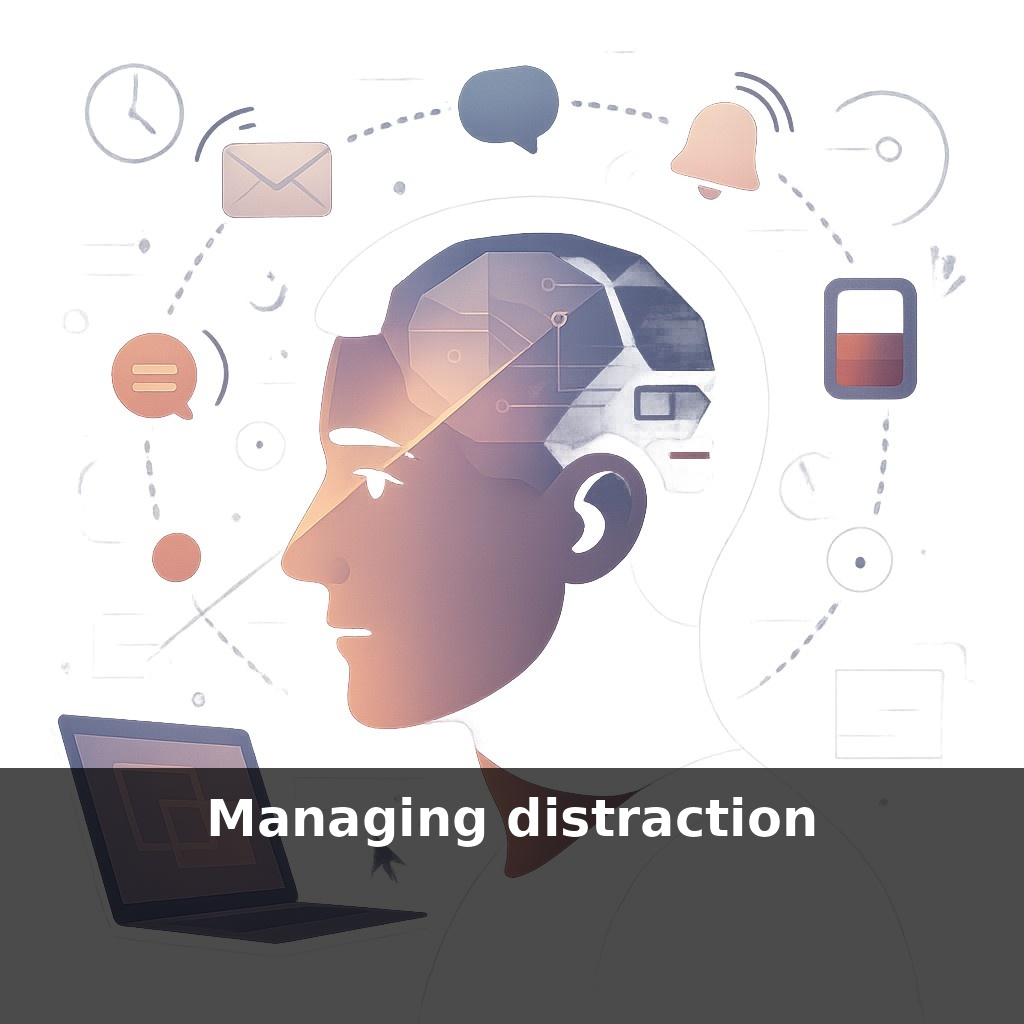
The real trap is that much of this isn’t dramatic—no fire alarms, just quiet nudges: a Slack ping, a colleague’s “quick question,” a mental itch to check one more tab. Each tiny switch draws on working memory and glucose, like a musician forced to swap instruments mid-song, over and over.
In this episode, we’ll zoom in on those micro-disruptions and treat focus as a system you can engineer: your environment, your brain, and your team norms—each tuned to protect depth.
Most people respond to this by adding more willpower—apps, timers, promises—but treat everything else as fixed. That’s like a musician trying to play a subtle solo while a rehearsal for a rock concert is happening on the same stage. The science points elsewhere: your brain’s control circuits fatigue faster when they’re constantly vetoing tempting inputs. That means the goal isn’t heroic self-control; it’s reducing how often you *need* self-control. In practice, that comes from three levers you can actually design: your physical environment, your mental habits, and the agreements you have with the people around you.
Most of what wrecks your focus day-to-day isn’t dramatic; it’s structural. To change it, think in terms of “default settings” you can reprogram, rather than moments you have to heroically manage.
Start with external triggers. Your devices and tools are currently optimized for *responsiveness*, not *depth*. Notifications arrive in real time because that serves the sender or the platform, not your thinking. A practical rule from attention research is: make interruptions **batch by default, real-time by exception**. That means:
- Turn off all non-essential real-time alerts (especially on desktop). - Create one or two deliberate “inbox windows” for communication. - Use status indicators (calendar blocks, Slack/Teams status, door signs) to make deep-work time visible and socially legitimate.
At the organizational level, teams that protect focus don’t rely on individual hacks; they change the **coordination protocol**. Meeting-free mornings, “maker days,” or explicit “no Slack for 2 hours unless production is down” policies convert personal preference into shared norm. This matters because social expectations are one of the strongest drivers of whether people actually defend their attention or feel guilty doing it.
Internal drift is trickier, because there’s no obvious ping to blame. Here, cognitive training is less about grand meditation retreats and more about building “micro-reps” of coming back. Techniques like:
- A 10-second pre-commitment before a session: write the *single* outcome you want by the end. - Brief, timed sprints (15–25 minutes) where your only job is to *notice* when you stray and gently return. - Simple body-based anchors (feeling your feet on the floor, one deeper breath) when you catch yourself tab-switching.
Over time, these reps strengthen top-down regulation in much the same way consistent rehearsal tightens a musician’s timing: not by force, but by making the desired pattern the path of least resistance.
Crucially, all three layers—tools, team norms, and training—interact. If your environment screams “always on,” no amount of meditation will keep you from checking messages. If your mind is exhausted, even a quiet office becomes a minefield of self-created distraction. The leverage comes from modest, well-chosen shifts in each layer that reduce how often you’re forced to switch in the first place.
At a fast-growing fintech, senior engineers noticed pull requests sitting idle for days while their calendars were packed with “quick syncs.” Rather than pushing people to “try harder to concentrate,” they reworked the workflow: code review slots twice a day, auto-assignment of reviewers, and a shared rule that deep-work blocks outranked non-urgent meetings. Within a quarter, review times dropped and bug counts fell, but—more importantly—people reported ending the day with energy left.
On the individual level, a machine-learning researcher I worked with treated their day like a music producer arranging a track. High-intensity “studio sessions” for model design came first, buffered by low-stakes “mixing” tasks like cleaning data or organizing notes. Notifications were allowed only in the mixing segments. This wasn’t rigid batching; it was a deliberate rhythm that matched cognitive demands to the time of day and created natural breaks, instead of letting random demands set the tempo.
Soon, attention may be treated less like a personal virtue and more like shared infrastructure. Teams could monitor “cognitive load budgets” the way they track server capacity, throttling non-urgent pings when people are near overload. Personal AI schedulers might learn your mental “chronotype,” clustering heavy thinking into custom focus windows. As this matures, job offers may advertise not just salary, but guaranteed protected hours—like quiet carriages on a train.
Treat this less like fixing a flaw and more like tuning an instrument. You’re learning which tempos, surroundings, and social rules let you play at your best. Your challenge this week: run one small “focus experiment” a day—change *one* variable (location, timing, tool setting, boundary) and notice which combinations quietly unlock longer, more satisfying stretches of depth.