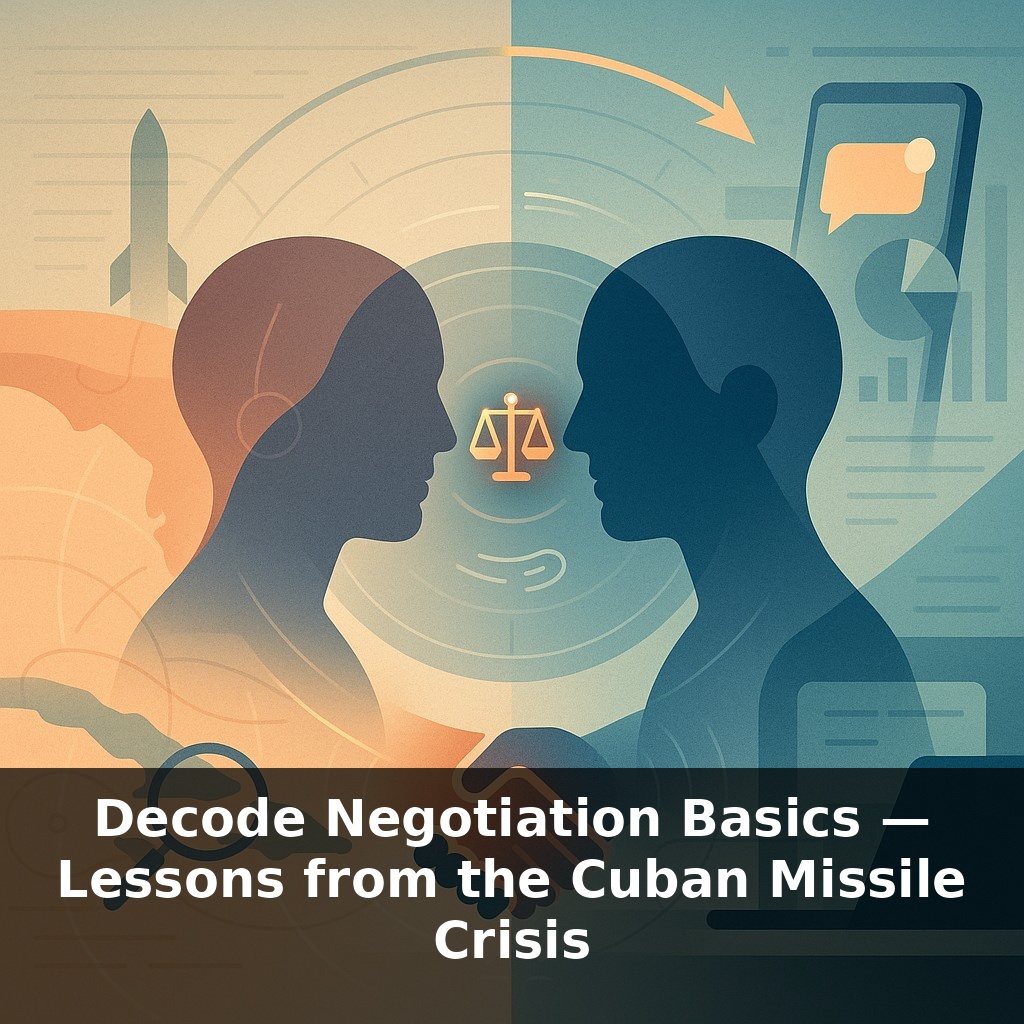
Decode Negotiation Basics — Lessons from the Cuban Missile Crisis
📝 Transcript
Missiles sat in Cuba, pointed at U.S. cities—yet the real battle wasn’t about rockets. It was about words, timing, and what each side refused to say out loud. Now jump to a job offer on your phone. Same question: what you ask next could quietly raise—or cap—your entire career.
The twist is that neither side in that crisis actually got what they *said* they wanted. Publicly, Washington demanded missile removal; Moscow demanded a U.S. pledge not to invade Cuba. But behind the scenes, both were obsessed with something more basic: survival, reputation, and avoiding a war no one could “win.” The public statements were just the storefront; the real deal-making happened in the back room.
Most career negotiations go wrong for the same reason: we argue over the storefront—salary, title, start date—while ignoring the real drivers—growth, stability, autonomy, respect. When you only argue over the visible label on the jar, you miss the chance to redesign what’s inside. In this episode, we’ll decode how to separate what you’re *asking* for from what you truly *need*, and how that shift quietly transforms your leverage in any conversation.
Kennedy’s team eventually mapped out not just what each side was saying, but the deeper needs those demands were protecting. Survival, yes—but also voters at home, allies watching abroad, military credibility, and personal legacies. Like a budget, every move had to “pay” multiple bills at once.
Your career talks are similar. “Higher salary” might really be covering student loans, childcare, or a planned pivot later. When you surface those hidden layers, you stop haggling in one dimension. Instead, you can trade across time, risk, recognition, and learning—often unlocking options you didn’t realize were negotiable.
Call that earlier “storefront” your headline. Useful, but headlines are cheap; the real decisions are made in the margins and footnotes. During those 13 days, both governments quietly expanded the page. They didn’t just ask, “Missiles in or out?” but, “Along which *dimensions* can we move?” Public security guarantees, private missile trades, inspection mechanics, timing of announcements—each was a different dial they could turn without shattering core interests.
That’s the shift most professionals never make. We say, “I want $X” and stop there, as if the only dial on the table is cash. Notice how rarely people add: pace of promotion, scope of role, support, visibility, or flexibility. The result is a yes/no box, when you could be drawing a whole matrix. Research backs this up: when negotiators treat BATNA as more than “walk away money” and actually name concrete alternatives—another offer, staying put, freelancing, relocating later—agreement rates jump and outcomes improve for both sides.
To do this, you need two parallel maps. First, your *issue map*: all the variables that matter enough to trade on—comp, title, location, remote days, budget, team size, learning budget, equity, bonus structure, review cadence, severance, even project mix. Second, your *interest map*: what each variable is secretly funding—debt payoff, family time, immigration stability, industry access, burnout recovery, or a future switch to leadership.
Now connect the maps. If your interest is faster growth, maybe you can be more flexible on base salary in exchange for a shorter review cycle, a formal sponsor, and written promotion criteria. If your interest is downside protection, you might anchor firmly on severance, layoff protections, or a guaranteed minimum bonus instead of chasing the last dollar of base pay.
Here’s where anticipation matters. Like a good investor rebalancing a portfolio, you’re not obsessing over one stock’s price. You’re shaping risk and return across the entire set of terms—preparing for gains, cushioning against shocks, and ensuring no single clause can sink you.
Instead of staring at one number in an offer, treat the whole thing like a box of puzzle pieces. Each piece looks small on its own—sign‑on bonus, relocation help, conference budget, mentoring, a carve‑out day for deep work—but together they can form very different pictures of your next year. Two offers with the same salary can feel nothing alike once you assemble the pieces into a week of your actual life.
Concrete example: You’re choosing between a startup and a big company. At the startup, you might ask for broader scope, a written learning budget, and clarity on what a “win” in six months looks like. At the big company, you might push for a team change, protected focus time, and early access to leadership programs. Same “position” on paper—you’re taking a job—but radically different interest maps.
This is where most people leave value on the table: they don’t bother to dump all the pieces out, so they never discover the picture they *could* have built.
Sixty years from now, your “offer moment” may be scored in real time—market data, performance signals, even AI‑predicted burnout risk feeding into a live dashboard. Instead of haggling over a single number, you’ll steer a portfolio of terms that updates like a stock ticker. The risk: letting algorithms script your choices. The upside: sharper BATNAs and faster, calmer decisions—*if* you keep humans setting the rules, and tech just sharpening the pencil.
Treat each future negotiation less like a one‑off haggling match and more like drafting the next chapter of your career. Small clauses today can echo like compound interest—shaping who you meet, what you learn, and how safely you can take risks later. The basics from 1962 still apply, but the story you write with them is entirely your own.
Here’s your challenge this week: Pick one upcoming real negotiation (salary talk, contract, or even a tricky family decision) and, before you speak to the other side, write a one-page “ExComm brief” like Kennedy’s team: your objective, your red lines, 3 acceptable outcomes, and at least 2 concessions you’re willing to trade. In that same brief, list the other side’s likely pressures and interests (their “Khrushchev memo”) and one face-saving option you could offer them, even if you never mention it directly. Then run the actual conversation with a hard rule borrowed from the crisis: don’t respond to any provocative email/text/call for at least 30 minutes—use that pause to reread your brief and adjust your offer, not your emotions.
From this course

The Art of the Deal: Unpacking Iconic Negotiations
5 episodesUnlock all episodes
Full access to 5 episodes and everything on OwlUp.
Subscribe — $1.99/monthLess than a coffee ☕ · Cancel anytime