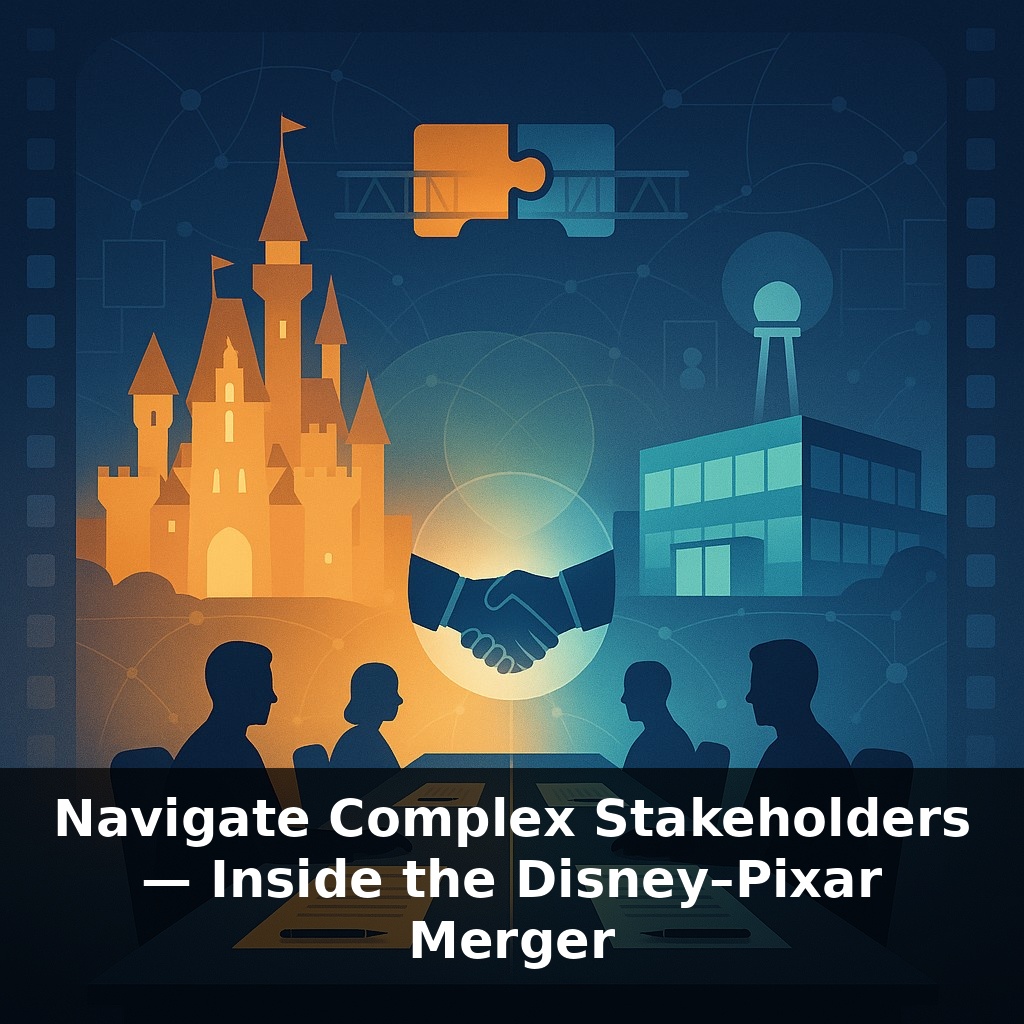
“Disney paid about seven billion dollars for a studio with barely a dozen films.” On paper, that sounds reckless. In practice, it rewired Hollywood. How did two rival animation houses turn a fragile peace deal into the engine of modern Disney? Let's step inside that negotiation.
For most people, “merger” sounds like a clean spreadsheet move: two logos become one, synergies get announced, and everyone pretends culture will somehow sort itself out. The Disney–Pixar deal was the opposite. Underneath that $7.4 billion headline sat a messy web of people whose interests didn’t naturally align: Pixar artists terrified of being swallowed, Disney animators fearing replacement, investors demanding discipline, and powerful directors guarding their creative turf.
Rather than bulldoze through those tensions, Bob Iger and Steve Jobs treated them like a map. Each stakeholder group had a different “red line,” but also a different prize they secretly wanted. By surfacing those—and trading across them—they turned potential sabotage into support. That’s the move we’ll unpack: how to navigate complex stakeholders so a high‑stakes agreement doesn’t just close, it actually works.
In this deal, the “map” got even more intricate because Iger and Jobs weren’t just balancing today’s voices; they were betting on tomorrow’s hits. Pixar’s track record—$3.2 billion in box office on sub‑$1 billion in budgets—proved its magic, but that magic depended on people who could walk out the door. So they baked in cultural preservation clauses and creative control for Ed Catmull and John Lasseter, like pre‑agreed guardrails. At the same time, they had to reassure Wall Street that this wasn’t a vanity play by tying upside to shared success, not just a splashy price tag.
Start with how Iger and Jobs handled Pixar’s own leaders. They didn’t just promise respect; they rewired the org chart. Ed Catmull and John Lasseter weren’t tucked into a subsidiary—they were put in charge of all feature animation. That flipped the usual script: instead of the buyer absorbing the seller, the buyer effectively handed the steering wheel to the smaller, more successful shop. It sent a loud signal to Pixar staff that the deal wasn’t a soft landing before decline; it was a promotion of their way of working.
Next, they tackled Disney’s existing animators, the group most likely to feel replaced. Rather than hiding the shift, Iger surfaced the hard truth: Disney’s animation track record had slipped. But he paired that with a path forward—access to Pixar’s processes, leaders, and technology without forced relocation. Jobs and Catmull stressed continuity on the other side: Pixar would stay in Emeryville, keeping its workflows intact. That dual narrative—“we’ll learn from them” and “we’ll keep being us”—reduced the instinct to resist.
Boards and shareholders had a different concern: Was this discipline or nostalgia? The answer showed up in structure. All‑stock consideration limited cash risk and aligned both sides to Disney’s future value. Jobs took shares, not a cash exit, telegraphing that he believed the combined company would be worth more than either alone. Governance concessions, like Jobs joining the Disney board, weren’t vanity; they reassured investors that Pixar’s interests would be heard at the top table.
On the market-facing side, distribution partners and analysts needed clarity on how movies would flow. The message: Pixar’s pipeline would stay methodical, quality‑first, while Disney’s broader machine—theme parks, consumer products, TV—could amplify each release. Think of it like carefully adding a new asset class to a portfolio: you don’t just chase returns; you want returns that move differently from what you already hold, so the overall mix gets stronger under stress.
Maybe the subtlest move was courting auteur directors. Catmull and Lasseter’s authority let them credibly promise that directors would still get room to experiment within a giant corporation. That helped keep top‑tier creators engaged, which, in turn, protected the very future hits the whole deal depended on.
Think about how this approach would look in your own career. Suppose you’re leading a product launch and marketing wants a splashy campaign, engineering wants stability, finance wants predictable costs, and legal wants low risk. Instead of forcing everyone into one generic plan, you map what each group truly values. Maybe marketing cares more about timing than format, engineering about limiting last‑minute changes, finance about capping downside, and legal about clear review gates. Once you see that, you can stagger feature releases, lock spec‑freeze dates, give finance tiered spend tied to milestones, and build legal checkpoints into the timeline. One carefully designed roadmap, but with visible “wins” placed where each group looks first.
Your challenge this week: pick one cross‑functional project you’re part of and privately list four different blocs with power to stall it. For each, write down one fear and one prize. Then tweak one concrete element—timeline, ownership, or upside—for each bloc so they’d see more to gain than to fight.
Future deals will likely treat creative pockets like rare ecosystems: disturb them too much and the whole environment weakens. As streaming, gaming, and AI-generated content collide, leaders who can map not just “who reports to whom” but “who protects which creative habitat” will spot smarter deal terms. Think option pools for experimental teams, carve‑outs for experimental IP, or rotating “creative senate” seats that give makers recurring influence instead of one‑time veto power.
Real influence in complex deals rarely comes from a louder voice; it comes from seeing the whole chessboard. As you practice mapping interests, you’ll spot non‑obvious trades—like swapping a small title for a big say, or short‑term restraint for long‑term upside. Keep testing where tiny structural tweaks—who decides, when, and with what data—quiet hidden vetoes before they surface.
Start with this tiny habit: When you open your calendar each morning, whisper to yourself, “Who’s my Steve Jobs and who’s my John Lasseter on this project?” and type the two names next to your top priority meeting. Then, before that meeting starts, spend 30 seconds asking, “What does my ‘Steve’ secretly fear losing here, and what creative ‘Lasseter’ outcome would make them excited?” Finally, add one sentence to your agenda that speaks to each side—one about risk/control, one about creative upside—so you’re practicing balancing power and creativity the way Disney and Pixar eventually did.