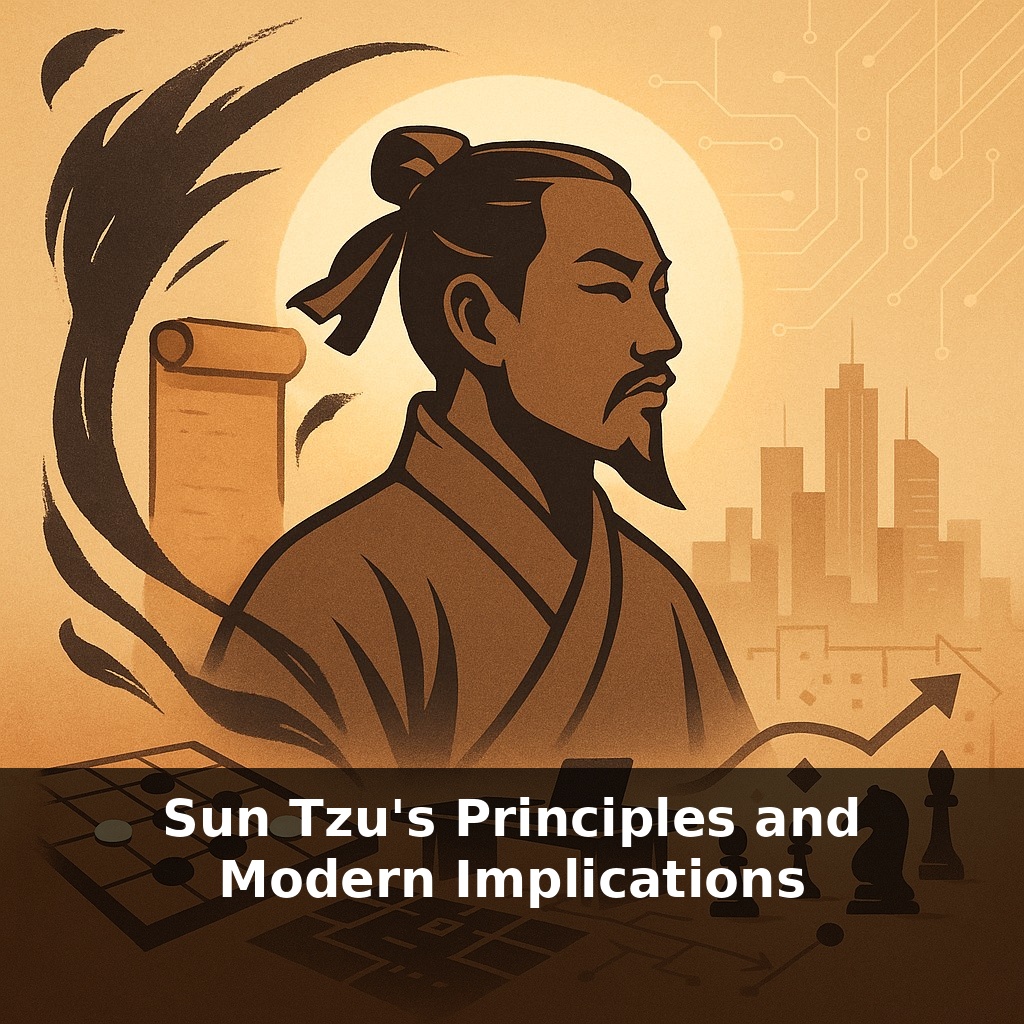
Sun Tzu's Principles and Modern Implications
📝 Transcript
A two-thousand-year-old war manual is quoted in modern boardrooms and military classrooms more than many recent bestsellers. A general from ancient China is quietly shaping how tech CEOs launch products and how officers plan missions—often without people realizing it.
Sun Tzu’s ideas survived for a reason: they describe patterns that keep repeating, whether the “battlefield” is a startup, a negotiation, or an information war online. Today, power often belongs less to those with the biggest budget and more to those who learn fastest, hide their intentions longest, and conserve energy while others burn out. When a small company undercuts a giant by focusing on one overlooked feature, or when a political campaign quietly tests messages before its opponent even notices the race has shifted, you’re seeing his playbook in motion. His focus on intelligence, speed, and morale speaks directly to an age of data leaks, social media storms, and supply chain shocks. This series will trace how those ancient principles travel from bamboo strips to board reports and briefings—and how to recognize them shaping choices around you.
Today, strategy often lives in spreadsheets and code, but the questions Sun Tzu posed still cut through: Who really holds the initiative? Where is the hidden weakness? How do you make opponents exhaust themselves while you stay fresh? Modern commanders talk about “decision cycles” and businesses obsess over “pivoting,” yet both are wrestling with the same challenge—shaping events instead of merely reacting. Think of a storm front quietly forming far offshore; those who read the pressure changes early can redirect the ship while others still see calm water.
Start with what Sun Tzu actually cared about. Before talking tactics, he lists five forces that decide outcomes: moral purpose, environment, rules and structure, leadership, and method. Notice what comes first. He isn’t romanticizing clever tricks; he’s asking, “Why are you fighting at all, and will people still stand with you when it gets hard?” In a world of cyber tools and financial firepower, that question is now a competitive filter: users, voters, and employees can walk away faster than ever.
From there, he moves to knowledge. He draws a sharp line between guessing and knowing—between acting on rumor and acting on verified insight. That maps neatly onto modern “intelligence, surveillance, and reconnaissance” or market analytics, but with a twist: he insists that good information is useless if you can’t turn it into faster, clearer decisions than your rival. Being flooded with dashboards isn’t the same as understanding the situation.
Another pillar is economy of effort. Sun Tzu constantly warns against long, draining campaigns: even if you win, you may collapse afterward. In modern terms, burning through capital, attention, or public trust to “dominate” a quarter or a news cycle can leave you weaker for the real contests ahead. The winning side is often the one that preserves optionality—keeping resources and reputation flexible enough to exploit sudden openings.
Then comes deception—not as a license to lie about everything, but as a way to shape what others focus on. Signal strength here matters more than firepower: false targets, quiet build-ups, and feints that pull competitors in the wrong direction. U.S. Marine Corps doctrine on maneuver warfare borrows this logic: strike where the enemy is disoriented, not where they are most prepared.
Modern organizations echo this across disciplines. Red-teaming in cybersecurity, A/B testing in product strategy, and “information operations” in defense all reflect Sun Tzu’s bias for learning cheaply before committing hard. It’s no accident Harvard Business Review keeps returning to him: he offers a coherent answer to a modern paradox—how to compete intensely without becoming addicted to confrontation itself.
Your challenge this week: identify one ongoing “campaign” in your life—a work project, negotiation, or long-term goal. For seven days, do three things Sun Tzu would recognize. First, clarify the moral purpose: write a one-sentence answer to why this effort deserves your energy and who benefits if you succeed. Second, map the terrain: note one external condition each day that helps or hinders you—rules, timing, constraints, or advantages you’ve been treating as background. Third, practice economy of effort: each day, deliberately choose one action you will not take because it burns time or goodwill without clearly moving you toward that purpose.
At the end of the week, look back and ask: where did clearer purpose change your decisions? What “terrain features” turned out to matter more than you thought? And which things you chose not to do left you unexpectedly stronger or more flexible? Those answers will give you a first, concrete feel for how Sun Tzu’s framework operates off the battlefield—and how much quiet leverage there is in simply refusing to fight the wrong battles.
A CEO quietly studying a rival’s hiring patterns, patents, and support forums is doing a modern form of reconnaissance, trying to see the “shape” of the other side without firing a shot. When Netflix shifted from mailing DVDs to streaming, it wasn’t brute force; it was reading where attention and bandwidth were flowing and moving first. A small cybersecurity firm that watches how attackers probe clients’ systems can redirect defenses to the true weak point rather than hardening everything. In politics, a campaign that releases a minor policy proposal to draw criticism might be using that reaction to map the opposition’s talking points before revealing its main plan. In personal terms, choosing which arguments not to enter at work—because they drain credibility for no real gain—is a Sun Tzu-style choice. Following his logic is like composing music around silence as much as notes: restraint and timing define the impact, not just how loudly you play.
In the next decade, Sun Tzu’s ideas may shift from strategy handbooks into system design. Leaders won’t just read him; they’ll encode his logic into algorithms that decide pricing, targeting, even crisis responses. That raises a deeper question: who sets the boundaries for digital “generals” that never tire, never panic, and can escalate faster than humans can react? Like a river redirected by invisible dams, whole markets and movements could be steered without people realizing who’s guiding the current.
Sun Tzu’s real legacy may be less about conflict and more about discernment: knowing when to press, when to pause, and when to vanish from the field altogether. As digital systems start “thinking” for us, that judgment becomes a daily practice. Like tending a small garden beside a freeway, your advantage is choosing what to cultivate—quietly, consistently—while the noise roars past.
To go deeper, here are 3 next steps:
1) Pull up a free PDF of *The Art of War* (public domain) and read just Chapters 1 and 3 with a highlighter, then map each key idea (like “know the enemy and know yourself” or “all warfare is based on deception”) to one real situation in your work or business this week. 2) Open a Miro or FigJam board and model your “terrain” the way Sun Tzu would: list your 3 biggest competitors, your own strengths/weaknesses, and where “high ground” exists in your market (e.g., a niche, channel, or capability where you can clearly dominate), using different colors for each. 3) Watch a strategy breakdown video that explicitly applies Sun Tzu to modern business—such as “Sun Tzu’s Art of War for Business” on YouTube—then pick one tactic (e.g., concentrating forces, feints, or alliances) and implement it in a current project by adjusting your team’s priorities or resource allocation before the end of the day.
From this course
The Art of War: Timeless Strategies Through History
4 episodesUnlock all episodes
Full access to 4 episodes and everything on OwlUp.
Subscribe — $1.99/monthLess than a coffee ☕ · Cancel anytime