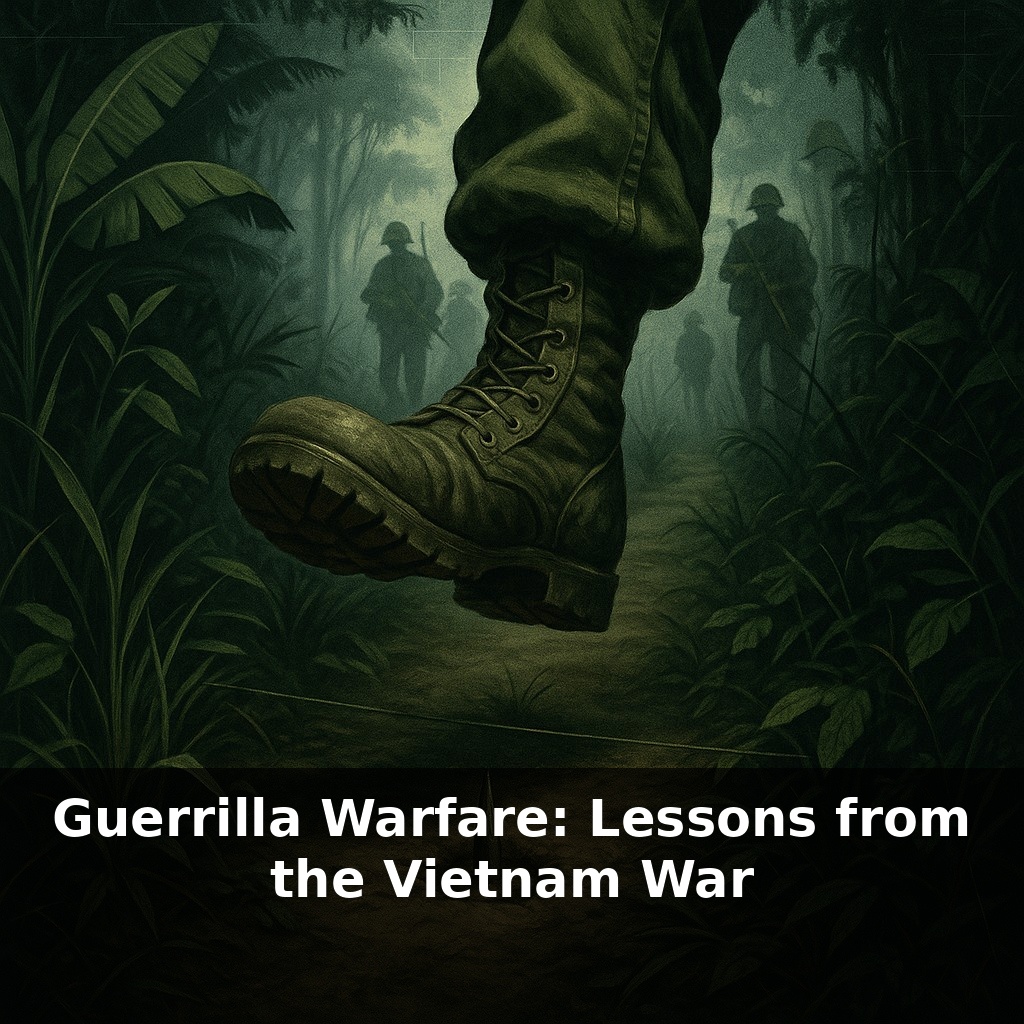
Gunfire echoes through a jungle where no enemy can be seen. A patrol moves carefully, but the deadliest threat isn’t ahead of them—it’s already buried under their feet. One step triggers it. In that instant, the world’s most powerful military learns it doesn’t control this battlefield.
In Vietnam, danger often waited in the quiet moments—on a narrow trail, at the edge of a rice paddy, beside what looked like an ordinary dirt berm. U.S. units could sweep an area in the morning, declare it “secure,” and by evening it had silently turned hostile again. The Viet Cong and North Vietnamese didn’t try to match U.S. firepower head‑on; they reshaped how and where contact happened.
Think of it like a song where the most important part isn’t the notes, but the pauses in between. The VC and NVA used those “pauses”: the nights, the lulls, the stretches of jungle no one watched closely. Tunnels, hidden supply routes, and local networks let them appear briefly, strike, then vanish. This style of war didn’t just target soldiers in the field—it chipped away at confidence, routine, and any sense that progress was permanent.
U.S. commanders kept asking, “Where is the front line?” In Vietnam, that question had no stable answer. Villages by day could serve as staging points by night. A farmer seen tending fields might, hours later, guide a unit through back paths the maps didn’t show. The key resource wasn’t just weapons, but time: stretching the conflict year after year until distant politicians felt as exhausted as the soldiers on patrol. Set-piece battles still happened, but they were only one layer of a campaign aimed at making certainty itself feel impossible.
U.S. patrols learned to fear the ground itself for a reason: booby traps and mines accounted for roughly 10–15% of American combat deaths. A single discarded ration can, a patch of disturbed soil, or a bamboo thicket might conceal a device that cost only a few dollars to build but could remove a soldier from the fight permanently. These weren’t random hazards; they were placed along predictable habits—favorite trails, vehicle routes, landing zones—turning routine into liability.
Beneath some of those same trails lay an entirely different war. The Cu Chi tunnel complex ran for about 120 miles, with chambers stacked as deep as three stories underground. Down there, units could rest, plan, stockpile explosives, then surface through hidden entrances just long enough to act. U.S. forces could “clear” a hamlet and move on, while a parallel network below remained largely intact, ready to reanimate resistance as soon as patrols pulled back.
Further out, the conflict’s circulatory system pulsed along the Ho Chi Minh Trail. By 1967, despite constant bombing, an estimated 60–80 tons of supplies moved south each day. Trucks might drive only at night, bicycles pushed by hand carried ammunition, and porters spaced loads so that destroying one segment never stopped the flow. The aim wasn’t to flood the South with abundance; it was to ensure enough weapons, rice, and replacement fighters always trickled in to keep pressure unbroken.
All of this infrastructure supported operations that, on paper, could look like failures. During the Tet Offensive, roughly 80,000 VC and NVA struck over 100 targets in cities and towns. Militarily, they lost around 50,000 fighters. Politically, they shattered the image that the war was nearly won. In three months, U.S. public approval for continuing the fight plunged from 63% to 39%. Hanoi’s planners weren’t measuring success by territory held or enemy units destroyed, but by shifts in willpower in Washington and Saigon.
This is the discipline behind guerrilla warfare: accepting disproportionate losses in bodies while seeking disproportionate gains in belief—who still believes victory is possible, and at what cost.
A useful way to see this is to shift scale. Zoom in: a small VC unit plants a mine on a road. They’re not trying to stop all traffic; they’re trying to force every convoy to slow down, add escorts, call ahead, clear routes. One cheap device multiplies into extra fuel burned, extra helicopters on standby, extra paperwork—costs that accumulate far beyond the blast itself.
Zoom out: planners in Hanoi think less about one ambush and more about rhythm. Hit a provincial capital, then a remote outpost, then a supply depot. Never in the same pattern, never on a schedule the other side can comfortably predict. Over months, commanders start treating every “quiet” sector as temporarily quiet, which means spreading forces thinner, rotating units faster, and keeping reserves in motion.
Modern movements borrow this logic. Cyber activists, for example, may not crash an entire state’s infrastructure, but selective leaks or brief disruptions can push governments into constant defensive posture, diverting attention and resources from their preferred agenda.
Future conflicts will likely stretch this logic into cities and cyberspace. Expect loosely linked cells using drones, code, and cheap sensors the way past fighters used shovels and wire—probing, harassing, forcing larger forces to stay tense. Your challenge this week: map one modern movement that blends online agitation with real‑world disruption. Note how it shapes media, law, and daily routines more than territory.
In the end, Vietnam’s guerrillas treated power like water around rock—flowing where it was weakest, seeping into hairline cracks of politics and perception. Today, small actors still test for those cracks: in media storms, drone swarms, or viral leaks. The lesson isn’t just who shoots better, but who reads the landscape of fear, attention, and belief more precisely.
Try this experiment: For the next 7 days, pick one “asymmetric advantage” you actually have (like local knowledge of your neighborhood, a niche skill at work, or a tight-knit online community) and deliberately use it the way the Viet Cong used terrain and tunnels—operate only where your edge is strongest. Each day, choose one task or challenge and ask, “If I were fighting guerrilla-style, how would I avoid the ‘open battlefield’ here?” (e.g., skip the big public debate at work and instead have 3 focused one-on-one conversations to shift opinion). Track which “guerrilla” moves (small, surprising, low-cost actions) create outsized impact, and which “conventional battles” you avoided that would’ve drained you. After a week, review what worked and decide one permanent “guerrilla tactic” you’ll keep using in your daily life.