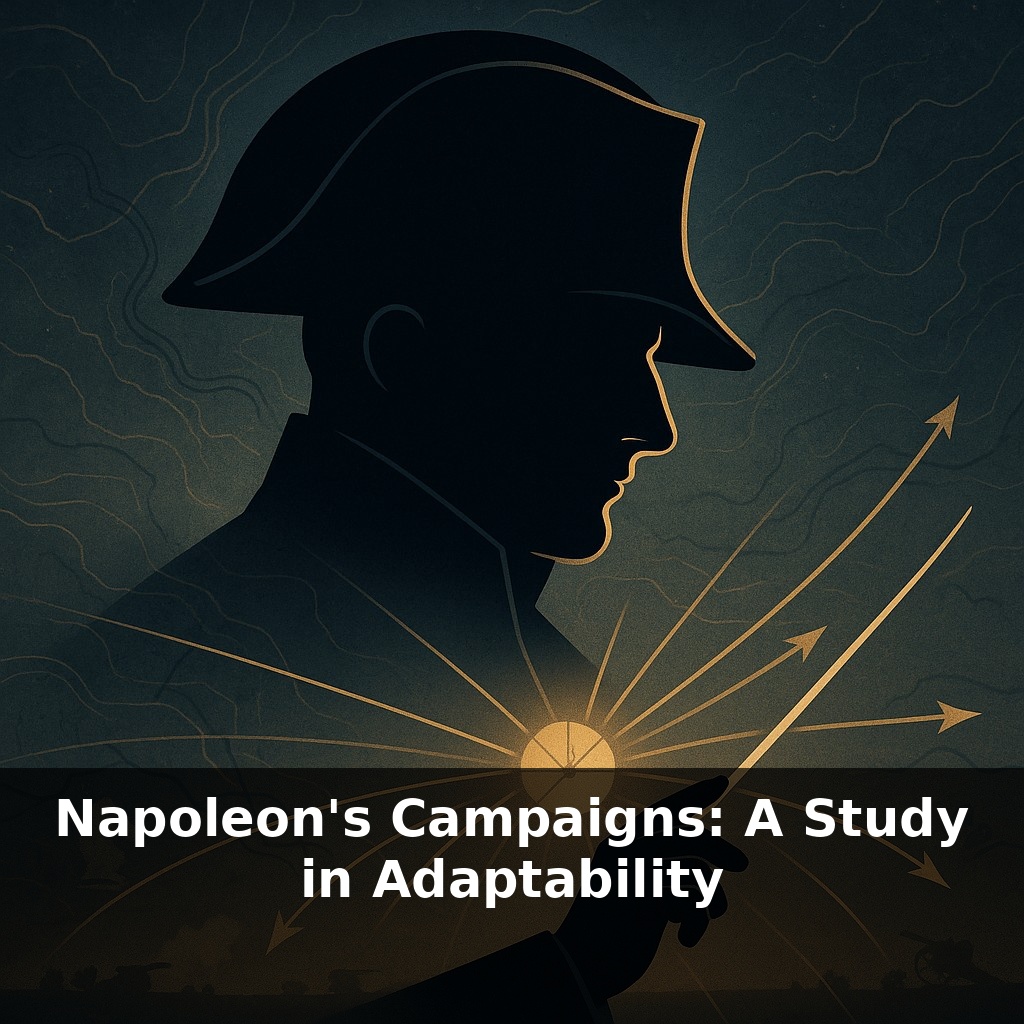
Cannons rumble in the distance, but Napoleon isn’t charging forward—he’s waiting. His army is scattered over miles of countryside, yet by tomorrow morning he’ll snap them together at one spot, like a closing trap. How does a leader control chaos that he’s designed on purpose?
Napoleon’s real genius wasn’t just boldness—it was how fast he could **change his mind without losing control of the army**. Orders went out, yes, but they were more like a flexible score for a symphony than a rigid script. Each corps commander had room to improvise as news came in: a delayed enemy column, a discovered bridge, a village full of supplies. Instead of dragging the whole army into one slow march, Napoleon let units move like a school of fish—separate, responsive, but still turning in the same direction. This demanded two things modern leaders still struggle with: **trust** and **timing**. Trust that subordinates wouldn’t freeze when plans broke, and timing in deciding *when* to tighten control and *when* to loosen it. The risk was obvious: misread the moment, and your “flexibility” becomes a gap your enemy can drive a wedge into.
On campaign, this meant Napoleon rarely moved his army as one giant column. He broke it into self-sufficient corps—each with infantry, cavalry, artillery, and just enough supplies to operate alone for days. It’s closer to a cluster of small, fast-moving storms than a single slow front: each one dangerous on its own, devastating when they collide. Crucially, he placed these corps so they could support each other within a day’s march, but not so close that they drained the same roads and villages. That spacing let him threaten multiple options at once while hiding his real objective.
Napoleon’s adaptability showed up in the **boring details**: routes, calendars, and wagons. On paper, his army looked dispersed. In practice, he was constantly calculating: *if* the Austrians accelerate here, *then* my left corps pivots; *if* they hesitate, my right pushes hard. At Ulm in 1805, this paid off spectacularly. While the Austrian general Mack waited for a decisive battle, Napoleon quietly folded his corps around Ulm like closing doors. By the time Mack realized what was happening, tens of thousands of Austrians were cut off and forced to surrender—before a classic “main battle” ever occurred.
Two enablers made this kind of maneuver possible: **pace** and **information**. A French corps could cover 15–20 miles a day on different roads, then concentrate almost overnight. That meant an enemy who thought he faced 30,000 men in the morning could suddenly be staring at 150,000 by the next day. But marching fast without firing effectively would have been pointless. Napoleon’s artillery—about a fifth of his total firepower—was standardized around systems like the 12‑pounder Gribeauval guns. Because the guns, carriages, and ammunition were uniform, he could shift batteries quickly to where a breakthrough seemed likely, instead of being trapped by fragile, one‑off equipment.
This combination of speed and standardized tools let him **change the main effort mid‑campaign**. If a flank attack began to look promising, he didn’t need weeks to rebuild his army’s shape. He just redirected marching columns, slid artillery where it mattered most, and adjusted supply routes to feed the new axis. It’s similar to a conductor subtly changing the tempo in the middle of a performance: the notes are the same, but the effect on the audience—and the opponent—is completely different.
Yet there were boundaries he couldn’t bend. In 1812, chasing a decisive result in Russia, he pushed the same system into a landscape that swallowed roads, forage, and time. Supply lines stretched hundreds of kilometers; food and fodder evaporated. No amount of organizational agility could refill empty wagons or warm frozen soldiers. The very dispersal that once gave him options now magnified losses across a vast, unforgiving space.
Think about how streaming companies launch a new show. The smartest ones don’t dump all their marketing into a single ad campaign and pray. They test trailers on different platforms, watch which audience clusters lean in, then reroute budget, push extra clips, or even shift release timing based on early signals. That’s not random experimentation; it’s structured freedom inside a clear objective: make *this* show a hit, *fast*, before rivals react.
Modern militaries do something similar with modular task forces. A brigade landing in a crisis zone might arrive with standard building blocks—infantry, engineers, drones, medics—but the mix that actually moves forward shifts daily. If a river crossing turns critical, engineers and drones surge; if civilians start fleeing, logistics and medical units suddenly become the “main effort.”
In tech firms, product teams mirror this by keeping codebases standardized and cross‑trained. When a competitor surprises them, they can reshuffle developers overnight toward the feature that now matters most, without rewriting every tool or process from scratch.
Napoleon’s campaigns hint at a future where winning depends less on predicting events and more on **reconfiguring fast when predictions fail**. As sensors, drones, and AI flood commanders with data, the edge will belong to those who can turn that data into **modular responses**—small teams, swarms, or apps that can regroup like birds wheeling in the sky, shifting direction together without waiting for a single shouted order from above.
Napoleon’s real lesson isn’t “move fast” but **design for fast rearrangement**. Today that might mean interchangeable teams, common tools, and clear intent so people can pivot without waiting. Your challenge this week: map one project as if a sudden shock hit tomorrow—who swaps roles, what pauses, what surges—and note every place you’d stall.