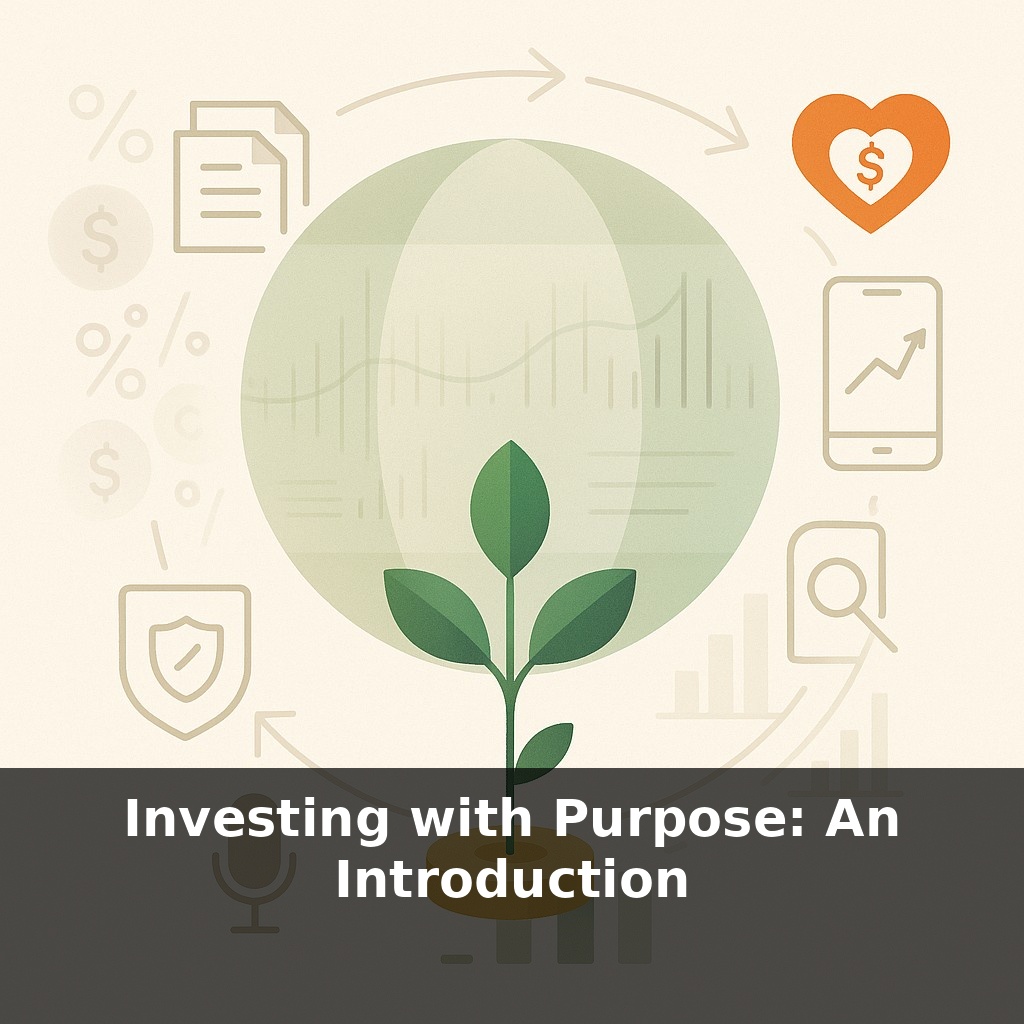
Investing with Purpose: An Introduction
📝 Transcript
Right now, roughly eight in ten everyday investors say they care how their money affects the world—yet most of their dollars still sit in funds they’ve never checked. You’re making an impact already, whether you mean to or not; the only question is whether it matches your values.
In this episode, we’ll zoom out from single “good” or “bad” investments and look at the system your money already lives in. Every mutual fund, retirement account, or trading app is quietly running a set of rules: which industries to include, what risks to tolerate, whose voices to listen to when companies misbehave. Purpose-driven investing is about learning those rules—and then rewriting some of them.
Instead of starting with “Which stock should I buy?” we’ll ask better questions: Who’s setting the agenda inside the companies I own? How are environmental and social risks being priced in—or ignored? When big asset managers push for climate disclosure or board diversity, what does that actually mean for your portfolio?
Think of this as shifting from passenger to co-designer. You’re still using the same markets, but with more intention, clarity, and leverage.
Most investors meet “purpose” for the first time through labels: ESG fund, low‑carbon ETF, faith‑based portfolio. Helpful, but they’re just the surface. Underneath are three powerful levers you can actually pull: what you own (or avoid), how you use your voice as a shareholder, and where new capital gets directed. Each lever mixes money and influence differently. Some aim to reduce harm; others try to push companies to change, or to grow entirely new solutions. As we unpack them, we’ll keep asking: which mix best fits your goals, risk tolerance, and time horizon?
When people talk about “investing with purpose,” they often jump straight to products—“Which ESG fund should I buy?” Instead, zoom in on the three levers you actually control, starting with what you own.
Ownership is more granular than “good companies vs bad companies.” You can tilt away from specific business models (thermal coal, predatory lending), but you can also dial exposure toward firms managing real-world risks better than peers. Think of two utilities: both deliver electricity, but one is locked into aging coal plants while the other is rapidly building renewables and modernizing its grid. Financially, they face different regulatory, legal, and technology risks. A purpose lens doesn’t just ask, “Who’s greener?” It asks, “Who’s prepared for the future my portfolio will have to live in?”
Next comes how you use your voice. Once you own even a single share, you’re part of the extended “cap table” influencing a company’s choices—directly through votes and indirectly through the asset managers who vote for you. When large investors backed Engine No.1’s campaign at ExxonMobil, they weren’t donating money; they were exercising rights that came bundled with their capital. Purpose-driven investors pay attention to that machinery: How are proxies voted? Which issues are escalated? When is divestment a last resort versus an opening bargaining chip?
The third lever—where new capital flows—is about shaping what gets built next. A green bond that funds energy‑efficient housing, a loan to expand rural healthcare, a private fund backing low‑carbon cement: all channel fresh money into specific outcomes while still targeting market‑rate returns. This is different from simply trading shares in the secondary market, where you’re mostly swapping ownership with another investor rather than changing what exists in the real economy.
None of these levers is “pure.” A screened index fund might combine ownership and voice. A climate‑solution private fund blends capital allocation with governance influence. The art is in choosing how much of your portfolio you want in each bucket—and why.
Think of three real‑world dials you can actually turn. First, ownership: an investor might keep a broad index but add a “tilt” toward companies with credible transition plans—say, firms tying executive pay to emissions cuts or worker safety metrics. They’re not chasing perfection; they’re rewarding direction of travel. Second, voice: a pension fund can stay invested in a lagging bank but file or back a resolution demanding clearer financing targets for high‑risk sectors. If enough shareholders back it, management must respond or risk reputational damage. Third, new capital: a city government might issue a social bond to fund affordable housing, and a foundation buys it, prioritizing both yield and local impact. The same foundation could seed a small fund backing minority‑owned businesses, accepting slightly less liquidity in exchange for deeper community outcomes. In practice, most purpose‑driven portfolios mix these dials—fine‑tuning over time as evidence, personal priorities, and life circumstances evolve.
Regulation and technology may soon act like new “gravity” in markets: invisible yet constantly tugging portfolios into closer contact with real‑world outcomes. AI tools could scan thousands of disclosures the way maps apps reroute around traffic, reshaping what “default” portfolios look like. At the same time, political pushback might splinter rules by region, forcing investors to navigate a patchwork. The open question: who will set the next decade’s norms—regulators, asset managers, or end investors?
As this landscape evolves, your role can, too: you might start by testing one fund, then later question how your pension, workplace plan, or robo‑advisor channels your savings. Think of your statements as storyboards for futures being funded. The experiment isn’t to be perfect; it’s to keep asking, “What am I building here—and who else is building it with me?”
Try this experiment: Log into your brokerage account today, pick your single largest holding, and trace it through one ESG or impact-rating site (like MSCI or Sustainalytics) to see how it actually scores on environmental and social impact. Then, choose one alternative investment from a values-aligned area mentioned in the episode (for example, a clean energy ETF or a community development fund) and compare their 10-year performance, fees, and impact side by side in a simple 3-column table. Finally, decide—just for one month—to redirect a fixed amount (say $50 or $100) from the original holding into the values-aligned option, and set a calendar reminder to review both financial performance and how “aligned” you feel with your portfolio after that month.
From this course
The Conscious Investor's Guide to Prosperity
5 episodesUnlock all episodes
Full access to 5 episodes and everything on OwlUp.
Subscribe — $1.99/monthLess than a coffee ☕ · Cancel anytime