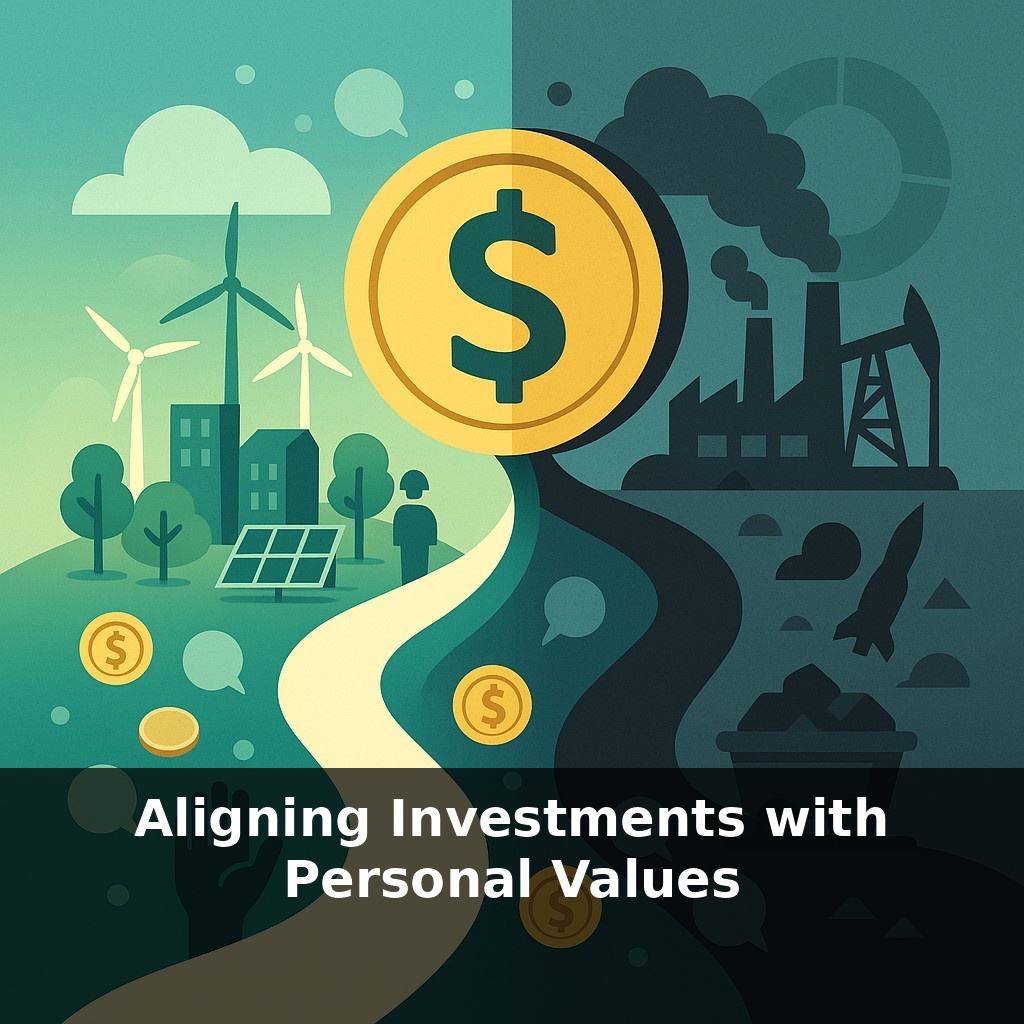
Your retirement account might be funding the very problems you rant about at dinner. One fund backs clean energy; another quietly supports coal and weapons. Same risk level, similar returns—opposite impact. The twist? Most investors have no idea which story their money is telling.
Think of your portfolio as a group chat you never muted: every dollar is a voice, and together they’re voting on what kind of world gets built. Some are cheering for fair labor and low-carbon tech; others are quietly backing pollution, surveillance, or predatory lending. The question isn’t whether your money has a say—it’s whether you know what it’s saying.
Values-driven investing is about moving from accidental influence to intentional influence. That doesn’t mean becoming a full‑time analyst or memorizing ESG jargon. It means recognizing you already express values when you choose a bank, a workplace, or even a coffee brand—and realizing your investments are just a larger, often neglected version of those choices.
In this episode, we’ll map the main ways investors are turning vague concern into concrete portfolio decisions.
Some investors start by avoiding industries they dislike; others go further, seeking out companies tackling climate change, health equity, or data privacy. Between those extremes is a wide middle ground that often gets ignored. That’s where most people can actually make progress.
Modern tools now let you zoom in on specific issues—water usage, board diversity, supply‑chain risks—rather than accepting a single “good” or “bad” label. It’s less like flipping a moral on/off switch and more like adjusting sliders on a soundboard, turning up what matters most to you while turning down what doesn’t.
Think of values-driven investing as a spectrum with four main moves, from light touch to full-on mission focus.
On the simplest end is **exclusionary screening**: you draw some hard lines and say, “Not with my money.” That could mean avoiding tobacco, private prisons, or companies with repeated labor violations. Norway’s sovereign wealth fund does this at huge scale, banning dozens of firms after ethical reviews. At your level, it might just be choosing the version of a broad-market fund that leaves out the categories you can’t stomach.
Next is **ESG integration**. Instead of just asking “Is this profitable?”, managers also ask “How exposed is this to environmental fines, social backlash, or governance scandals?” Here, ESG data is treated as another risk/quality input—less about moral purity, more about durability of the business model. This is where much of that NYU Stern research shows a link between thoughtful ESG and corporate performance.
A step further is **thematic investing**. You pick long-term change you want to back—renewable power, gender equity, cybersecurity, affordable housing—and use funds or ETFs that concentrate there. These aren’t charities; they still chase competitive returns, but with a tighter thesis about how the world is shifting and which solutions will win.
At the far end is **impact investing**, where you demand two receipts: one for financial results and one for measurable outcomes. That might be a bond funding clean water access, or a private fund backing regenerative agriculture with specific soil or emissions metrics. Institutions and wealthy families pioneered this, but platforms are slowly opening it up to smaller investors through community bonds and crowdfunded vehicles.
Across this spectrum, you can also choose **how you use your voice**. Even if you hold a plain index fund, you—or your manager—can vote proxies, support or oppose environmental and social resolutions, and join coalitions pushing companies on issues like pay equity or human rights. The rising approval rates on these resolutions signal that more investors are treating “ownership” as active, not passive.
Your challenge this week: pick one existing investment account—no matter how small—and trace how at least one holding uses ESG, screens, themes, or impact goals. You’re not changing anything yet; you’re just decoding the story your money is already telling.
Think of three friends using the same investing app in totally different ways. One scrolls through fund descriptions and quietly unchecks anything tied to animal testing. Another hunts for a climate-transition ETF that owns both today’s leaders and incumbents rapidly cutting emissions. The third doesn’t change holdings at all, but signs up for a platform that lets them piggyback on large shareholders’ votes for stronger data-privacy safeguards. Same app, same starting menu—very different expressions of values.
Now zoom into the tools behind those choices. One fund leans on third-party ESG ratings; another builds its own scoring model, overweighting supply-chain safety after messy headlines in the sector. A municipal bond in your account might be financing upgraded public transit instead of a generic infrastructure pool. The nuance lives in the details: prospectus language, top 10 holdings, current shareholder campaigns.
Your job isn’t to memorize it all—it’s to notice which levers are actually being pulled on your behalf.
New tools will stretch your options far beyond a basic “green” label. As reporting rules tighten and data streams multiply, your statements could start looking less like bank receipts and more like real-time dashboards: emissions trends, workforce metrics, supply-chain checks. It’s less about picking saints and sinners, more about steering capital like a GPS—setting a destination, then adjusting as traffic, detours, and new roads appear. The experiment shifts from a one-time choice to an ongoing craft.
Over time, this gets less like a one-off spring‑clean and more like tuning a playlist: skip tracks that jar, add artists that match your mood, let the algorithm suggest adjacent sounds you hadn’t considered. As more data appears, you can test, adjust, and even contradict your own rules—treating each trade as a small hypothesis about the future.
Start with this tiny habit: When you open your banking or brokerage app (even just to peek at your balance), tap into ONE holding and ask yourself out loud, “Does this company match my values on [environment / workers / community]?” Then, without changing anything yet, use the app’s search bar to look up just ONE values-aligned alternative mentioned in the episode (like a fossil-free fund, a fair-labor ETF, or a local community investment option) and tap the “save,” “watchlist,” or “favorite” button. That’s it—no selling, no reallocating—just building a habit of pairing every money check-in with a quick values check-in and one concrete option for “better” next time.