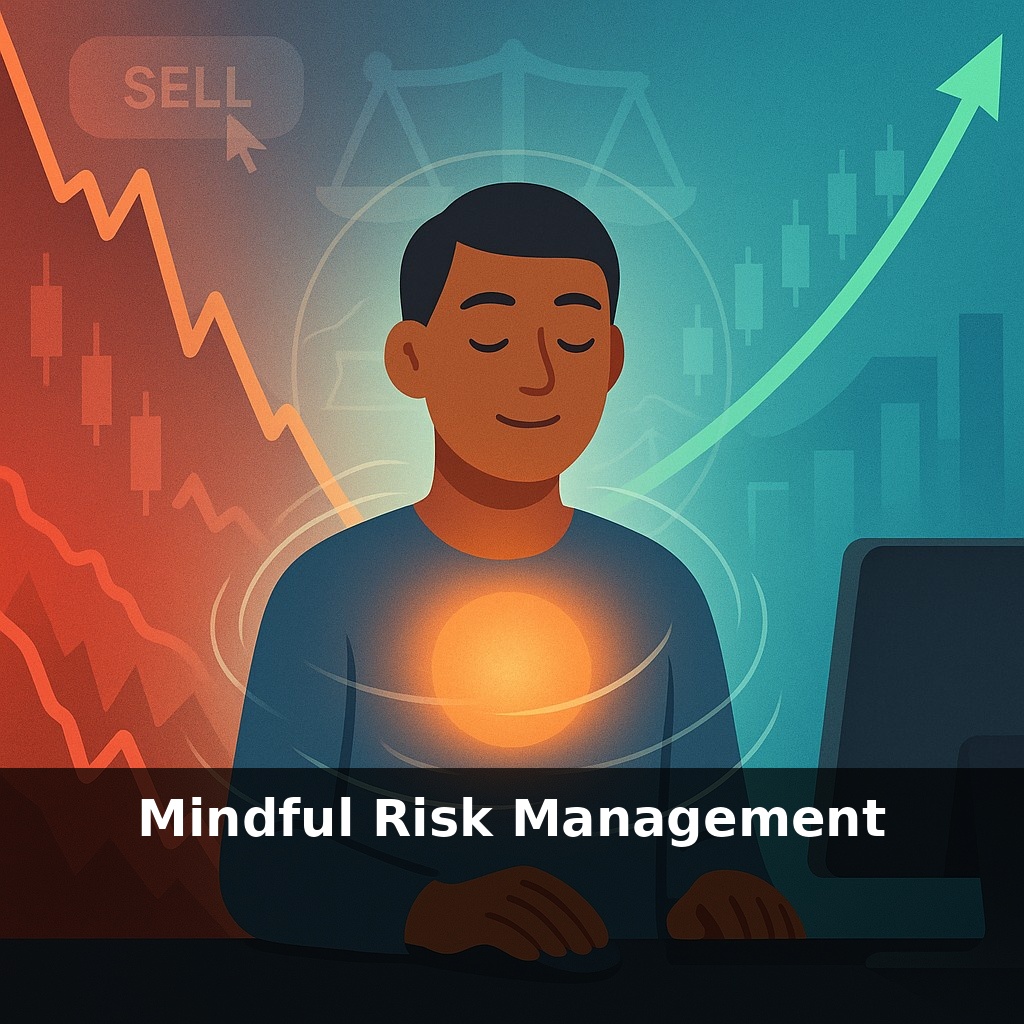
Most investors trail the market for one main reason: they panic at the wrong moment. You’re staring at a sea of red on your screen, heart racing, cursor hovering over “sell.” In that split second, here’s the twist: your breath may matter more than your spreadsheet.
That “sell now” impulse doesn’t just hurt in crashes; it quietly erodes performance year after year. Dalbar’s 2023 QAIB study shows the average equity investor lagged the S&P 500 by 1.7 % annually over 30 years. Over a few months that sounds trivial. Over three decades, that gap can turn a potential $500,000 into closer to $350,000–$380,000, purely from poorly timed decisions. The issue isn’t a lack of data or tools. Many of those same investors already had access to diversification metrics, risk reports, and backtests. What they lacked in the moment was a way to pause long enough to use those tools properly. This is where mindful risk management enters: not as something soft or “spiritual,” but as a performance skill that keeps your prefrontal cortex online exactly when your capital is most exposed.
Here’s the shift: instead of using models to justify what you already feel like doing, you train yourself to consult them before acting. That means turning tools like diversification metrics, Value-at-Risk, and scenario analysis into mandatory checkpoints, not optional decoration. For example, before cutting a position by 50 %, you might require: (1) a current VAR report, (2) a simple stress test—“what if this drop repeats?”—and (3) a portfolio-impact estimate in dollars. If that 50 % cut only reduces total portfolio risk by, say, 0.2 %, your reaction may be more about nerves than numbers.
Start with this principle: numbers set the outer guardrails of risk; mindfulness governs how you move inside them. To make that practical, you need a simple “inner dashboard” you can actually use in live markets.
Think in terms of three layers: body, mind, and model.
**1. Body: catch the risk signal early**
Physiology moves faster than thought. Before you override your plan, scan for three concrete cues:
- Heart rate: is it noticeably higher than during normal screen time? - Breath: are you holding it or breathing in short bursts? - Muscles: are your shoulders, jaw, or hands tight on the mouse?
Treat any “yes” as a red flag. Research on brief breath regulation shows that 60–90 seconds of slower exhale (e.g., 4 seconds in, 6 seconds out, 10–15 breaths) can measurably reduce amygdala reactivity. You are not relaxing for comfort; you are buying back analytical bandwidth.
**2. Mind: separate signal from story**
Once the body is quieter, you examine thoughts like data, not commands. Write a one-line description of what your mind is shouting, with a number attached:
- “If I don’t exit, I could lose another 20 %.” - “If I miss this rally, I’ll fall 5 % behind my target this year.”
Next, ask two questions:
1. “What specific evidence supports this number?” 2. “What evidence contradicts it?”
Force at least one item in each column before you touch the position. This shifts you from narrative (“this always happens to me”) to probability (“this outcome has maybe a 10–15 % chance given past drawdowns”).
**3. Model: convert fear into basis points**
Now you reconnect to the formal tools—not to reassure yourself, but to translate emotion into portfolio impact. Examples:
- If a position drops another 15 %, does total portfolio volatility rise by 0.1 %, 1 %, or more? - If your worst realistic scenario plays out, what’s the dollar drawdown versus your pre-defined risk budget? Is it $2,000 on a $100,000 account (2 %) or $20,000 (20 %)?
Having explicit thresholds (e.g., “I only adjust when projected loss exceeds 5 % of portfolio or moves my yearly risk beyond plan”) keeps you from trading every twinge of discomfort.
Over time, this three-layer check becomes a repeatable sequence you can run in under three minutes. The aim is not to feel Zen—it’s to create just enough psychological distance to let your risk tools, not your fight-or-flight reflex, drive the final decision.
A professional allocator I worked with set two concrete “mindful risk” rules after noticing he cut winners too early. Rule 1: any change over 25 % of a position triggered a mandatory 3-minute protocol—30 slow breaths, then a single-page check of position size, liquidity, and worst-case loss in dollars. Rule 2: no intraday reversals; once he overrode a plan, he logged it and reviewed weekly. Within six months, his annualized turnover fell from 180 % to 110 %, and his 12‑month Sharpe ratio rose from 0.6 to 0.9, mostly from avoiding whipsaw decisions.
A 2016 Cambridge Judge experiment points in the same direction: traders who added just 15 minutes of daily mindfulness for eight weeks improved risk‑adjusted performance by roughly 10 %. That’s the edge: not “being calm,” but acting on your models only after you’ve passed a quick physiological and cognitive checkpoint, so each trade reflects your system, not your latest spike in arousal.
Boards and CIOs can hard‑wire this discipline. For example, require a 90‑second pause protocol before any trade that shifts portfolio risk by more than 0.5 %, and mandate a “mindful review” for the worst 5 % of drawdowns each quarter. As climate and cyber risks expand, integrate a 10‑year risk lens into every capital‑allocation memo, with at least two scenarios beyond base case. Teams that practice this can cut unforced decision errors by double‑digit percentages over time.
Treat this as an edge you can quantify. Decide in advance: “I will not alter positions unless a move changes my 1‑month loss estimate by at least 3 % or my annual plan by 0.5 %.” Then pair it with a 2‑minute breath‑and‑review protocol before any order over 1 % of capital. You’re training a repeatable process, not chasing a perfect state of mind.
Try this experiment: For the next 48 hours, whenever you face a decision that feels even slightly risky (sending a bold email, speaking up in a meeting, pitching an idea, saying no), rate the risk on a 1–10 scale and then ask yourself out loud: “What’s the *real* worst-case outcome here, and how likely is it?” Then, before you act, commit to a tiny “safety net”—for example, who you’ll debrief with if it goes badly, or how you’ll repair any damage. After each risky action, quickly rate how it *actually* turned out versus what you predicted, and notice where your fear was exaggerated. By the end of the 48 hours, look for one pattern in how your brain overestimates risk, and decide one type of risk you’re now willing to take more often.