What is Space-Time?
📝 Transcript
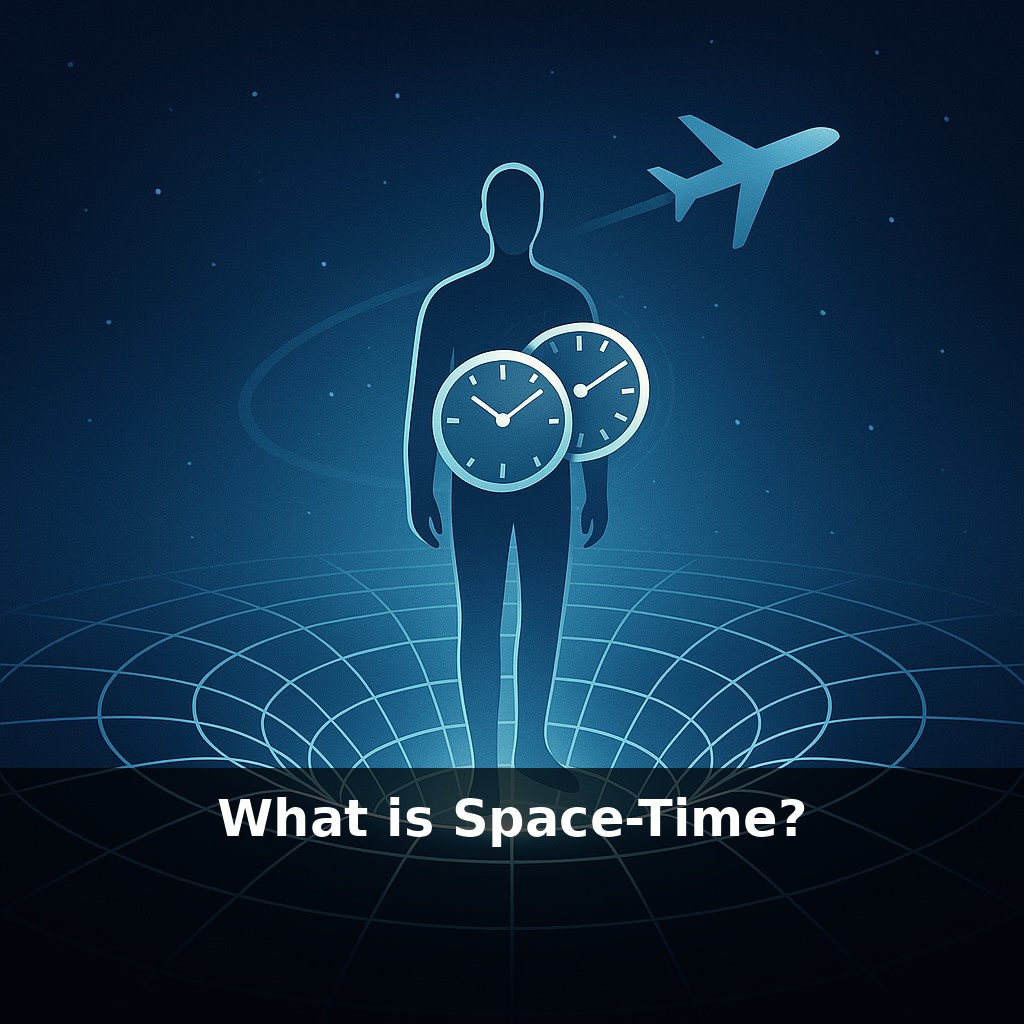
Time runs slower on your head than at your feet. Right now, your body is quietly stretching time by a tiny amount. On a jet, your watch disagrees with the clock at home. In this episode, we’ll follow those tiny disagreements to their strange source: the fabric of reality itself.
Einstein’s radical move was to stop asking, “Where is this event?” and start asking, “When and where is this event, together?” Every firework you see, every text your phone sends, every heartbeat in your chest isn’t just happening “out there in space” or “at some moment in time”—it’s a single point in space-time with four coordinates: three for position, one for time. Change any one of them, and you’re talking about a different event. Physicists track these events the way a delivery app tracks a package: not just which city it’s in, but exactly which step of the route it’s on. Space-time is that universal tracking system for reality. Crucially, its structure isn’t fixed. Mass and energy continuously tweak the “routing rules,” so two observers can disagree about distances, durations, and even the order of events—yet still both be right within space-time’s shared geometry.
To see why this four‑dimensional view matters, leave thought experiments and look at your phone. When GPS tells you where you are, satellites aren’t just pinging distances; they’re relying on relativity‑aware clocks whose readings only make sense inside space‑time’s combined map of “when + where.” Miss that, and your location drifts by kilometers. Physicists push this further with particle colliders: smashing protons together, then reconstructing entire interaction histories from fragments, like crime‑scene analysts working in 4D. In both cases, the calculations only close if space and time are treated as a single, structured stage.
Physicists make this 4D picture concrete with something called a “worldline.” Take a single object—say, you sitting in a chair. In ordinary space, you’re just…there. In space‑time, you trace a continuous line: each point on that line marks where you are at a particular moment. Start walking, and your worldline tilts; board a plane, and it bends in a new direction through space‑time. An entire life becomes a long, squiggly thread.
Now zoom out. The universe is a tangled bundle of such threads: Earth looping around the Sun, photons streaming from screens, satellites arcing overhead. Space‑time isn’t just a blank grid; it’s the pattern formed by all these intertwined worldlines plus the rules that say which shapes are allowed. Some shapes are forbidden because they’d require breaking cosmic speed limits. Nothing with mass gets a worldline that tilts so far it outruns light.
That light‑speed limit does more than cap how fast rockets can go. It builds a causal structure into reality: which events can influence which others. Draw a flash of light as a burst in space‑time, and it spreads out as a cone. Anything inside the cone can be reached by a signal moving at or below light speed; anything outside is forever out of causal reach. Your present moment is surrounded by a vast “can’t get there from here (yet)” region.
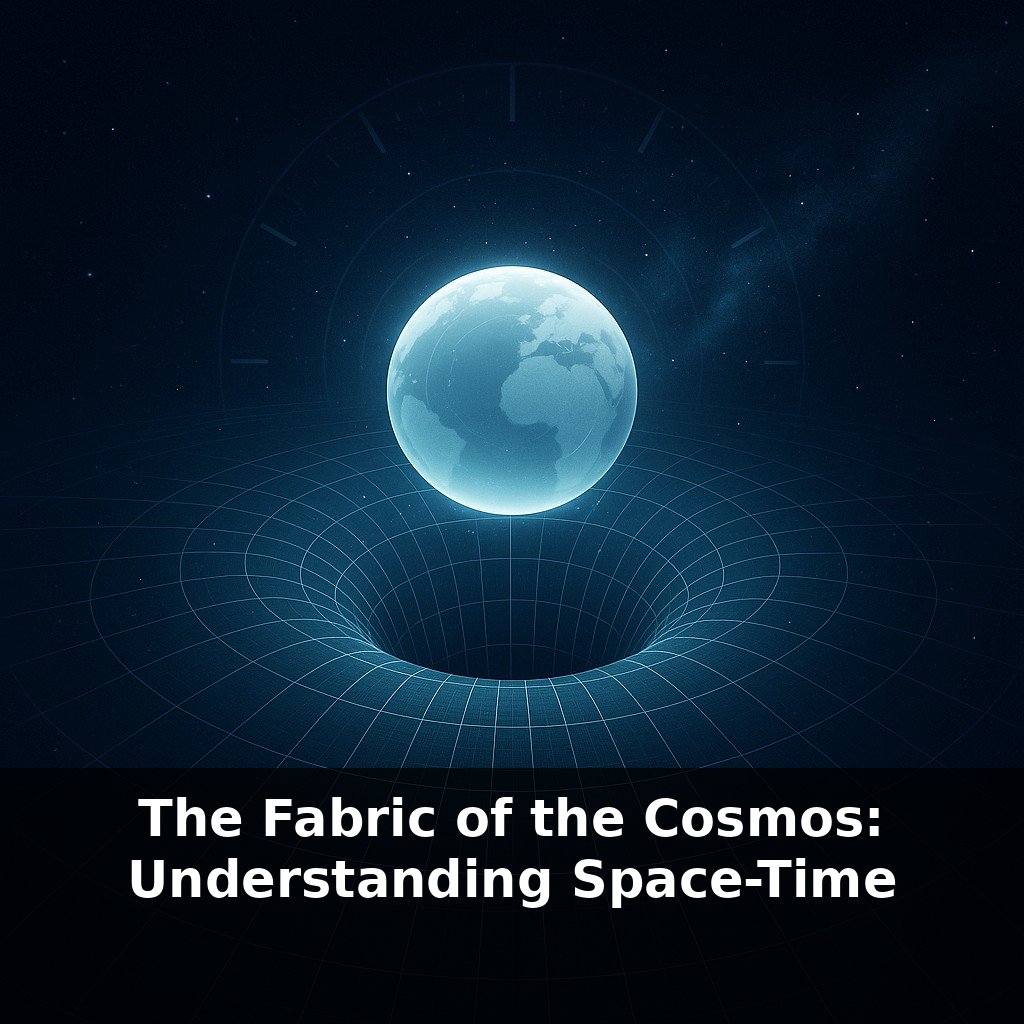
Curvature complicates this picture in a specific way: it changes which straightest‑possible paths (geodesics) worldlines can take. Left unchecked, your natural motion is to follow these geodesics. Stand on Earth and you’re actually being pushed away from your preferred path by the ground. In orbit, a satellite is left to glide along one of these curves, which is why it “falls around” the planet instead of crashing into it.
This same geometry carries ripples. When massive objects like black holes collide, they disturb the surrounding structure, launching waves that stretch and squeeze distances as they pass. Detectors like LIGO don’t watch objects get tugged by a mysterious force; they watch space‑time itself flex, ever so slightly, as a wave sweeps through.
A good way to feel space‑time’s strangeness is to look at systems that only make sense in 4D. Start with your calendar and maps. A concert ticket isn’t just “Row 12, Seat 8”—it’s meaningless without a date and start time. Airlines quietly exploit this: two planes can occupy “the same place” at different times without risk, but scheduling errors that overlap them in time become disasters. Stock markets do something similar. A trade’s value depends on price *and* when it executes; milliseconds matter for high‑frequency algorithms. Rearranging the order of otherwise identical trades can change profits, just as reordering events in space‑time can change who can affect what. In computing, distributed databases must agree not just on data but on a shared notion of order, using protocols like logical clocks to mimic a consistent causal structure. Physicists effectively do this for the universe, reconstructing which collisions could influence which detectors so their models don’t allow “trades” that clear before they’re placed.
Einstein’s equations hint that space-time might be more like software than hardware: update the “code” and planets, light, even clocks behave differently. Future detectors could treat black-hole collisions as system logs, reconstructing how the “program” evolves. Your challenge this week: when you read tech news, mentally tag stories as “better clocks,” “better sensors,” or “better models”—and ask how each might sharpen our ability to debug the universe’s source code.
The deeper we probe, the less space‑time looks like a silent backdrop and more like an active participant in every process—from brain signals to GPS to particle collisions. It may even have a quantum “grain,” like pixels on a screen, that only reveals itself at extreme energies. For now, we’re reverse‑engineering its rules from the rare glitches we can measure.
Before next week, use a time-lapse app to document a simple event—like a sunset or a plant's growth over several days—and create a visual representation of its path through 'space-time'. Discuss with a friend or online community how each element (Earth’s rotation, gravity, etc.) plays a role in shaping this 'path'. Finally, choose a physical experiment such as watching a pendulum to observe how gravity influences time and motion, connecting these observations back to what you've learned about 'space-time'.
From this course
The Fabric of the Cosmos: Understanding Space-Time
5 episodesUnlock all episodes
Full access to 5 episodes and everything on OwlUp.
Subscribe — $1.99/monthLess than a coffee ☕ · Cancel anytime