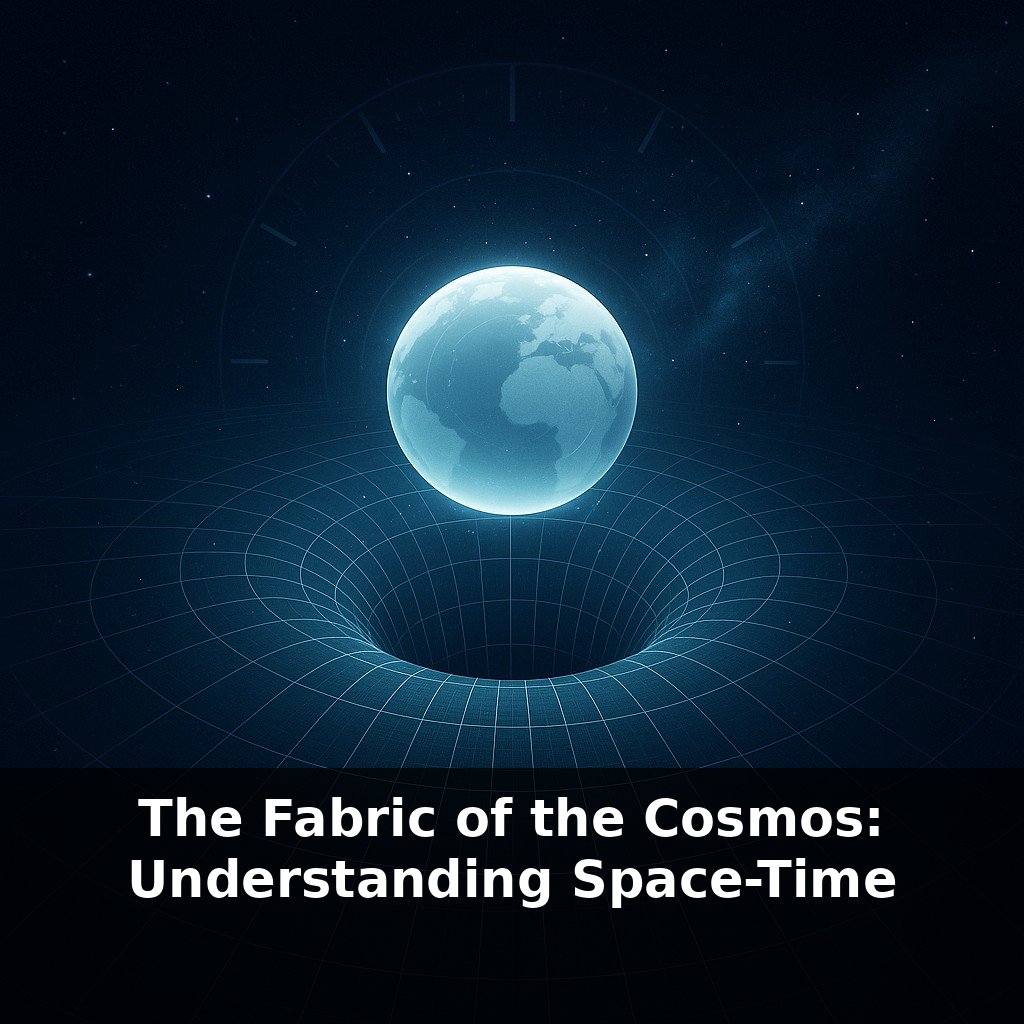
A region smaller than a city can outweigh millions of suns. Somewhere, right now, two of these invisible monsters are colliding, shaking the fabric of space-time—and every detector on Earth twitches. In this episode, we’ll follow those ripples back to their source.
A teaspoon of black‑hole matter would outweigh a mountain range—and yet, as far as we know, it has no surface at all. We talk about “falling in,” but in Einstein’s language what really happens is that space and time themselves get twisted into a shape our everyday intuition is utterly unprepared for.
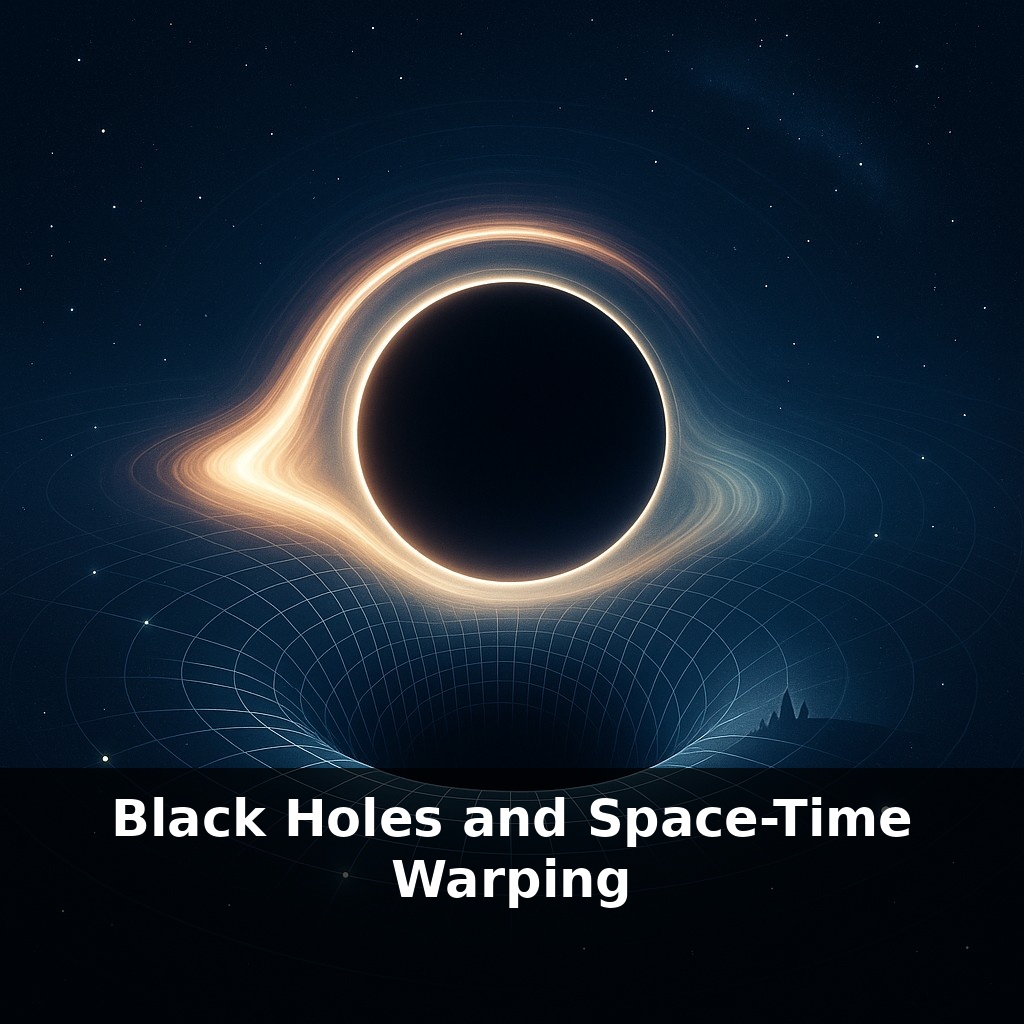
The edge of this extreme region has a precise location: the event horizon. Cross it, and every possible future path you could take ends at the same destination. Stay outside, and you can still orbit, skim, and steal energy from the beast.
This strange border isn’t just theoretical. Astronomers now routinely weigh black holes at the centers of galaxies, map how stars slingshot around them, and watch hot gas glow as it spirals down. Each observation lets us probe how far we can trust our best theory of gravity before something even stranger must take over.
To really grasp what black holes do to space and time, we need to zoom out and see where they live. They’re not isolated oddities; they sit in star clusters, anchor galactic centers, and grow by swallowing gas, stars, and sometimes each other. The mass ranges are staggering: some black holes weigh just a few suns, others billions. That mass doesn’t just disappear—it sculpts the motions of nearby stars like a hidden CEO shaping company policy from behind the scenes, setting orbits, feeding jets, and influencing how galaxies light up and evolve.
Most of the drama around a black hole happens *outside* the horizon, where matter and light are still allowed to argue with gravity. Gas rarely falls straight in; it arrives with angular momentum and spreads into a flattened accretion disk, orbiting at a good fraction of light‑speed. Friction and magnetic turbulence in that disk crank random motions into heat, so the gas flares in X‑rays and gamma rays before losing the last of its orbital energy and plunging away from view.
That region is where we start turning Einstein’s equations into actual measurements. The innermost stable circular orbit—the last place a particle can loop around without spiraling in—depends on both mass and spin. For a non‑spinning hole it sits farther out; for a rapidly spinning one it can nestle much closer. By modeling the flicker of X‑ray light from that inner edge, astronomers infer how fast the hole is rotating, and how far space‑time itself is being dragged around with it.
Spin doesn’t just reshape orbits; it’s a huge energy reservoir. In systems like M87*, magnetic fields thread the rotating region and can act a bit like power transmission lines in a grid, funneling rotational energy into narrow, relativistic jets that lance out for thousands of light‑years. Those jets slam into surrounding gas, compressing, heating, and sometimes quenching star formation on galactic scales. A compact object smaller than our solar system ends up regulating how efficiently an entire galaxy can turn gas into new suns.
Scale matters, too. Stellar‑mass black holes, just a few to a hundred times the Sun’s mass, tend to reveal themselves in binary systems, flashing and flaring over human timescales. Super‑massive ones evolve leisurely, but their mergers send out gravitational waves so intense we can pick them up from billions of light‑years away. Somewhere in between, we’re now uncovering “intermediate‑mass” candidates that may bridge how the smallest seeds grew into the giants we see today.
And on the ultimate timescales—far beyond any galaxy’s normal life—Hawking radiation slowly leaks energy away. For an astrophysical hole it’s utterly negligible now, but in principle even the darkest regions in the universe have an expiration date, written not in millions or billions, but in numbers with sixty‑plus zeros.
Astronomers treat different black holes almost like a portfolio of “gravity assets.” Stellar‑mass ones in X‑ray binaries are the volatile stocks: their brightness can double in minutes, tracing how quickly material can rearrange itself under extreme conditions. Super‑massive ones are the blue‑chip giants, changing slowly but shaping the long‑term “market” of stars and gas in a galaxy.
We also use them as precision tools. When LIGO/Virgo record a merger, the exact chirp pattern lets us test whether space‑time springs back *exactly* as General Relativity predicts, or whether there’s a tiny mismatch hinting at new physics. So far, Einstein’s “balance sheet” closes to remarkable accuracy.
On smaller scales, stars that skim close to a galactic center can be tidally stretched, spraying gas that lights up as it spirals inward. Each such flare is a brief audit of conditions near the hole: density, magnetic fields, even the distribution of dark matter, all leave subtle fingerprints in how that light rises and fades.
Some of the wildest payoffs may come on the smallest scales. If we can read subtle distortions near horizons, they could expose new particles or extra dimensions, much like a chef infers hidden ingredients from the way a sauce thickens. Space‑based detectors will tune in to slower, heavier mergers, while sharper radio “movies” of nearby giants may reveal whether quantum rules ever tweak Einstein’s script in strong‑gravity labs far beyond any accelerator.
In the end, these extreme objects become tools: natural colliders, clocks, and rulers scattered across the universe. Future arrays—linking radio dishes like synchronized smartphones—will zoom closer to horizons, while space‑borne detectors “listen” to slower mergers. As we refine these instruments, we’re not just mapping the cosmos; we’re reverse‑engineering its source code.
To go deeper, here are 3 next steps: (1) Watch the free “Black Holes” lecture in Leonard Susskind’s *The Theoretical Minimum* series on YouTube and pause to sketch the space-time diagrams he draws, paying attention to how light cones bend near the event horizon. (2) Open the free NASA “Black Hole Simulator” (or the open-source tool *Gargantua Black Hole Renderer* on GitHub) and play with parameters like spin and viewing angle to see how gravitational lensing visually warps a background star field. (3) Read the black hole chapters in Kip Thorne’s *Black Holes and Time Warps* and, in parallel, pull up the corresponding entries on the Stanford Encyclopedia of Philosophy (“Spacetime: Holes” and “Black Holes”) to compare the physical description with the deeper space-time structure questions the podcast hinted at.