Half our best physics breaks down at the edge of a black hole, and the other half fails in the first heartbeat after the Big Bang. Tonight, we step into that no‑man’s‑land where time can stretch, particles flicker, and the universe quietly refuses to follow one rulebook.
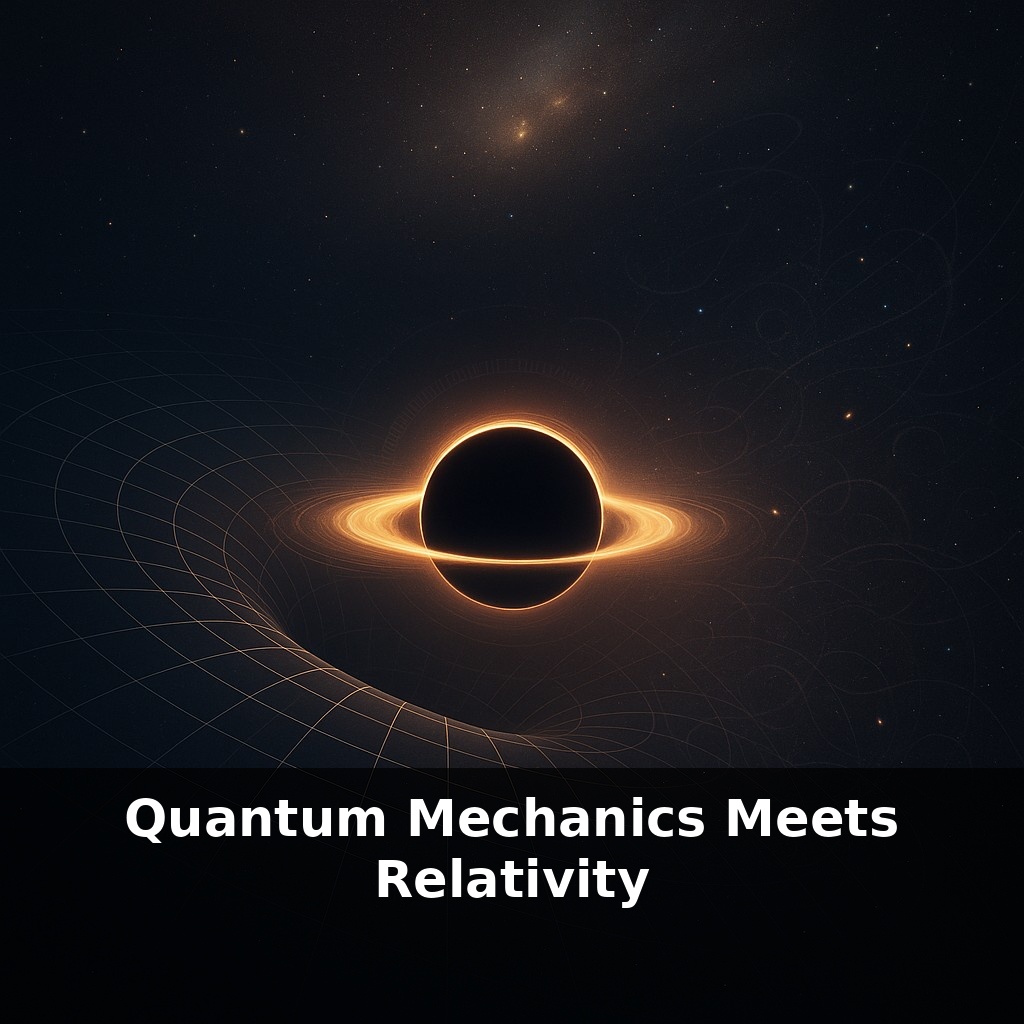
Physicists call that rulebook clash the “quantum gravity problem,” but the name undersells the drama. On one side stands quantum mechanics, fluent in uncertainty, field quanta, and probabilities that only settle down when we measure. On the other stands general relativity, a smooth geometric story where matter tells spacetime how to curve, and curvature tells matter how to move.
The trouble begins when both must speak at once. Near extreme densities, their predictions diverge like two navigation apps giving opposite turn‑by‑turn directions. One suggests spacetime should ripple and stretch; the other demands a seething foam of fluctuations where position and energy refuse to sit still.
To move forward, researchers don’t just juggle equations—they test how far each theory can be pushed before cracks appear, hunting tiny mismatches in cosmic data and ultra‑precise lab experiments.
In practice, this clash shows up whenever we push nature to extremes: crushing matter into neutron stars, slamming particles together at the LHC, or timing pulsars with absurd precision. Each setting is a stress test for our theories, a way to ask, “Whose rules bend first?” At the tiniest scales, near the Planck length, we suspect the familiar smoothness gives way to something more granular, like zooming into a high‑resolution photo until you hit individual pixels. The challenge is that these pixels of geometry hide behind energies and distances far beyond everyday reach.
When physicists talk about “reconciling” quantum rules with gravity, they’re not just trying to tidy up theory space. They’re betting that at ultra‑short distances there’s a deeper description hiding underneath both current formalisms. That’s where ideas like the Planck length come in—not as a hard-edged wall, but as a scale where today’s equations start lying to us in predictable ways.
Below that distance, the very notion of a smooth backdrop for events becomes suspect. Loop quantum gravity, for example, doesn’t treat space as continuous at all; it assigns discrete spectra to geometric quantities like area and volume. In that picture, you can’t shave a surface down indefinitely—its “size” jumps between allowed values, the way an atom’s energy levels do. String theory takes a different route: instead of pointlike entities, it uses tiny extended ones, whose vibrations give rise to what we perceive as different particles, including a built‑in candidate for the graviton. Both approaches agree on one thing: the classical continuum is an approximation.
Curiously, some proposals go further and demote gravity from fundamental status. In emergent‑gravity schemes, gravity is more like interest rates in an economy: a large‑scale, statistical outcome of countless microscopic degrees of freedom we don’t yet see directly. Causal set theory, by contrast, strips the story to bare bones: the world is a growing network of elementary “events” ordered by cause and effect, with spacetime geometry reconstructed from the pattern.
These aren’t just mathematical games. LIGO’s use of quantum‑squeezed light to sharpen gravitational‑wave measurements shows that quantum tricks can upgrade our probes of strong‑gravity environments. Future detectors, ultra‑stable atomic clocks, and precision satellite timing might all become sensitive enough that tiny quantum‑gravity corrections stop being negligible. And on the theoretical side, puzzles like the apparent loss of information in evaporating black holes are forcing every contender to explain how quantum rules survive in regimes where classical intuition fails most dramatically.
Think of it like debugging two enormous software systems that were never meant to talk to each other. One team stress‑tests high‑energy collisions at CERN, searching for tiny deviations in how rare events unfold. Another compares ultra‑precise clock readings on satellites and mountain‑top labs, hunting for anomalies in how frequencies shift with altitude. A third sifts through gravitational‑wave catalogs, checking whether waveforms from colliding objects show subtle distortions not accounted for in current models.
Concrete proposals turn these into “if‑then” checks. If spacetime has a smallest unit, then extremely energetic gamma‑ray bursts from distant galaxies might arrive with an energy‑dependent delay. If gravitons interact in unexpected ways, then the polarization patterns of future space‑based detectors could look slightly “off.” Each possible signal is faint and messy, but together they form a growing to‑do list for experiments that push technology as hard as theory.
Gravitational‑wave maps, ultra‑stable clocks, and space‑based detectors will soon probe regimes where tiny quantum signatures could surface as small “rounding errors” in classical predictions. A working theory might inspire navigation systems that correct for quantum‑level distortions or error‑correcting schemes for quantum chips shaped by holographic ideas. Your challenge this week: pick one future experiment, and track how its design quietly weaves quantum and gravity tools together.
As theory and data tighten their feedback loop, even null results matter: each “nothing unusual here” quietly prunes vast forests of possibilities. It’s like tuning a radio in stormy weather—the more static we rule out, the narrower the band where a faint, consistent signal could hide, waiting to hint at a deeper layer of physical law.
Before next week, ask yourself: “Where in my everyday life (GPS, electronics, particle detectors in the news) am I already relying on both quantum mechanics and relativity without realizing it, and can I trace how each theory shows up in that example?” “If I had to explain in 3 minutes to a curious friend why quantum field theory treats particles as excitations in a field instead of little billiard balls, what story or analogy from the episode would I use?” “When I hear about ‘spacetime curvature’ and ‘quantum uncertainty’ seeming incompatible, which part actually confuses me most, and what’s one concrete thing I can read, watch, or re-listen to this week to sharpen that single point of confusion?”