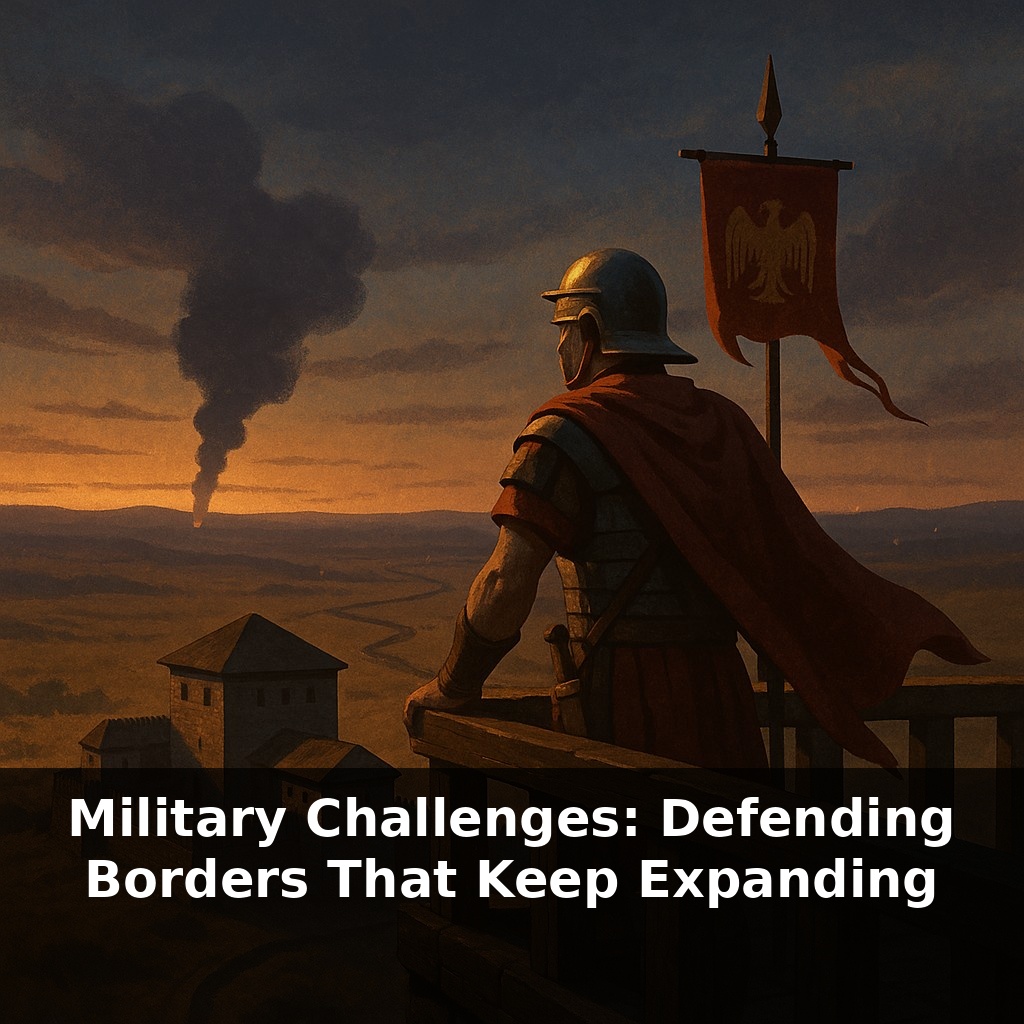
An empire once guarded a frontier so long it could take weeks for a single order to reach one end. Now, drop yourself at a lonely fort on that border: the horizon is quiet… until smoke appears. Do you hold, call for help, or retreat—knowing help may be far too late?
Five thousand kilometers of border, guarded by roughly 300,000 soldiers: on paper, Rome looked invincible. Yet by the 3rd century CE, that impressive number was closer to a ceiling than a strength. Every new province meant more roads to patrol, more garrisons to man, more officers to pay—and no automatic surge in taxpayers or recruits to match.
Think of a household adding subscription after subscription: each one seems small, but the total quietly buries the budget. For Rome, each “subscription” was a new river line to watch, a mountain pass to hold, a client king to monitor. Over time, emperors discovered a brutal arithmetic: defending what they had already taken demanded almost as many resources as conquering it—and then some.
Your challenge this week: map these pressures onto a modern state or organization you know well.
By the late 2nd century, Rome’s map looked stable, but its defense system was quietly changing character. Instead of pushing outward, emperors like Hadrian began thickening the edges: more watchtowers, denser networks of forts, and permanent bases for troops who once moved more freely. That shift mattered. Soldiers tied to fixed posts were harder to redeploy in a crisis, and officers spent more time on local logistics and local politics than on coordinated campaigns. It’s like a kitchen that keeps adding specialized gadgets—each helpful alone, but together they clutter the counter and slow the cook.
On the ground, the shift from expansion to static defense changed how Roman units actually lived and fought. Earlier armies had marched in large, flexible groups under a single general. By the 3rd century, many soldiers spent entire careers in one sector, learning the local river crossings, smugglers, and tribal politics—but losing the habit of operating as part of a unified, empire‑wide force.
This created a patchwork of semi‑specialized border commands. Along the Rhine and Danube, troops grew used to fast raids and winter floods. In the East, they trained for long desert marches and cataphract cavalry. In Britain, they adapted to wet terrain and small‑scale skirmishes. Each zone evolved its own routines, supply tricks, and informal deals with nearby communities. That made them effective locally, but it also meant that “the Roman army” was less and less a single, interchangeable instrument.
Strategy started bending around that reality. Emperors increasingly relied on local commanders to decide when to negotiate, when to pay off a group beyond the line, and when to strike first. Those officers knew their theatre, but they also had powerful incentives to make short‑term choices: keep their sector quiet, keep their troops paid, and avoid disasters that could end a career—or a life. A governor might promise settlement land to a migrating group just to plug a manpower gap, without thinking through how that precedent would play out two provinces away.
Logistics magnified the problem. Slow communication meant that by the time a crisis message arrived in the capital, the local commander had already acted—or failed to. Central authority began to function less as a director and more as a reviewer of faits accomplis. Armies raised emergency taxes, requisitioned food, or stripped nearby towns to feed themselves first, and only later justified it to the emperor.
Over time, this encouraged a mentality where regional armies saw themselves as guardians of “their” stretch of territory, rather than of a single shared system. When succession disputes erupted, those same forces were perfectly placed—and politically practiced—to back a local strongman. The structures built to secure the frontiers were slowly teaching Rome’s soldiers how to operate without Rome.
A modern way to grasp Rome’s stretched defenses is to look at global companies that grow faster than their ability to supervise. A firm might start with one office where the founder knows every team. As it opens branches on different continents, each site hires locally, tweaks procedures, and cuts quiet deals with nearby partners just to keep business flowing. Headquarters still sends strategy memos, but by the time they land, local managers have already improvised—and often solved problems in ways that don’t match the official playbook.
You can see this in multinationals that operate in both tightly regulated markets and loosely regulated ones. Compliance rules, sales tactics, even hiring norms diverge. The org chart says “one company,” but daily life says “loose federation.” When a shock hits—say, a sudden regulatory change or supply disruption—those branches react first to protect themselves. Only afterward do they sync with the center, if at all. At that point, the “core” isn’t directing the system; it’s negotiating with semi‑independent power centers it once assumed it fully controlled.
Modern states face a quieter version of Rome’s dilemma: how do you guard far‑off interests without hollowing out the core? Drones and satellites shrink distance, but budgets, personnel, and political patience still cap how many crises can be handled at once. Think of a cybersecurity team chasing simultaneous breaches: plug one gap too aggressively and you expose another. Rome hints that durability lies less in rigid lines than in flexible depth—alliances, shared capacity, and the ability to retreat, regroup, and still recover.
In the end, overstretch wasn’t just geographic; it was cognitive. No one mind—or council—could truly track every moving part. That’s a warning for any complex system today: from global supply chains to sprawling cloud networks, resilience depends less on holding every line than on knowing which lines you can afford to bend, reroute, or quietly abandon.
Try this experiment: Pick one “expanding border” in your own life—like always being on call for work, answering messages late at night, or saying yes to extra responsibilities—and draw a hard, military-style boundary around it for the next 72 hours. Announce this new “perimeter” to at least one person who regularly crosses it (a boss, teammate, or family member) using clear, no-apology language, the way a commander would brief a unit. Track every time that boundary is tested and how you respond—treat each test like a probing maneuver and note whether you held the line or retreated. At the end of the 72 hours, decide whether to reinforce, adjust, or advance that boundary based on what actually happened, not what you feared would happen.