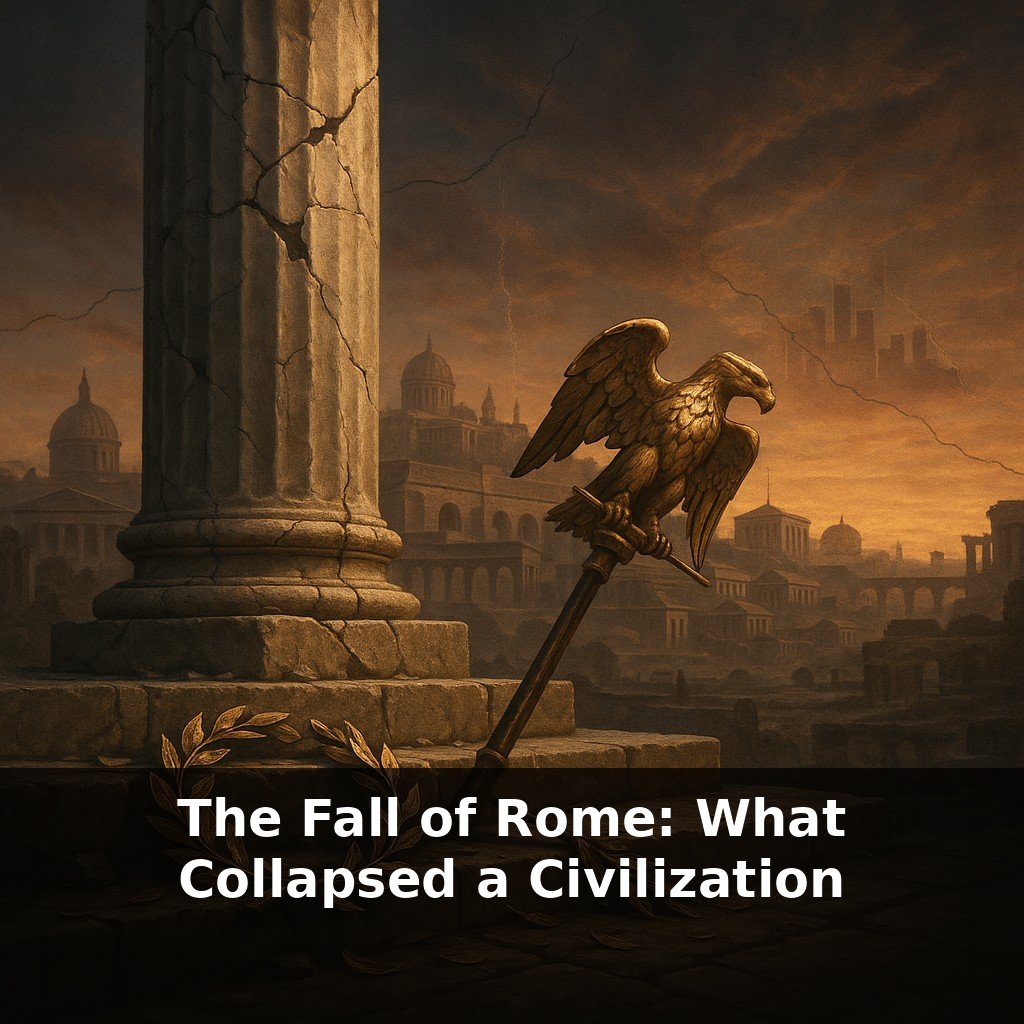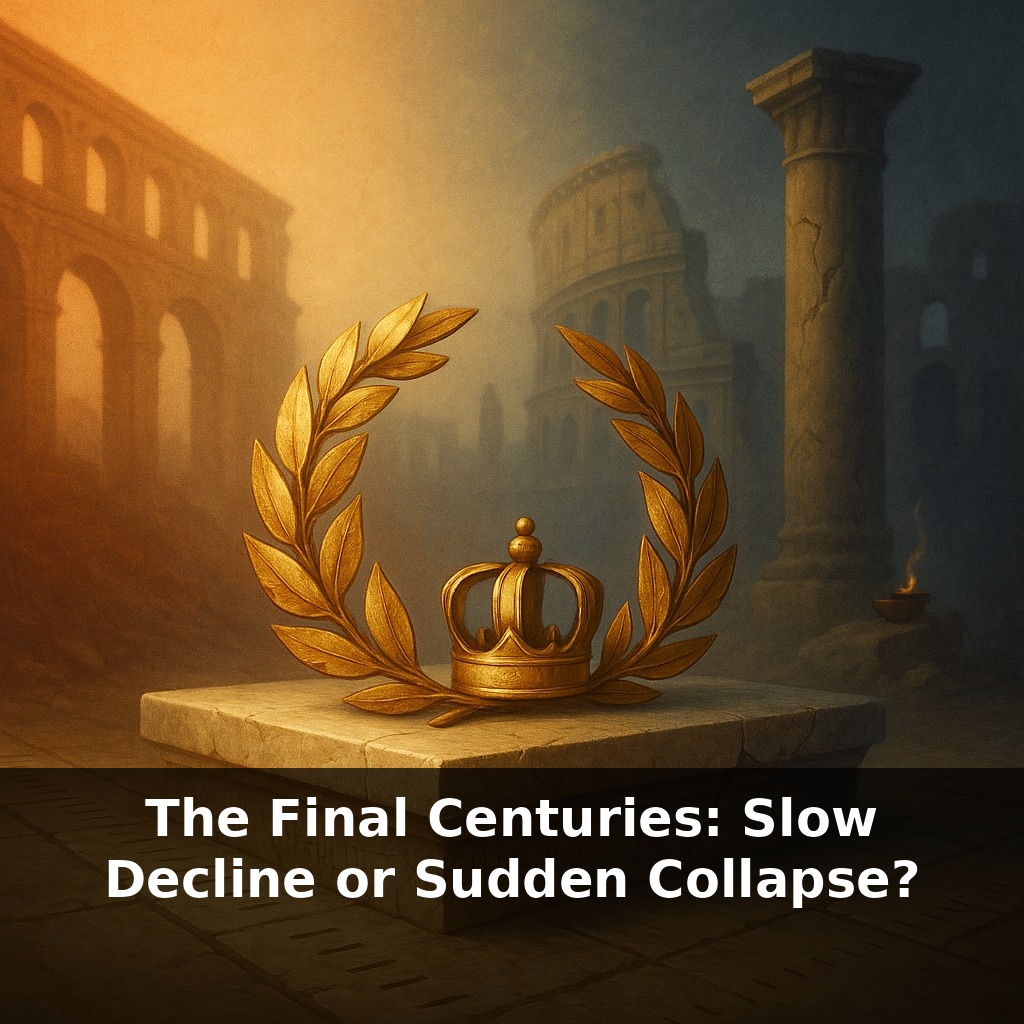
One August day in the late 400s, the last Roman emperor in the West quietly handed over his crown—and most people in the old empire had no idea anything “ended.” Was Rome’s fall a sudden crash, or a long, slow fading that only became obvious when the lights finally snapped off?
By the time that final emperor stepped down, the real drama had already played out over generations—mostly in ledgers, census lists, and military payrolls. The controversy now isn’t so much *whether* Rome weakened over time, but *how* that weakening interacted with sudden shocks. Specialists talk less about a clean “decline” or a single “collapse,” and more about resilience slowly being chipped away until even modest blows hit like a hammer. New research combines climate data, coin hoards, and burial records to trace shrinking tax bases, over-stretched armies, and shifting populations. In this episode, we’ll zoom in on three layers: long-term stress, short-term crises, and that final unravelling in 476. Not as a neat morality tale, but as a messy, data-driven story of how a superpower actually comes apart.
To see how this played out, we need to zoom way in—down from empire-wide trends to the level of villages, pay chests, and harvests. Think of the empire’s systems not as “strong” or “weak,” but as networks that could reroute strain for a while: a bad year in one province covered by surplus elsewhere, a lost battle patched by new recruits from another frontier. What changed between the 3rd and 5th centuries was how often those workarounds were needed, and how thin the margin for error became when bad weather, new migrant groups, or political gambles all arrived at once.
Start with the ground-level picture. Around 150 CE, the empire at its height may have supported 60–70 million people; by the mid-400s in the West, many historians suspect that number had fallen below 30 million. Fewer people didn’t just mean emptier roads and quieter forums—it meant fewer taxpayers, fewer recruits, and less redundancy when anything went wrong.
One of the clearest windows into this thinning margin is money. Under Augustus, the standard silver coin, the denarius, was about 90% silver. By the mid-3rd century, that purity had plunged below 5%. For ordinary Romans, this wasn’t an abstract number: soldiers demanded higher nominal pay to keep up, merchants raised prices, and anyone on a fixed income was quietly squeezed. The state kept the army marching by stretching every coin further on paper, but the trick worked less well every decade.
At the same time, the military was eating more of the budget than ever. By the 4th century, perhaps 60–70% of imperial expenditure went to soldiers, fortifications, and logistics. That’s not just “a lot of money for defense”—it meant almost everything else, from roads to city baths to local officials’ salaries, had to fight over the scraps. The empire was betting nearly its whole fiscal capacity on keeping its borders manned and its generals loyal.
This left little room to absorb big, discrete shocks. When the Gothic forces smashed a Roman field army at Adrianople in 378, killing around 15,000 troops—roughly two-thirds of the Eastern field army—it wasn’t just a bloody day on one battlefield. Replacing that many trained soldiers in a world of demographic contraction was brutally hard. The court had to offer better terms to new recruits and bargain more with powerful generals, who now knew how indispensable they were.
Something similar happened on the psychological front with the three-day sack of Rome in 410. Most buildings survived; the city wasn’t flattened. But an aura was punctured. For the first time in some 800 years, an enemy army roamed Rome’s streets. Survivors and distant observers alike began writing not just about troubles, but about the possibility that the old order itself might be fragile.
Think of the political system here less as “strong then weak” and more as software patched so often that even a small new bug could crash the program. By the time 476 arrived, the Western court didn’t so much topple as fail to reboot, while the Eastern half kept running on a differently configured, more adaptable version of the same code.
Think about how this played out in a single frontier town. A bad harvest meant local elites had less surplus to lend the state. To keep troops supplied, officials might demand grain in kind, squeezing small farmers who were already on the edge. Some quietly walked away, joining semi-nomadic groups or slipping into less-taxed regions. Each departure slightly hollowed out the community’s ability to meet the next demand. Over decades, once-busy markets thinned, workshops closed, and the state increasingly leaned on fewer, larger landowners who could bargain for exemptions or private protection.
On the military side, commanders in these zones faced a tactical puzzle: spread troops thin along roads and forts, or mass them to confront larger raiding forces. Pulling units from one sector to plug a gap in another worked in the short term, but left patches of territory exposed. Local city councils, seeing imperial forces come and go, began funding their own watchmen or walls—signs that confidence in distant authority was fraying. By the 5th century, that mix of local improvisation and imperial improvisation often clashed, rather than aligned.
Modern researchers treat Rome less as a one-off tragedy and more as a data-rich test case for how big systems behave under pressure. Climate records, isotope studies, and software models of trade routes now sit alongside dusty manuscripts. Your challenge this week: follow one modern “system” you rely on—say food delivery or cloud storage—and list three ways it might fail slowly, and one sudden shock that could expose those weaknesses.
Seen up close, late Roman life was less an apocalyptic countdown than a series of workarounds: officials juggling arrears, generals negotiating recruits, towns patching aqueducts like tenants taping leaky pipes. That’s the puzzle historians now chase—how long creative fixes can stretch before they no longer mend, but merely mask, the breaking points.
Before next week, ask yourself: 1) “If our civilization were closer to sudden collapse than slow decline, which of my current habits (news intake, tech dependence, commuting, consumption) would I most urgently want to change, and what’s one concrete shift I could start experimenting with today?” 2) “Looking at the specific risks discussed in the episode (AI misalignment, climate tipping points, institutional fragility), which one feels both plausibly near-term and personally relevant to my life, and how could I start building a tiny bit of resilience around it—through skills, community ties, or where I put my time and money?” 3) “If I imagined explaining our era honestly to a grandchild in 2100, what would I hope to say I *actually did* this year in response to these risks, and what’s the first visible step toward that story that I’m realistically willing to take this week?”