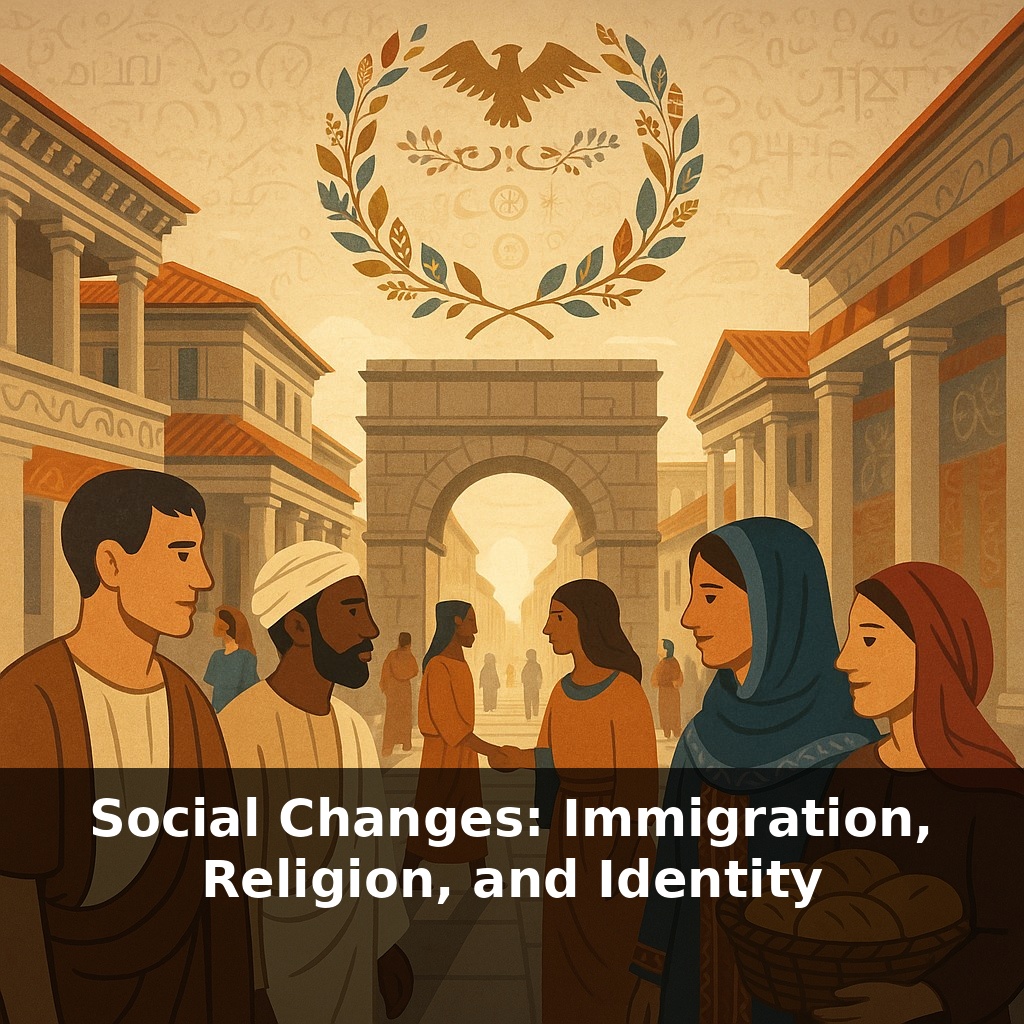
On a busy day in second‑century Rome, you could walk a single street and hear merchants speaking half a dozen languages. Here’s the twist: the empire didn’t fall apart under that diversity. It turned it into law, religion, and a whole new idea of what “Roman” meant.
By the 2nd century CE, Rome wasn’t just big—it was porous. People, gods, and customs didn’t just enter; they seeped into daily life in quiet, practical ways. A baker from Syria might adjust his bread recipe to suit Latin‑speaking customers, the way a modern food truck tweaks a family dish for a new neighborhood. A senator could sponsor an Egyptian festival in the morning, then attend a traditional Roman ceremony at night without feeling like he’d betrayed anything. These weren’t grand ideological choices so much as social shortcuts: ways to get business, secure favors, and build trust in a city where your neighbor’s accent, clothing, and gods might all be different from yours. Over time, those small, everyday compromises did something powerful: they made mixture feel normal, even when politics and polemic said it shouldn’t.
Walk a bit farther down that same street and the shifts become more visible in stone and ink than in conversation. Funerary inscriptions start listing origins—“from Bithynia,” “a Jew from Tarsus,” “a merchant of Palmyra”—like tiny passports chiseled into marble. Military diplomas record discharged soldiers from Spain ending up with land in Gaul, or Thracians retiring in Egypt. Over time, these scattered traces add up to a pattern: people weren’t just passing through Rome’s world; they were sticking, marrying, inheriting, and leaving legal footprints that forced the system to adjust.
Look closely at those scattered names and origins and you start to see something bigger: the empire quietly rewiring its social operating system. One obvious pressure point was immigration. Foreign‑born residents in the capital weren’t just labor; many arrived with existing networks—trading guilds from the eastern Mediterranean, Jewish communities with their own courts, Syrian and North African entrepreneurs clustering in particular streets. They brought their own rules of trust and obligation, which didn’t vanish on arrival. Roman officials learned to work around, through, and sometimes with these parallel structures rather than trying to bulldoze them.
The army became another engine of change. A recruit from the Danube might enlist under local tribal leaders, swear oaths in Latin he barely understood, then spend twenty years posted in Britain or Judaea. When he retired with land and citizenship, his children grew up speaking a different first language than he had, worshipping a mix of deities, and inheriting rights he’d never expected to own. Multiply that story by hundreds of thousands of veterans and you get slow demographic tilts that no single emperor decreed but every province felt.
Then Christianity added a new, cross‑cutting layer of belonging. At first it was one more minority cult, but its insistence that “there is neither Jew nor Greek” cut across ethnic labels the state had long relied on. Christian communities built their own welfare systems, burial clubs, and dispute‑resolution habits, attracting migrants and the poor who were already accustomed to leaning on informal networks. As bishops gained influence, they didn’t stay in a separate religious lane; they began to speak for cities, negotiate with governors, and, eventually, lobby emperors. The social map was being redrawn so that a person might be, say, a Punic‑speaking shipowner in Carthage, a Roman citizen by law, and a Nicene Christian by conviction—all at once.
When the Constitutio Antoniniana suddenly extended citizenship to tens of millions, it didn’t create unity overnight. It did, however, flatten an old hierarchy between Italians and everyone else, pushing elites from Syria, Africa, and the Balkans into the same legal category as senators in Rome. The result was less a melting pot than a layered portfolio: people managed multiple identities—local, imperial, religious—and shifted which one they emphasized depending on who was in the room and what they needed.
By the late 3rd century, you can watch these layered identities playing out in careers that look almost improvised. Take a hypothetical official from North Africa whose grandfather spoke Punic at home. He studies rhetoric in Greek at Alexandria, learns Latin legal formulas to advance at court, and ends up administering a tax district along the Danube. His correspondence might quote the Hebrew scriptures in a Christian sermon, cite jurists trained in Italy, and reference a local river god when addressing village elders. He isn’t “switching cultures” so much as stacking tools, choosing whichever signal best unlocks cooperation in front of him.
In some cities, this stack became visible in stone. A single inscription from the eastern Mediterranean might list donors with Berber, Greek, and Syrian names funding repairs to a bathhouse that hosts both civic meetings and a bishop’s sermon during winter. The building’s purpose changes by hour, but the same handful of families underwrite each use, turning their blended backgrounds into a kind of shared civic credit line.
By tracing how these overlapping loyalties evolved, we glimpse a society constantly beta‑testing who could belong, on what terms, and with which symbols. The experiment didn’t erase boundaries; it rearranged them, letting people “log in” to different roles as needed—neighbor, patron, believer, subject. For us, the live question is less “Can pluralism work?” and more “Who gets to update the rules?” When only a narrow elite edits that code, fractures widen; when more users shape it, cohesion deepens.
In the end, Rome shows that belonging wasn’t a single label but an ongoing negotiation, closer to editing a shared document than signing a fixed contract. As new voices annotated the margins—former outsiders, local notables, bishops, traders—the “final” version kept shifting. Our own arguments over passports, borders, and belief fit into that longer, unfinished draft.
To go deeper, here are 3 next steps: (1) Stream an episode of the “Immigration Nation” docuseries on Netflix or the “This Land” podcast and jot down 2–3 moments that challenged your assumptions about immigration policy, then fact‑check them using the Migration Policy Institute’s data tools (migrationpolicy.org). (2) Read chapter 1 of *The Spirit Catches You and You Fall Down* by Anne Fadiman and, while you read, keep an interactive map of your city’s religious and ethnic communities open (e.g., on City-Data or your local government site) to see where similar cultural intersections might be happening around you. (3) Take the “Religious Typology” quiz from Pew Research Center (pewresearch.org/quiz/religious-typology) and then compare your results with their reports on religious change and identity in your country, highlighting one statistic that surprises you and sharing it in a conversation or on social media to spark a thoughtful discussion.