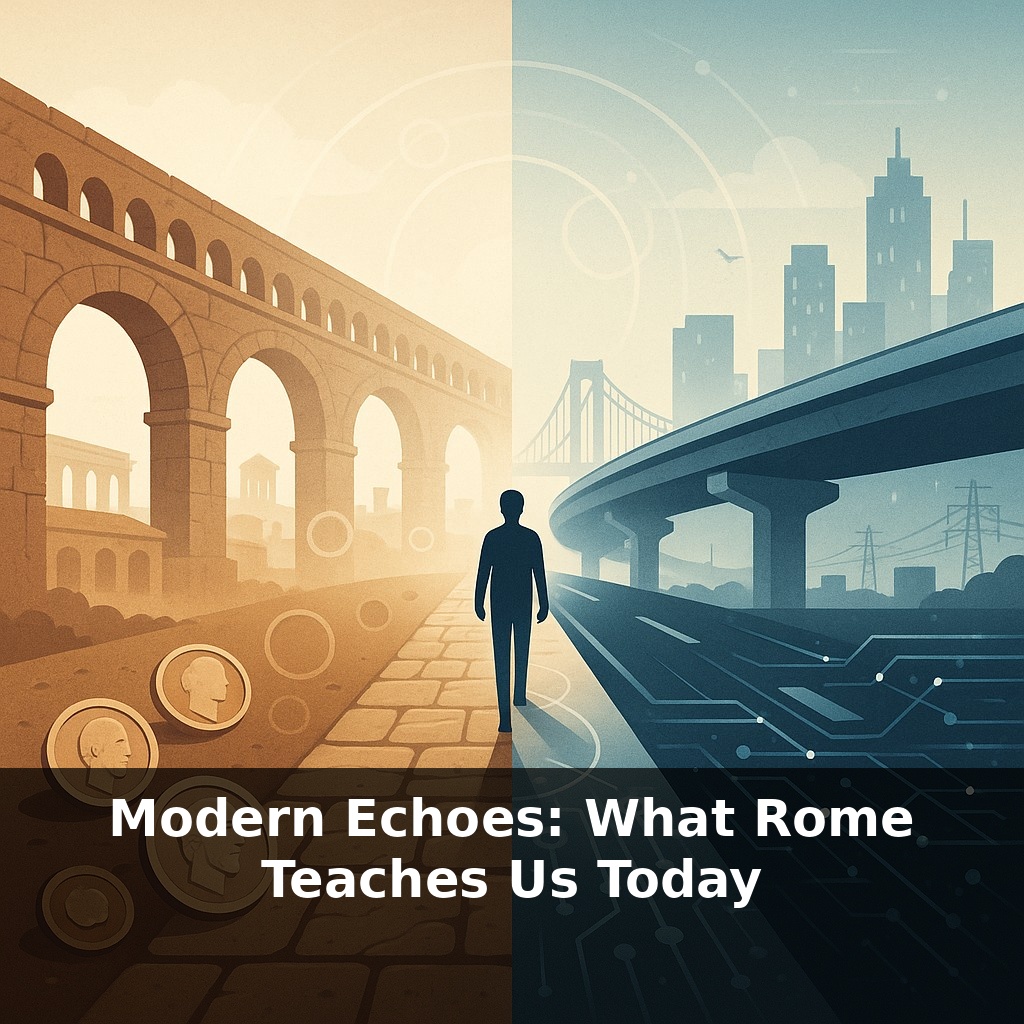
A world‑spanning superpower once let its stone highways crumble, not because it lacked engineers, but because its political will and budget slowly unraveled. Today, our bridges, grids, and digital networks face eerily similar stress tests—often for the very same reasons.
By the third century, Rome looked brilliant on the surface—monuments gleaming, arenas full, trade still humming—yet everyday life was fraying in small, cumulative ways. Tax collectors showed up more often, coins bought a little less each year, border skirmishes felt more frequent than formal wars. No single change felt “apocalyptic,” but together they quietly rewired how people trusted the system.
Modern societies often move the same way: not through one big disaster, but through a long drizzle of minor crises—higher rents, longer hospital waits, polarizing news cycles—that slowly soak institutions. Think of a neighborhood where each family adds just one more car to the street; no one decision kills parking, but over time movement becomes jammed, frustration rises, and informal rules replace shared norms. That’s the Rome we need to study: the one that was still working—just worse, for more people.
By late antiquity, Roman leaders kept announcing “restorations” and “renewals,” yet each reform felt more like rearranging furniture in a house with hidden rot. New taxes patched last year’s shortfalls; emergency edicts calmed one revolt while stoking anger somewhere else. The core problem wasn’t a single bad law, but the way fixes piled up faster than anyone could measure their side effects. Modern governments do something similar when they stack temporary subsidies, bailouts, and stop‑gap rules—creating a maze that even well‑intentioned citizens struggle to navigate or believe in.
By the third century, Rome’s rulers understood they were in a bind, but not the full shape of it. They saw symptoms—shrinking tax yields, harder military recruitment, more petitions from cities begging for relief—yet they lacked the data tools, independent institutions, and time horizons to see how these trends interacted.
Consider manpower. After the Antonine Plague wiped out perhaps a tenth of the population, every policy choice touched the same shrinking pool of people. Draft more soldiers, and you hollow out farms and workshops. Ease conscription, and border units become understaffed. Rome leaned on one workaround after another: hiring more federate troops, tying colonists to the land, granting tax exemptions to favored groups. Each fix made sense locally, but together they narrowed future options, locking the system into brittle paths.
Fiscal policy followed a similar arc. Instead of overhauling how wealth was created and taxed, emperors repeatedly tapped the easiest targets—landowners who couldn’t move estates, urban councils forced to guarantee local tax quotas, smallholders too poor to evade levies. As productive people slipped into debt or informal economies, authorities responded with stricter rules, harsher penalties, and occasional amnesties. The more the state squeezed, the more effort went into dodging the squeeze.
This is where Rome feels close to home. Modern states can also drift into “short-term survival mode”: plugging budget gaps with creative accounting, off‑balance‑sheet promises, and politically convenient borrowing. The strain shows up not as a single meltdown, but as slower repairs, longer queues, and rising cynicism about whether rules apply evenly.
Rome’s story also reminds us that resilience is unevenly distributed. Great estates with private security and storage weathered shocks better than small farms on marginal land. Cities with diversified elites and access to sea routes adapted; others hollowed out. When we talk today about climate adaptation, social safety nets, or who can move when a region becomes unlivable, we’re replaying a Roman question: whose resilience are we actually funding?
In that sense, Rome doesn’t hand us a script; it hands us a mirror. The useful exercise is not to ask, “Are we Rome?” but, “Which parts of our system already behave like late Rome—and who’s feeling that first?”
When Rome stopped maintaining certain routes, merchants quietly shifted to safer, if longer, detours. Over time, markets that had once been central turned into sleepy backwaters without any formal decree announcing their decline. You can see a softer version of this when ports lose shipping routes to better‑run competitors, or when a once‑busy downtown thins out as logistics parks and data centers sprout by the highway.
Caracalla’s universal citizenship edict worked similarly: on paper, it flattened legal distinctions; in practice, status still hinged on local clout, patronage, and the ability to navigate bureaucracy. That tension—universal rights vs. unequal access—echoes in modern debates over who actually benefits from global trade regimes or climate finance.
Think of a complex tax code as a dense recipe: every exemption is an extra ingredient. A handful can improve the dish; thousands make it so fussy that only elite chefs—big firms, specialist lawyers—can cook it properly, while everyone else just hopes they aren’t burning something invisible.
Rome’s long decline hints that resilience is less about strength than agility. Today’s systems—financial, ecological, even cultural—interlock so tightly that strain in one spreads like heat through a crowded kitchen. Supply shocks reshape where food is grown; migration reshapes labor markets and elections. Our advantage is foresight: satellites, sensors, and models can flag weak links early, if we’re willing to act on them before they harden into fate. Your challenge this week: notice one everyday system you rely on, then ask: what’s its single point of failure—and who’s in charge of fixing it?
Rome’s warning isn’t a prophecy of doom; it’s a user manual for complex societies running hot. Instead of asking when collapse might come, we can track where small cracks cluster—like hairline fractures in a favorite mug. The lesson isn’t “panic,” but “prototype”: test new ways to share risk, shift power, and repair faster than the pressure builds.
Here’s your challenge this week: Choose one “Roman-inspired” reform for your own life—either time, money, or power—and test it for seven days. For time, block off a 90‑minute “Roman forum” each day where you handle only deep work (no email, no phone, no multitasking). For money, create your own “bread-and-circuses audit” by listing every subscription and impulse purchase from the last 30 days and canceling at least two that are pure distraction. For power, host a 20‑minute “mini Senate” with someone you lead (at work, home, or community) and give them real decision-making authority over one concrete issue this week.