The Birth of Democracy
📝 Transcript
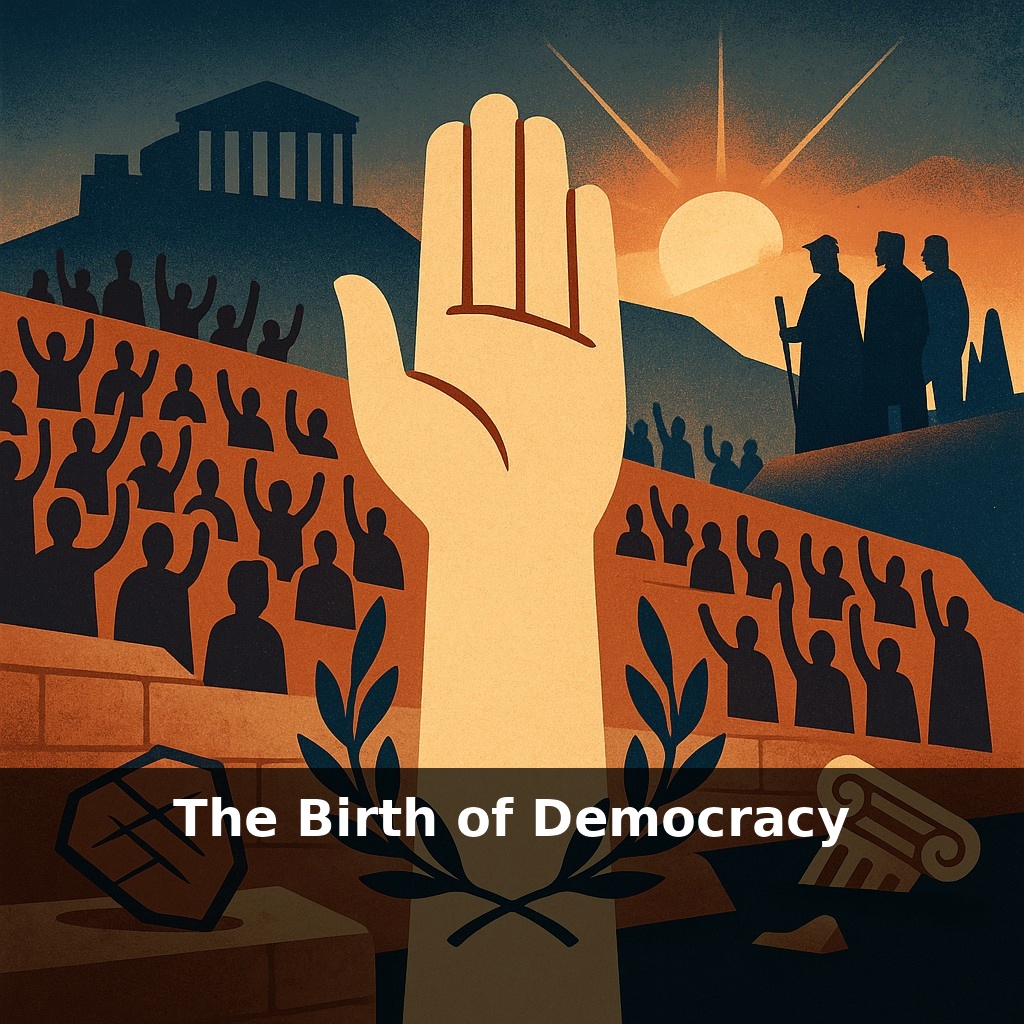
A city where most people have no vote somehow invented the idea that power should belong to ordinary citizens. In Athens, a few tens of thousands of men gathered on a rocky hillside to decide war, taxes, and justice—by raising their hands, and sometimes, by kicking leaders out.
Those hillside gatherings didn’t appear out of nowhere—they were the outcome of decades of tug-of-war between rich families, angry debtors, ambitious generals, and nervous neighbors watching rival cities grow stronger. Early Athens was closer to a family-owned business than a “government of the people”: a few lineages held the best land, the top offices, and the final say. What changed was not a single heroic leader, but a chain of crises that made the old setup too risky to keep. Grain shortages, debt slavery, and military threats forced Athenians to rethink who should be trusted with power. Instead of snapping overnight, their system updated in patches—some reforms clashed, some backfired, and some only made sense years later. By tracing these messy upgrades, we can see democracy less as a miracle, and more as a hard-fought workaround to constant trouble.
Solon’s moment came first. By the early 6th century BCE, Athens felt less like a proud city and more like a household on the brink of collapse: arguments over land, unpaid loans, and old family grudges piled up faster than anyone could clear them. Solon was asked to “fix everything” without tearing the city apart—an almost impossible brief. Instead of choosing a side, he tried to redraw the rules so each group lost something and gained something else. Think of a tense business partnership where the only way forward is to rewrite the contract so no one gets exactly what they want, but everyone gets enough to stay in.
Solon’s rule changes didn’t magically calm Athens; they mostly bought time. Once the dust settled, old rivalries reappeared in new shapes. Three power blocs formed, each rooted in different regions and interests: farmers of the plains, coastal traders, and hill-country smallholders. They weren’t just arguing over policy—they were arguing over whose status counted as “real” power. Into this tension stepped a series of strongmen, the most successful being Peisistratus, who seized control not by erasing the rules, but by bending them.
Under Peisistratus and his sons, Athens experienced something unsettling: economic growth and cultural flowering under an essentially one-man regime. Temples rose, festivals expanded, and poorer citizens found work and patronage. The lesson was dangerous: maybe you didn’t need broad participation to prosper—just a clever ruler who kept enough people happy. When this regime was finally overthrown, the question wasn’t simply “Who rules now?” but “How do we stop any one faction from grabbing everything again?”
This was Cleisthenes’ opening. Instead of letting politics follow old family lines and regional gangs, he sliced the map differently. He mixed coastal, inland, and urban areas into new units, then stacked those units into larger groupings that cut across traditional loyalties. It was as if a city constantly dominated by the same few neighborhoods decided to redraw its district map so every council seat depended on a mix of rich streets and back alleys.
The real innovation wasn’t the map itself, but what it did to identity. People still knew their clan and village, but they now appeared on official lists by new civic units, tied to shared responsibilities—especially military service and local administration. When the council was later expanded to 500 members, these units became the pipeline that fed ordinary men into daily governance. You could still be proud of your ancestors, but your route into influence now ran through structures designed to dilute their grip.
Cleisthenes’ new civic units didn’t just shuffle paperwork; they reshaped daily experience. A farmer from a rocky hillside might now sit on the same local board as a shipbuilder and a pottery merchant, forced to hash out road repairs or festival budgets together. The Boule drew from these mixed pools, so a man’s route into influence could run through an obscure village rather than a glamorous surname. Over time, this created overlapping circles of obligation: you might owe favors to someone from a different region because you had served on the same council committee or shared a military campaign. Political trust began to flow less through bloodlines and more through repeated cooperation in these settings. It was a slow, uneven shift, but it made it harder for any single network to lock down every pathway to authority. Building Athenian democracy was like assembling a three-layered amphitheater: the broad base (Ekklesia) provided volume, the middle tiers (Boule) shaped the performance, and the top tier (courts) ensured the rules were followed—each layer essential for the full civic ‘production.’
Athens’ experiment still echoes. When cities test citizens’ assemblies on climate targets or data laws, they’re reviving that risky bet: many minds, shared power. Digital tools could stretch the “assembly” across continents, like turning a town-hall into a live-streamed global studio. Yet scale, misinformation, and unequal access threaten to drown out quieter voices. The open question is whether we can code systems that reward listening as much as loudness, so participation feels less like shouting and more like co-writing the script.
Today’s “demos” isn’t packed onto one hillside; it’s scattered across timelines, comment sections, and encrypted chats. Algorithms now act like unseen stagehands, dimming some voices and spotlighting others. The next frontier isn’t copying Athens, but stress‑testing new forums where code, custom, and conscience learn to share the same political stage.
Start with this focused action: Identify a local issue you care about—like public transportation improvements or neighborhood safety. Attend one community meeting or city council session this month, taking inspiration from the Athenian practice of assembly. Prepare a question or comment ahead of time, something specific and actionable, to share during the public discussion.
From this course
The Grand Adventures of Ancient Athens
4 episodesUnlock all episodes
Full access to 4 episodes and everything on OwlUp.
Subscribe — $1.99/monthLess than a coffee ☕ · Cancel anytime