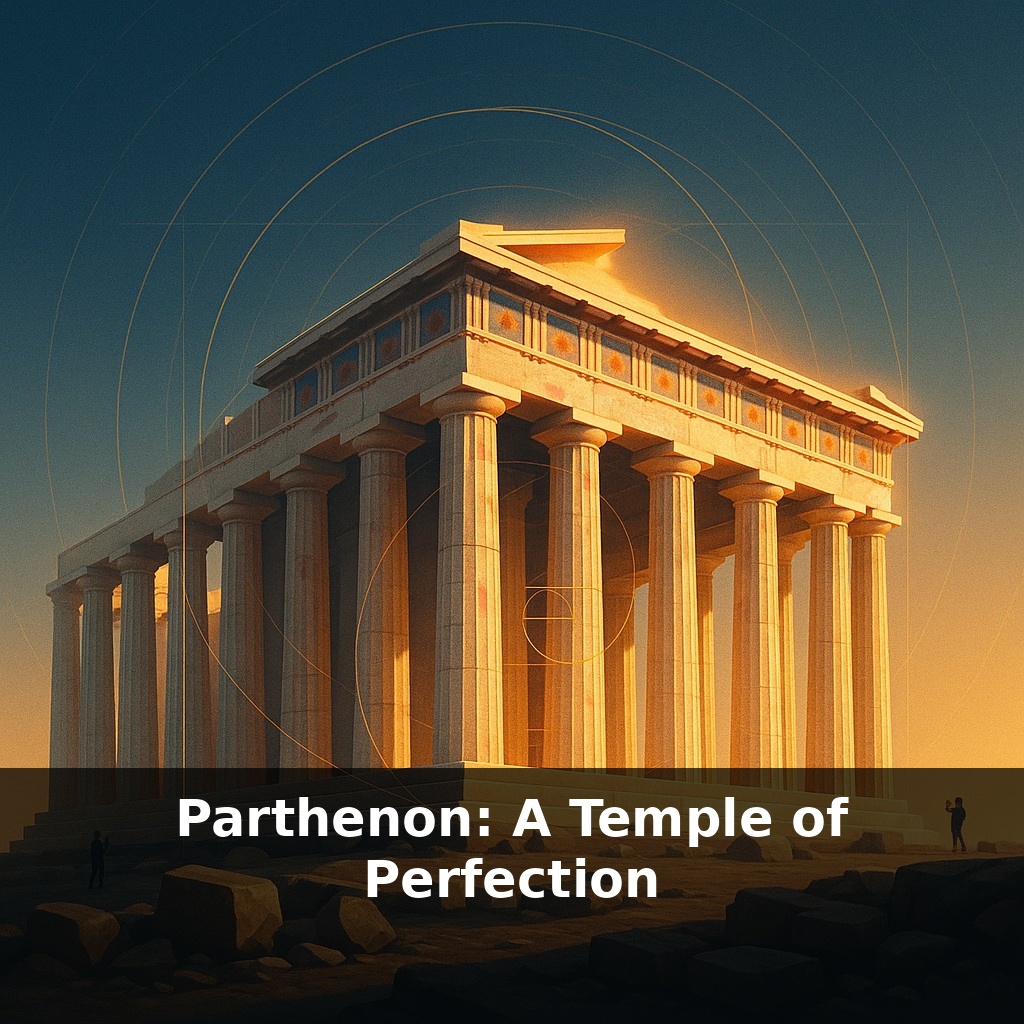
The most famous temple in the Western world was once blindingly colorful, slightly crooked on purpose, and built without a single drop of mortar. As tourists snap photos of broken white columns, they’re standing inside one of history’s most precise optical illusions.
Stand at the right spot on the Acropolis and the Parthenon stops being a “ruin” and turns into a manifesto carved in stone. Those columns and pediments weren’t just meant to impress visiting pilgrims; they were Athenian bragging rights, broadcasting: “We beat the Persians, we control an empire, and we know exactly what we’re doing.”
Yet this monument of confidence has lived many lives that scrape against that image of perfection. It has been a treasury stacked with tribute, a Christian church echoing with hymns, an Ottoman mosque threaded with call to prayer, and, disastrously, a gunpowder magazine that exploded in 1687, blowing out its heart.
Each transformation left scars and questions. Who owns its story—the ancient Athenians, modern Greeks, museums abroad, or the global public? Today’s lasers, 3D scans, and titanium clamps are just the latest voices joining a 2,500‑year‑long argument about what it means to “preserve” a masterpiece.
Walk closer, and the “perfect” lines start to misbehave. Columns swell gently in the middle, corner pillars are subtly thicker, the floor bends upward in a shallow arc. None of this is damage; it’s design. The builders knew human eyes curve straight lines and shrink distant objects, so they pre‑warped the stone to counter our perception. Later architects, from Roman imperial forums to neoclassical banks and museums, treated this place like an open‑source blueprint, borrowing proportions the way coders copy elegant snippets of code. Yet we still don’t fully agree on how they calculated it all.
Step inside the numbers and the Parthenon turns from “pretty building” into a piece of hardcore problem‑solving.
Start with scale and money. The Athenians were not rich by accident; they ran an empire funded by allies’ tribute. Diverting an estimated 469 silver talents into one project was a political gamble: you’re turning tax revenue into stone, in public, for everyone to judge. Getting it wrong wasn’t just embarrassing—it was a visible admission that maybe Athens didn’t deserve to lead.
So everything about the structure had to signal control. The main rectangle follows a 4:9 rhythm: height to width, column diameter to spacing, even some internal elevations echo it. No mystical Golden Ratio diagrams, just a clear, repeatable pattern that could be checked on site with cords and measuring rods. That regularity mattered because the building crew was enormous. Quarrymen at Mount Pentelikos, ox‑drivers hauling blocks, teams cutting, polishing, carving, fitting. To coordinate all that without blueprints as we know them, you rely on strict proportional rules and a shared design language.
The real genius hides in the joints. No mortar means every stone had to meet its neighbors like precision‑milled machine parts. Masons carved tiny bosses and ridges on contact surfaces, then tested, shaved, and retested until the blocks locked. Iron clamps and dowels, poured around with molten lead to prevent rusting, tied the pieces into a single, flexible frame that could ride out minor tremors.
Then there’s the sculpture program, which functioned like a narrative user interface. Walk around the outer frieze and pediments and you’re fed stories: contests of gods, battles with Amazons and centaurs, a quiet civic procession at the center. After the Persian Wars, those images weren’t neutral decoration. They reframed a messy, brutal conflict as a timeless victory of “order” over “chaos,” with Athens ethically cast as the steady hand.
One modern‑sounding twist: the project schedule was brutal. The main building rose in about fifteen years—fast for something this size in stone. That pace forced iterative decisions. Evidence of recut blocks, abandoned clamp cuttings, and adjusted carvings suggests constant on‑site tweaking, more like a live software deployment than a frozen master plan, with Phidias and the architects steering a rolling wave of micro‑corrections toward a single, coherent effect.
Stand close to one column and you’ll notice faint carving marks, almost like the debug notes of a programmer left in the margin of live code. Scholars follow those clues the way forensic accountants follow money flows: a half‑finished molding here, a shifted joint there, hints at which team worked where and in what order. Even the marble tells stories. Blocks from different quarry layers age and weather differently, letting researchers track supply chains and labor logistics across the site.
Modern conservators add their own layer of experimentation. Laser cleaning is tuned so precisely that it can strip soot but leave ancient tool‑polish intact—more like non‑destructive data recovery than scrubbing stone. And every new titanium insert or replacement block is deliberately distinguishable on close inspection, a physical acknowledgment that our “fixes” are provisional. The building becomes a palimpsest of decisions: ancient political bets, Venetian artillery errors, 19th‑century removals, 21st‑century lab work, all legible if you know where to look. With these insights, technology pushes boundaries even further. Augmented‑reality overlays could one day ‘rebuild’ lost sculptures in situ, letting visitors toggle between centuries like layers in a design app.
Future implications Augmented‑reality overlays could one day “rebuild” lost sculptures in situ, letting visitors toggle between centuries like layers in a design app. As carbon‑fibre tendons and nanolime treatments mature, engineers may treat the structure less as fragile relic, more as a test‑rig for long‑life cities. Restitution decisions will set case law: how much of a monument’s story must stay on its hill, and how much can live in dispersed collections and their digital twins worldwide.
So when you next see a photo of those battered columns, treat it less like a postcard and more like an open tab in a shared design file. New scans, pigments, and fragments can still be “uploaded,” changing how the whole thing reads. Your challenge this week: pick one everyday object and trace how future repairs or upgrades might quietly rewrite its story.