In a crowded marketplace of ancient Athens, one old man’s questions caused more chaos than any angry mob. No books, no slides—just conversation. How did simple, stubborn questions in the Agora reshape law schools, therapy rooms, and even modern AI labs?
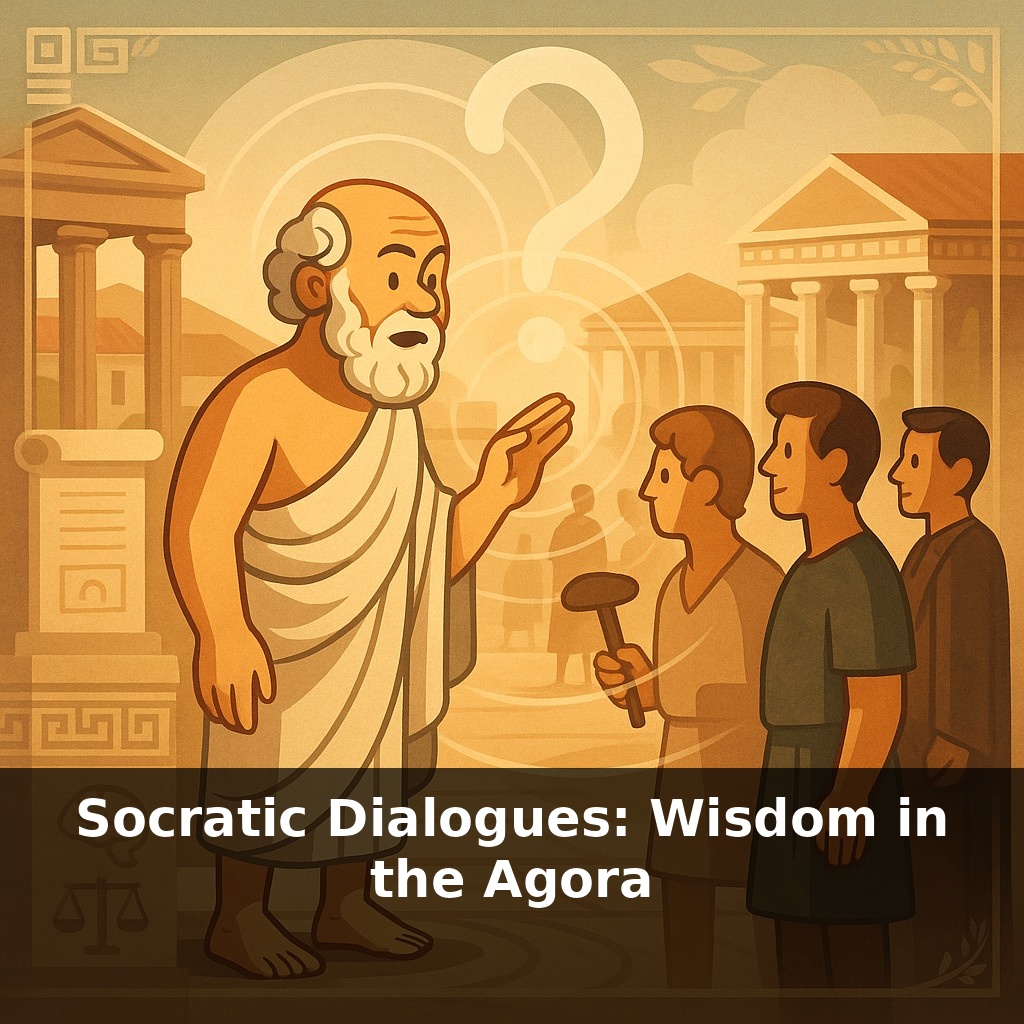
Socrates didn’t just ask questions; he treated everyday opinions like untested prototypes, stress‑testing them in public until they either cracked or emerged sharper. In the Agora, he stopped craftsmen, politicians, and teenagers alike, treating each passerby as a collaborator in a live experiment on what it really means to live well. Instead of lecturing, he exposed contradictions, then handed responsibility back: if your beliefs don’t fit together, what will you change—your life, or your logic? This is where “know thyself” becomes less a slogan and more a relentless audit of your own mind. His method turned casual chit‑chat into a disciplined search for clarity, where losing an argument wasn’t a defeat but an invitation to rebuild your thinking from the ground up.
In that crowded square northwest of the Acropolis, amid vendors shouting prices and citizens trading news of wars and festivals, Socrates treated big ideas like everyday objects you could pick up, turn over, and test for cracks. Instead of retreating to temples or lecture halls, he brought talk of justice, courage, and piety right into the civic bloodstream, stopping people on their way to lawsuits, sacrifices, or council meetings. The Agora could hold around 20,000 people; any of them might suddenly find their casual opinion drafted into a public experiment on what kind of city—and souls—they were helping to build.
Socrates’ favorite move in the Agora was deceptively simple: ask someone who seemed confident about a moral or civic topic—say, a priest about piety or a politician about virtue—to define what they were so sure they understood. Once a neat answer appeared, he pressed: does that hold in every case? What about this exception? His elenchus—literally “refutation”—was less a trick than a stress test: could a definition survive collision with real and imagined cases?
In dialogues like *Euthyphro*, a man heading to prosecute his own father claims to know what piety is. Step by step, Socrates leads him through conflicts: if the gods disagree, can “what the gods love” really define the pious? Each contradiction is a small civic earthquake: if you don’t know what piety is, what exactly are you doing in court today?
This was philosophy with skin in the game. Socrates had marched as a hoplite at Potidaea and Delium; he’d seen what happened when words like “courage” or “loyalty” got tested in battle rather than debate. In the Agora, he brought that seriousness to talk itself: if your life and your city rely on certain values, you’d better be able to say what those values are without collapsing into confusion at the first probing question.
The method was abrasive enough that some Athenians saw it as a civic threat. When 500 jurors gathered to judge him on charges of impiety and corrupting the youth, the vote—about 280 to 220 for guilt—shows how split the city was over whether his questioning strengthened democracy or dissolved its shared assumptions. Was he purifying public reasoning, or dissolving the glue that held the polis together?
What makes these exchanges even stranger is that Socrates himself wrote nothing. Our window into more than two dozen dialogues comes mostly from Plato, who likely used his teacher as both character and instrument. Many scholars think Plato’s later works put bold new theories into Socrates’ mouth, turning the historical gadfly into a kind of dramatic engine for ideas that reach far beyond his original conversations in the marketplace.
Yet that messy origin is part of the legacy. Socratic dialogues don’t hand down fixed doctrines; they model a posture: stand in the middle of your culture’s busiest crossroads and keep asking whether the words everyone relies on—virtue, law, piety, citizenship—actually hold together when pressed from every side.
In a modern classroom, a professor might cold‑call a law student: “You say the statute is clear. Clear how? Would it still be clear if the victim were a corporation instead of a person?” Each answer triggers a new twist until the student’s neat view looks less certain, but more precise. Therapists do sBuilding on Socrates' method, cognitive-behavioral therapy employs a parallel approach: “You’re sure you’re a failure. Compared to whom? Always? What counted as success the last time you felt proud?” The goal isn’t to humiliate; it’s to dislodge automatic stories. In AI research, alignment teams probe models with sequences of edge‑case prompts, watching for hidden contradictions between stated rules and actual behavior. One way to picture this process is like debugging a complex piece of software: you keep feeding in unusual inputs, not to crash the system, but to reveal where its underlying logic bends or breaks, then iteratively refine the code so future decisions rest on more coherent, inspectable reasoning.
Soon, your feed might argue back. Instead of just serving content, systems could pause you mid‑scroll: “You liked this claim—what would change your mind?” News platforms might add interactive “cross‑examination” layers where you and an AI take turns strengthening and attacking a position. In civic forums, town‑hall tools could surface the sharpest unanswered question in a proposal, then invite citizens to co‑author better versions before any vote even happens.
Socratic dialogues hint that wisdom is less a trophy than a training routine: you stay in motion or you lose it. Swap hot takes for slow questions; treat convictions like drafts, not final copies. Your challenge this week: once a day, ask someone to probe one belief you hold—and resist defending it. Just map the questions that survive the first round.