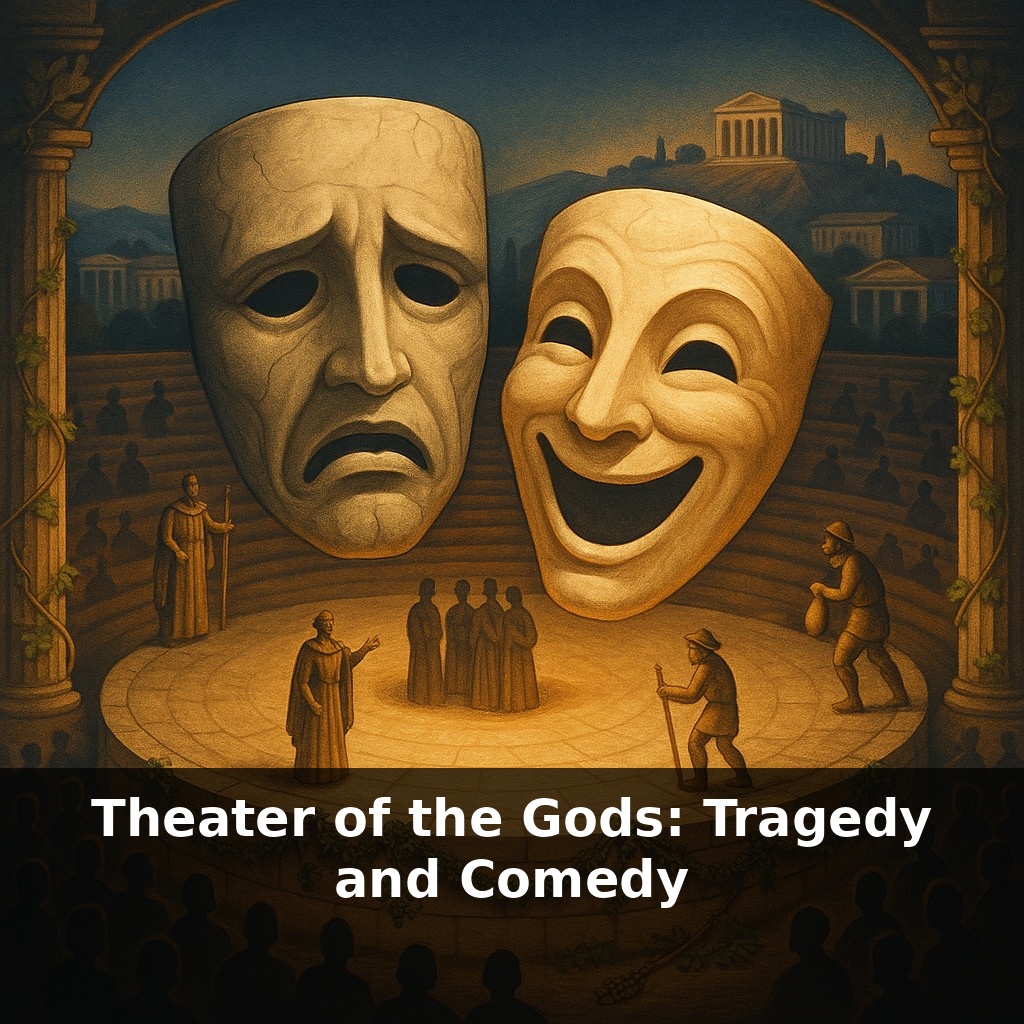
An entire city once gathered to watch gods, kings, and drunk farmers share the same stage. One moment, a king faced a terrible choice; the next, a chorus mocked politicians by name. In this single theater, comedy and tragedy argued over what it really meant to be human.
No tickets, no popcorn, no phones to scroll—yet the stakes were higher than any modern blockbuster. At the spring festival of Dionysus, Athenian citizens didn’t just watch stories; they were woven into them. The city paused lawsuits and politics so thousands could sit shoulder to shoulder, judging not only the plays, but themselves. These performances unfolded under open sky, daylight exposing every mask, every misstep, like harsh office lighting that reveals what soft stage bulbs might hide. The same crowd that voted in the Assembly now voted on which poet best captured their world. Over several days, they watched new works premiere in sequence, following characters across emotional cliff edges and comic collisions, while the judges—ordinary men chosen by lot—held the power to crown a victor and fix his vision into civic memory.
Seats stretched up the hillside in careful rows, cradling a crowd the size of a small modern stadium. From stone benches, spectators could see not only the actors below but also each other, a living backdrop of reactions and loyalties. This wasn’t a dark, anonymous auditorium; it was more like a giant open meeting where everyone’s face was visible evidence of approval, boredom, or outrage. Beneath the performances lay a complex machinery: wealthy choregoi funding singers and training, city officials assigning chorus members, priests overseeing rituals, and poets gambling careers on a single, risky script. Even the gods, it seemed, had front-row seats.
Tragedy stepped onto that stone stage first, draped in the language of heroes and gods. But under the ornate myths, it drilled into problems that felt unsettlingly close to home: What happens when law clashes with family loyalty? How far should you obey the city when you think it’s wrong? Sophocles’ Antigone pits a young woman against a ruler over the burial of her brother—no abstract puzzle for Athenians who had fresh memories of war dead and civic decrees. Aeschylus’ Oresteia traces cycles of blood revenge that end with a law court replacing private vengeance; it’s myth, but also a thought experiment about how a democracy might tame violence without losing justice.
These stories unfolded in strict, almost architectural patterns: prologue, choral entry, alternating scenes and songs, final reckoning. Yet within that frame, poets could twist expectations. Euripides in particular filled his plays with unsettling women, doubting gods, and endings so tangled he sometimes literally dropped a god in by crane to untie the knot. Critics in his own day accused him of corrupting morals; later ages praised him for exposing hypocrisy.
Comedy barged in using the same stage but a different toolkit. Aristophanes armed his actors with obscenity, slapstick, and songs that stuck in the ear like advertising jingles, then aimed them at very real targets: generals, demagogues, even the whole war policy. In The Knights, he skewers the populist politician Cleon so directly that everyone knew who was being roasted under the thin veil of costume. Jokes about jury pay, grain prices, and gossip in the marketplace turned current events into punchlines sharp enough to sting.
The chorus here didn’t just comment; it could confront. In the famous parabasis, they marched forward, broke the story open, and spoke in the poet’s own voice about rivals, lawsuits, and the audience’s taste. It’s as if, midway through a modern film, the director stepped on screen to argue with the critics while the crowd booed or cheered in real time.
Across both genres, masks, music, and dance were not decoration but argument. A single masked face could shift from noble to ridiculous with a tilt of the head; a choral rhythm could tighten anxiety or suddenly release it in laughter. The same physical space, the same daylight, held opposing emotional climates—mourning and mockery—inviting Athenians to test where they stood in between.
Take one well-known day in Athenian life: a jury trial over a disputed inheritance. A tragic poet might spin it into a story about a family cursed by an old crime, ending with a choice between mercy and strict justice. A comic poet could grab the same dispute and turn it into a farce about greedy relatives, ridiculous witnesses, and a legal system drowning in petty cases. Both dramatists start from the same raw event but tune it to different frequencies, like two software engineers taking identical data and building totally different apps—one a risk-analysis tool, the other a meme generator.
We can trace this double vision in specific plays. When Athens grappled with imperial overreach, a tragedian could show a conquering city punished by the gods for hubris, while Aristophanes, in works like The Wasps or Peace, transformed war weariness into jokes about veterans, armistices, and profiteers. The result wasn’t a single moral, but a layered conversation in which no angle fully canceled the others.
Future implications
As AI, VR, and global streaming reshape storytelling, that old Athenian split into serious reckoning and sharp mockery becomes a design choice in every feed. A livestreamed town hall might feel like a sober script; the meme storm around it, a rogue rewrite. If VR reconstructions restore ancient stages, they may double as labs for testing how communities process crisis: slow, searching debate beside chaotic satire—two tools for thinking in public.
In the end, those stone seats trained a whole city to switch modes: solemn one hour, irreverent the next. Today, we binge prestige dramas, then flip to late-night monologues doing something similar with news. Your own reactions—lump in the throat here, sudden laugh there—are like dials, tuning how you face power, loss, and the stories you live inside.
Here’s your challenge this week: Pick one “tragic script” you tend to run in your head (for example, “I’m always the one who’s misunderstood”) and, for three days, deliberately “recast” it as a comedy bit once per day by exaggerating it out loud in a playful, over-the-top way for 60 seconds. Then, choose one minor frustration (a commute delay, a tech glitch, a social awkward moment) and, each time it happens, pause and ask, “If the gods were watching this as theater, what would make this scene funnier or more surprising?” and actually do that one small twist (a ridiculous inner monologue, an exaggerated bow, a mock-heroic narrator voice). By the end of the week, tell one friend the story of your “mini-tragedy turned comedy” as if you’re a playwright explaining how you rewrote the scene for the gods’ amusement.