A single day’s advantage in getting the news once helped a banker tilt the entire British bond market. In this episode, we step onto the noisy floor of 1815 London and ask: when everyone trades on information, what happens when one family hears the cannon fire first?
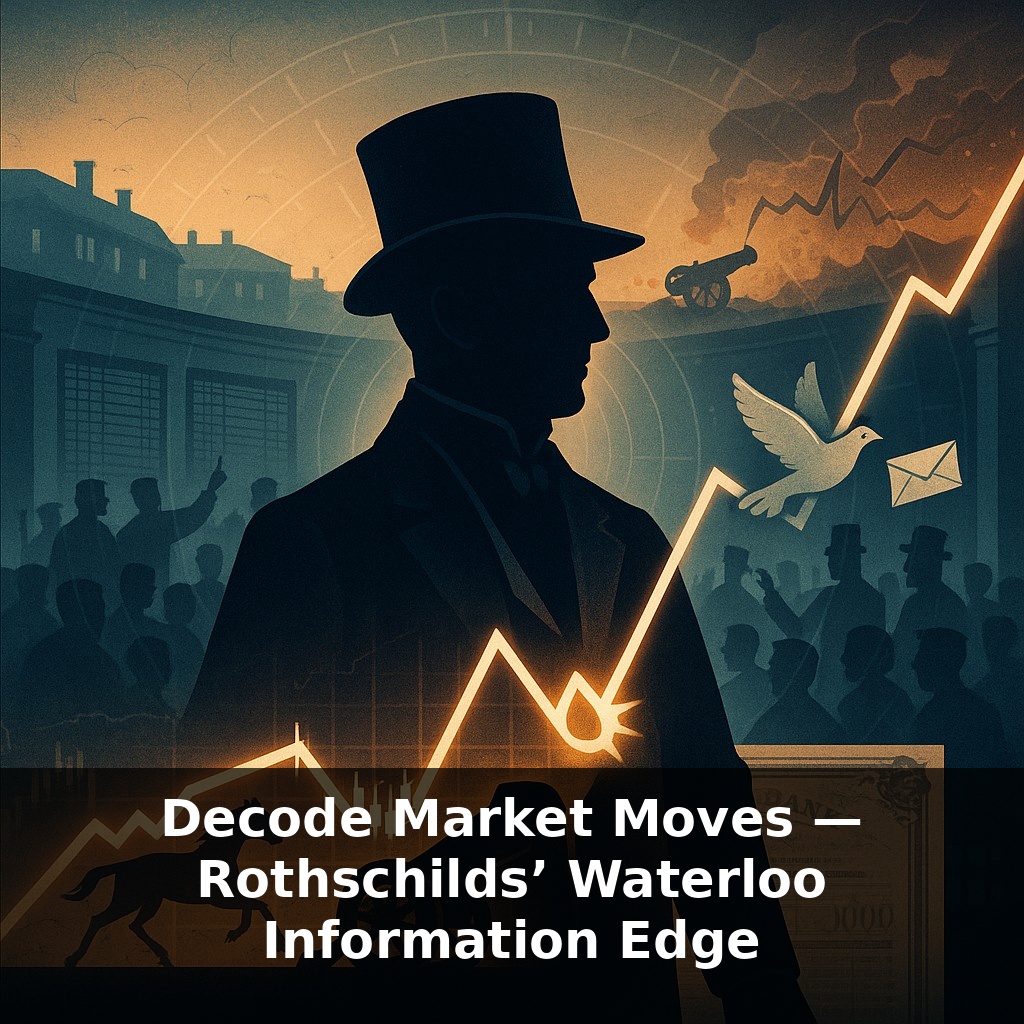
In 1815, news didn’t travel at the speed of light; it moved at the speed of muscle, wind, and wings. Couriers on horseback, ships tacking across the Channel, and, in rare cases, trained pigeons stitched Europe’s battlefields to its banking houses. In that world, being a few hours ahead was not a marginal edge—it was the difference between betting on a victorious empire or a broken one. Nathan Rothschild built a network designed precisely for those hours. While the public stared at the government’s signal flags, he was watching private signals: discreet messengers, prearranged routes, trusted eyes near the front. This wasn’t just fast news; it was a deliberate system for turning distant gunfire into local prices, long before anyone spoke of “high-frequency” anything.
Rothschild’s real innovation wasn’t just hearing first; it was knowing what to do next. His network sifted chaos into conviction. Reports weren’t treated as gospel—each was weighed, cross‑checked, and ranked for reliability. A lone rumor might move his eyebrow; three aligned accounts could move millions of pounds. Think of it as a hierarchy of trust, where each messenger, officer, or diplomat occupied a rung. At the top sat signals strong enough to justify bold action—buying when others froze, or unloading when crowds still cheered, long before any official proclamation reached the public.
The Waterloo episode shows how that hierarchy of trust turned into a concrete trading play. When Nathan Rothschild judged his information strong enough, he didn’t storm into the market with a visible buying frenzy. He started small, through intermediaries, testing how much he could accumulate without tipping his hand. Other dealers watched his orders, but they couldn’t see his reasoning—only his footprints. Was he buying because he knew something, or because he was merely speculating? In a market built on rumors, even his caution became a kind of signal.
Around him, speculation cut both ways. Some investors bet that Wellington had lost and that British finances would unravel; others simply froze, unwilling to commit capital without official confirmation. That paralysis created the conditions for an edge: prices reflected collective uncertainty, not the outcome on the battlefield. Rothschild’s advantage was not just early knowledge that Britain had likely won, but the willingness to translate that probability into a large, visible stance before it felt “safe.”
Here the value of speed becomes clearer: the information decayed with every hour that passed. As soon as the government’s riders arrived and the news turned public, the price of Consols jumped. The gap between the “informed” price and the “official–news” price was his opportunity window. Once it closed, his private insight reverted to trivia—interesting, but no longer profitable.
This basic pattern survives in modern markets, only the tools have changed. Joseph de la Vega’s warning that “news is the soul of the trade” echoes through firms paying millions to shave microseconds off their data feeds. A high‑frequency trader might invest in a faster microwave link between Chicago and New York for the same core reason: to act on a price discrepancy before it disappears. Owning a fleeting lead on reality—whether about a battle’s result or a futures quote—becomes a tradable asset.
Yet the Waterloo story also exposes limits. Speed, by itself, is not a guarantee of correctness or profit. A courier could fall, a report could be wrong, a battle could turn after the message was sent. Acting early magnifies both gains and mistakes. The real skill lies in calibrating conviction to the strength of the signal, and in knowing when the race for speed merely invites you to be first in line to be wrong.
Modern markets hide smaller Waterloos every day, but the battlefields look different. One example: weather data. Commodity desks pay handsomely for slightly earlier, higher‑resolution forecasts on frost in Brazil or heat waves in the U.S. Midwest. A few hours’ lead on a crop shock can justify shifting billions in coffee or corn exposures, long before supermarket prices move a cent.
At the corporate level, some funds specialize in “alternative data”: satellite images of parking lots, credit‑card swipes, even ship‑tracking signals. None of these streams guarantee truth; they’re noisy, partial glimpses. The edge comes from combining them into a coherent picture faster than rivals, then sizing trades according to how clear that picture is.
Speed in this world is closer to a skilled surgeon deciding when to operate. Cutting earlier can save a life—or create needless harm. Waiting brings more information but less room to act. The craft is not just acquiring data, but judging when “fast enough” beats “absolutely certain.”
Regulators now face a twist Rothschild never did: machines reacting faster than most humans can even notice. As quantum links and laser relays narrow delays further, the real fault line may shift from “who is fastest?” to “who is allowed inside the loop?” Think of stadium gates: premium lanes, standard lines, and those left outside. How we design those gates will decide whether markets feel like contests—or closed clubs.
For individual investors, the lesson is quieter but practical: your edge is rarely raw speed. It’s choosing which signals to ignore and which to study until they slow down enough to understand. Algorithms will keep chasing milliseconds; your advantage can be pattern‑spotting—like noticing recurring “weather fronts” in sectors before the storm hits headlines.
Before next week, ask yourself: 1) “If I’d been on the ground at Waterloo like the Rothschilds, where in today’s markets would my ‘early signal’ likely come from—options flow, credit spreads, shipping data, social sentiment, or something else—and how can I start tracking just one of those data streams this week?” 2) “Looking at a position I hold (or want to take), what specific piece of information could give me a *decisive* edge—an earnings detail, a regulatory risk, a supply-chain vulnerability—and where exactly can I go today to dig for that (10-K, alternative data source, expert commentary, etc.)?” 3) “In my current investing process, where do I still act like the crowd—waiting for headlines, price moves, or influencer takes—and what is one concrete way I can flip that, by setting my own ‘information checkpoints’ *before* news breaks?”