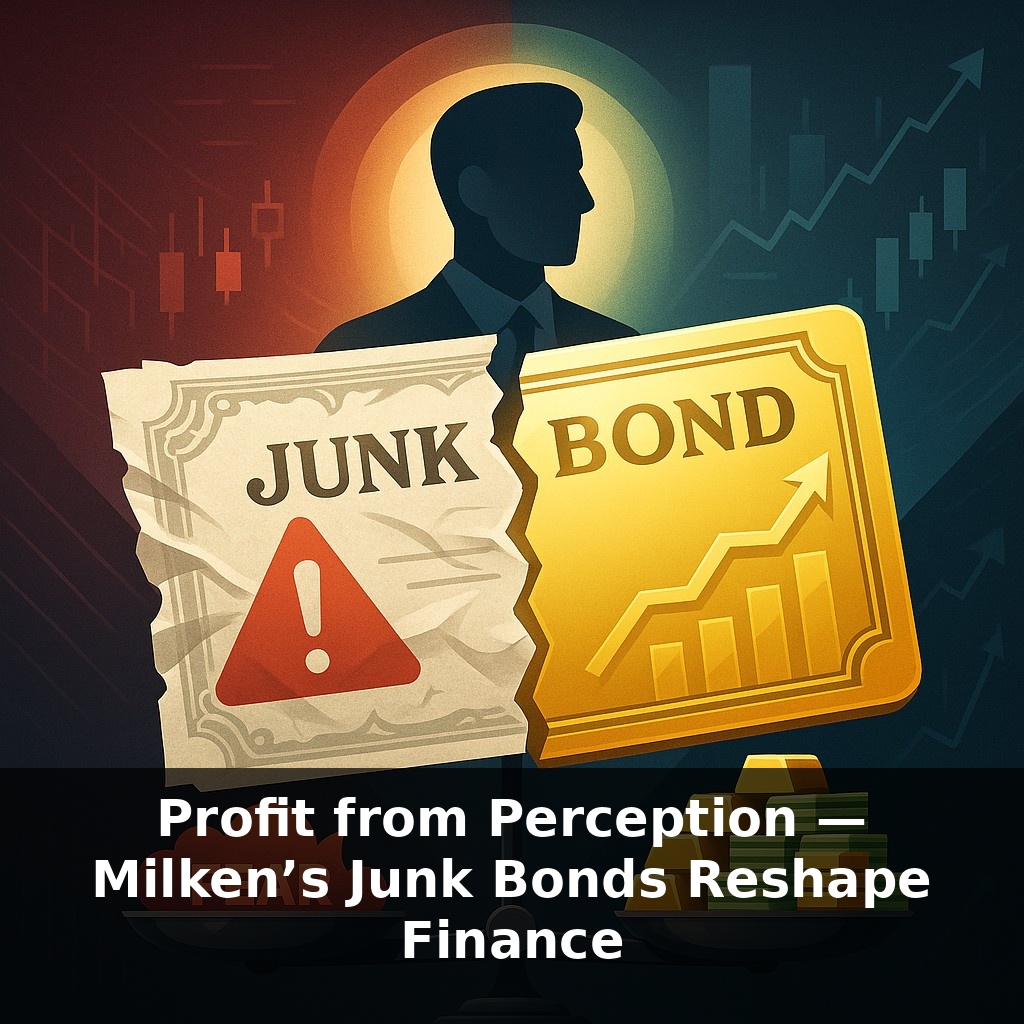
A man once made more in a single year than many small banks—by selling debt everyone else called “junk.” In this episode, we dive into how Michael Milken turned rejected bonds into a powerhouse market, and why your gut feeling about “risk” might be quietly costing you money.
By the late 1970s, Wall Street treated below‑investment‑grade issuers like banned books: technically available, but kept on the back shelf, stamped with a warning label. Milken’s real insight wasn’t just that these credits existed—it was that the label itself was distorting price. Ratings agencies, pension rules, and career risk all pushed capital toward the same “respectable” shelves, leaving a long tail of overlooked companies forced to pay giveaway yields to anyone willing to read past the cover.
This wasn’t some fringe corner case. Over decades, actual default and recovery data quietly undercut the prevailing fear, yet the spread between high‑yield and “safe” bonds swung wildly as moods shifted. In other words, psychology was moving billions. And once someone proved you could systematically profit from that gap, the entire financing playbook for growing businesses—and for takeovers—started to change.
Milken’s key move was to treat the whole capital stack like flexible clay, not a fixed menu. Instead of asking, “Can this company borrow?” he asked, “At what structure does this become a good bet?” That meant staggering maturities, adding features like payment‑in‑kind coupons, and pairing risky slices with safer ones, so different investors could each take the piece that fit their mandates. Think of it as redesigning a crowded city: by rerouting traffic and opening side streets, he allowed capital to reach neighborhoods Wall Street had effectively red‑lined for years.
Milken’s real breakthrough was treating those scary-looking coupons as a math puzzle instead of a moral judgment.
Start with the numbers. From 1983–2022, U.S. high‑yield bonds defaulted about 3.4% per year, with average recovery around 39 cents on the dollar. That combo is painful if you own a single weak issuer—but across a broad portfolio, it’s just another cost of doing business. Milken’s team asked: “How high do coupons need to be so that, after a few blowups and partial recoveries, the whole pool still earns an equity‑like return?” Then they went out and structured deals to hit those targets.
Crucially, they weren’t just buying what already traded; they were manufacturing new supply. Drexel would identify a growing company locked out of traditional funding, design a bond package around its cash‑flow profile, and then pre‑sell that package to institutions hungry for yield. The RJR Nabisco takeover was a dramatic showcase: $4.3 billion of zero‑coupon PIK bonds that deferred cash interest, giving the company breathing room while still compensating creditors on paper.
When spreads blew out—like the 1,800‑plus basis points seen in late 2008—Milken‑style thinking said: “Either defaults and recoveries must get dramatically worse than history, or investors are overpaying for fear.” Conversely, when spreads compressed to record lows near 262 basis points in 2021, the same framework warned that the margin for error was evaporating.
This is where perception and price entwine. The label “junk” scared away many constrained buyers, forcing yields higher than the realized loss experience justified. Milken’s operation stepped into that vacuum, warehousing reputational risk that others wouldn’t touch, in exchange for excess financial return.
One careful lesson for investors: the opportunity wasn’t in pretending credit risk didn’t exist; it was in measuring it more precisely than the market’s mood. Where earlier episodes highlighted information edges or business moats, this story shows a pricing edge: exploiting the gap between how risky something feels and what the statistics actually say over a diversified, long‑run game.
Milken’s twist wasn’t limited to corporate takeovers; it seeped into how entrepreneurs, CFOs, and even landlords think about funding today. A private equity firm deciding whether to use more leverage is essentially running Milken’s playbook in miniature: mapping cash flows, shock‑testing bad years, and asking what mix of debt and equity keeps the whole structure standing.
Consider a fast‑growing software business deciding between a dilutive equity round and a high‑coupon term loan. The founders who understand this history don’t just ask, “Is this expensive?” They ask, “What failure rate is the lender implicitly pricing in, and do we believe we’re that fragile?” That same lens now shows up in areas Milken never touched directly: private credit funds lending to mid‑market companies, real‑estate sponsors layering mezzanine tranches, even infrastructure projects tapping long‑dated high‑yield.
Your challenge this week: when you see a headline about “risky” debt or a scary spread chart, pause and sketch the implied story. What disaster path is the market baking in—and do you actually buy that script?
Milken’s legacy is now colliding with new tools and new frontiers. AI‑driven credit models can scan thousands of issuers, hunting for tiny gaps between fear and fact. As banks retreat, sprawling private‑credit funds step in, quietly shaping which companies live or die. Green high‑yield issues add another twist: investors are no longer just pricing cash flows, but climate and regulation too—like reading not only today’s weather, but the storm systems forming just off the map.
Milken’s story hints at a broader habit to cultivate: whenever the crowd treats an asset like a haunted house, check whether the ghosts are priced like a thriller or a children’s cartoon. The same skill applies to frontier areas—crypto lending, emerging‑market debt, even carbon credits—where fear, fashion, and regulation still tug prices away from cold arithmetic.
Here’s your challenge this week: Pick one publicly traded company today that has a below–investment-grade (junk) credit rating and download its latest annual report plus a recent bond prospectus. Using Milken’s lens, calculate its leverage ratio (total debt / EBITDA) and compare the bond’s yield to current yields on investment‑grade corporate bonds. Then, write a 3-sentence investment thesis that argues either “this is a misunderstood, Milken-style opportunity” or “this is a value trap,” backing it up with one concrete risk and one concrete upside drawn from the documents.