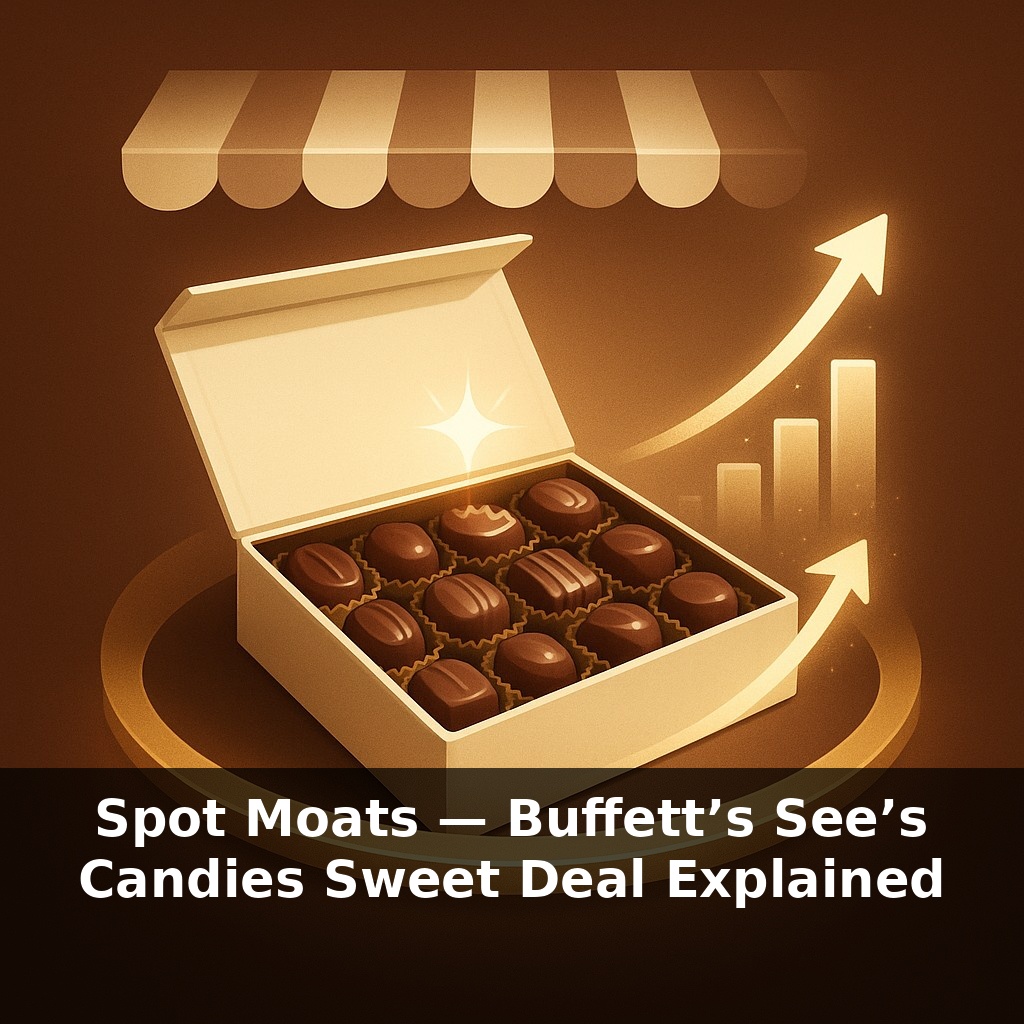
“Your best investment might be a small chocolate shop,” Warren Buffett once joked. In the early seventies, he bought a modest West Coast candy company. Decades later, that quiet deal had thrown off cash worth far more than the original purchase price—without massive expansion.
Warren Buffett once said, “The ideal business is one that takes no capital and yet grows.” See’s Candies came surprisingly close to that ideal. By the time Berkshire owned it, See’s didn’t need shiny new factories or a national rollout to become more valuable. It needed something quieter and harder to copy: customers who *insisted* on See’s, especially on holidays when the box itself carried emotional weight.
In earlier episodes, we saw how stories move markets and how information timing can tilt outcomes. Here, the “edge” isn’t a faster quote or a secret tip—it’s the slow, stubborn strength of a brand that lets you nudge prices up a little each year, like turning a dimmer switch, while demand barely flickers. Understanding why that works is key to spotting businesses that quietly compound in the background.
So how did See’s turn that quiet strength into hard numbers? Start with the simple act of raising prices. A weak brand hikes prices and watches buyers drift to cheaper shelves. See’s pushed prices 4–6% a year, often faster than inflation, and customers largely stayed. Like a chef trimming a recipe, they adjusted portions, recipes, and packaging just enough to protect quality while widening gross margins from roughly 25% to over 40% within two decades. Volumes didn’t need to explode; each box simply contributed more profit that Berkshire could send elsewhere to work.
Buffett didn’t always hunt for this kind of business. Earlier in his career, he was a “cigar butt” investor: pick up discarded companies cheap, take a few remaining puffs of profit, then toss them. See’s helped pivot him toward paying up for endurance instead of bargains that burned out.
On paper, the 1972 deal looked almost uncomfortable to him. He was used to buying at low multiples of earnings; See’s carried a richer tag because the sellers knew they had something special. What edged him over the line wasn’t a spreadsheet tweak but the *behavior* he and Charlie Munger observed: customers driving past other options to reach a See’s shop, people unwilling to substitute when gifting, regional holidays where the brand felt almost mandatory. Those patterns hinted that price tags were only half the story; the other half lived in customers’ heads.
From there, the numbers started telling a different kind of tale. Instead of pouring money into new locations across the country, See’s funneled much of its internally generated surplus back to Omaha. Berkshire then placed that surplus into very different arenas—insurance float, public stocks, later even capital-intensive businesses—where high returns could be earned on someone else’s balance sheet. See’s didn’t just succeed *itself*; it became a funding engine for Buffett’s next decisions.
Notice what *didn’t* happen: See’s never became a coast‑to‑coast behemoth with thousands of outlets. Competitors appeared, supermarket aisles filled with alternatives, diet trends came and went. Yet the core franchise stayed tight and profitable because it defended the part of the business others struggled to touch: the emotional real estate in customers’ minds.
This is the deeper lesson: sometimes the most powerful edge isn’t visible in the product specs or the store count. It hides in small, repeatable evidence that buyers are granting a company quiet privileges—tolerance for higher prices, preference in special moments, patience when mistakes occur. Spot those early, and a plain-looking business can suddenly deserve a far less plain valuation.
Think about places where you *quietly accept* paying more without much comparison shopping. That’s where moats often hide. A few non‑obvious candidates:
A neighborhood coffee shop that hardly advertises, yet always has a line at 8 a.m. When rent rises, they add 25 cents to every drink and the queue barely shortens. That tiny change, multiplied by hundreds of cups a day, funds their next move—better staff, a second location, or simply a healthier balance sheet.
Or a niche software tool used by accountants every filing season. Switching would mean retraining staff, risking errors, and redoing workflows. So when the annual subscription creeps higher, firms grumble—but pay. Over a decade, that reluctant tolerance can turn a small codebase into a cash fountain.
You can even see early hints in creators and newsletters: when followers stay through price tiers, optional tips, or paid upgrades, you’re watching a miniature version of See’s logic play out in real time.
As more of the economy shifts to code, data, and communities, moats start to look less like walls and more like deep-rooted vines: hard to see from afar, difficult to rip out once entangled. See’s hints at a future where the scarcest asset isn’t capital but *permission*—the quiet consent from users that “this is the default.” Watch how often products become verbs, how rarely core apps get deleted, how smoothly subscriptions renew; those frictions—or lack of them—are tomorrow’s See’s-style signals.
Your challenge this week: spot three “quiet toll booths” in your own spending. Look for services where you never hunt coupons, rarely compare alternatives, yet renew on autopilot—like a streaming bundle or go-to takeout. Then ask: if they raised prices 5% tomorrow, would you actually switch? That instinct is where modern moats start.