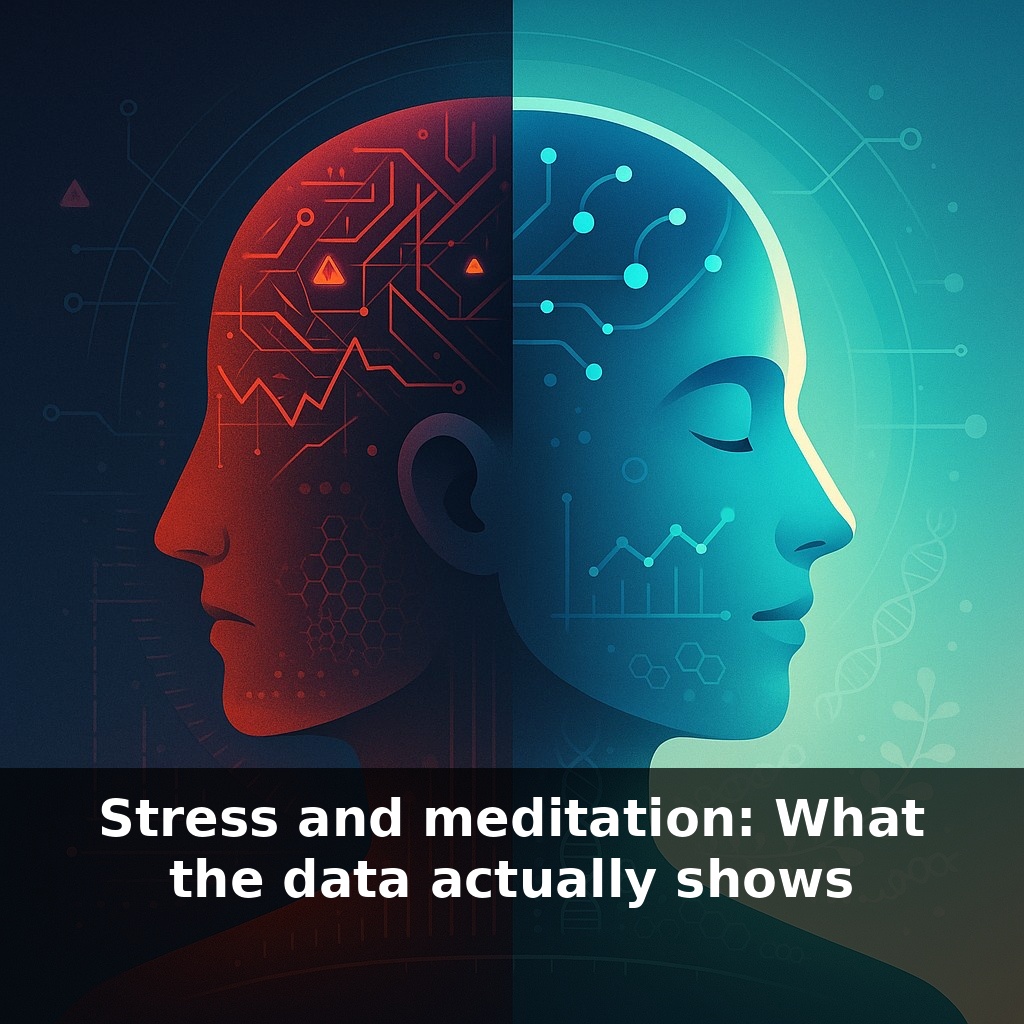
Under chronic stress, your body can age faster than your passport says—down to your cells. Now picture three versions of you: one stuck in daily chaos, one pausing for a few mindful minutes, and one treating meditation like a vital sign. Which one lives longer?
Here’s the uncomfortable twist: your body doesn’t just react to stress in the moment—it keeps a running “wear-and-tear” score, and that score predicts how long you’re likely to stay alive. Large studies now show that people reporting high, unrelenting stress before age 60 face a 43% higher risk of dying early, even after accounting for smoking, weight, and exercise. In other words, two people with identical habits can age very differently, simply based on how their nervous systems spend the day. What’s new is that we can now track this difference in lab values, not just feelings: patterns in inflammation, hormone rhythms, and cellular repair all shift in measurable ways. And here’s where structured mental training enters the picture—not as a vague wellness trend, but as a candidate lever for changing those numbers.
Here’s the twist that rarely makes it into wellness headlines: we now have enough data to treat stress management less like self-care and more like a modifiable risk factor, alongside blood pressure and LDL. Large cohorts and controlled trials point in the same direction—dialing down reactivity isn’t just about feeling calmer; it’s about shifting odds on who gets heart disease, who develops metabolic issues, and who recovers faster after illness. Instead of chasing “stress-free” lives, the more realistic (and testable) goal is training how quickly your system returns to baseline after daily hits. That recovery speed is what modern studies are starting to quantify.
Here’s where the numbers get interesting. When researchers stop asking, “Do people *feel* better?” and instead ask, “Do their bodies *behave* differently?”, three patterns keep showing up.
First, the threat response itself shifts. In lab tasks designed to spike anxiety—public speaking, mental math under pressure—people who’ve completed even an 8‑week mindfulness course show smaller cortisol surges and faster recovery afterward. That 0.25 µg/dL average drop in baseline salivary cortisol from MBSR isn’t just a trivia point; it maps onto lower blood pressure, better sleep architecture, and less abdominal fat over time in follow‑up studies. The signal is modest per person, but when you scale that across years, it resembles the kind of risk nudges we accept as meaningful for diet or walking.
Second, the “slow burn” of inflammation appears to cool. Black and Slavich’s review pulled together randomized trials where participants didn’t just sit quietly—they learned to notice reactions in real time and let them pass. Across those studies, IL‑6 and CRP, two key inflammatory markers, dropped by roughly a third within a few months. That scale of change is similar to what some people get from starting a statin or losing a clinically significant amount of weight, which is why cardiology and oncology groups are paying attention, not just psychologists.
Third, there’s the cellular maintenance story. The Ornish work often gets over‑simplified, but the nuance is more compelling than the headlines. Meditation in that program wasn’t isolated; it lived alongside nutrition, movement, and social connection. Telomerase activity rising 29% in three months suggests that mental training may amplify other behaviors’ impact, rather than operating as a standalone fix. Newer trials that strip away the diet piece still show smaller yet consistent boosts in telomerase, hinting at a direct effect worth refining.
The observational mortality data, like the Harvard cohort showing a 7% lower all‑cause death rate among regular meditators, sit on top of these mechanisms. They can’t prove causality, but they do echo what we’d predict: slightly calmer stress chemistry, slightly cooler inflammation, slightly better cellular upkeep—compounding into slightly longer lives. Not miraculous, not negligible, and crucially, achievable in weeks to months, not after years in a monastery.
A useful way to see how this plays out is to look at specific people rather than theory. In one cardiac rehab clinic, patients who added a brief, eyes‑open breathing practice in the waiting room—five minutes before blood‑pressure checks—saw enough reduction that several avoided medication escalation over 6–12 months. In an oncology unit, a hospital introduced 10‑minute guided awareness sessions via bedside tablets; nurses reported fewer after‑hours anxiety calls, and patients requested less short‑acting sedative medication. Tech companies have experimented too: one firm embedded 3‑minute “micro‑pauses” before high‑stakes meetings; over a quarter reported fewer stress‑related migraines at six months. Think of it like adjusting the “gain” on an audio mixer: you’re not deleting the soundtrack of a hard day, but you’re turning down distortion so the system doesn’t blow a speaker every time there’s a spike in volume.
A quiet shift is coming: stress‑aware tech, short-form practices, and policy are starting to intersect. Instead of generic wellness apps, next‑gen systems may adapt like a navigation app rerouting around traffic—spotting your personal “rush hours” and offering two‑minute resets before damage stacks up. Trials are now testing whether employers, insurers, and clinics can fold these tools into routine care, not as perks, but as core infrastructure for extending healthy working years.
So the open question isn’t “does this work?” but “how precisely, and for whom, does it move the needle on lifespan and healthspan?” Future trials will likely splice practices as finely as a DJ isolates tracks—testing duration, timing, and individual traits—to see who benefits most, and how these tools can be woven into daily life without feeling like another task.
Before next week, ask yourself: “When during my day do I actually notice my stress spike the most (e.g., right after checking email, during my commute, before bed), and where could I realistically insert a 5-minute, ‘eyes-closed, focus-on-breath’ session right there?” “When I try a short, data-backed practice like 10 slow diaphragmatic breaths or a 10-minute guided meditation today, what do I notice in my body and mind within the first 3 minutes, and again 30 minutes later?” “If I treated this like a 7-day experiment instead of a forever habit, what specific time, place, and app or technique from the episode (e.g., basic breath counting, body scan, or non-sleep deep rest) will I commit to testing, and how will I decide at the end of the week whether it actually helped my stress?”