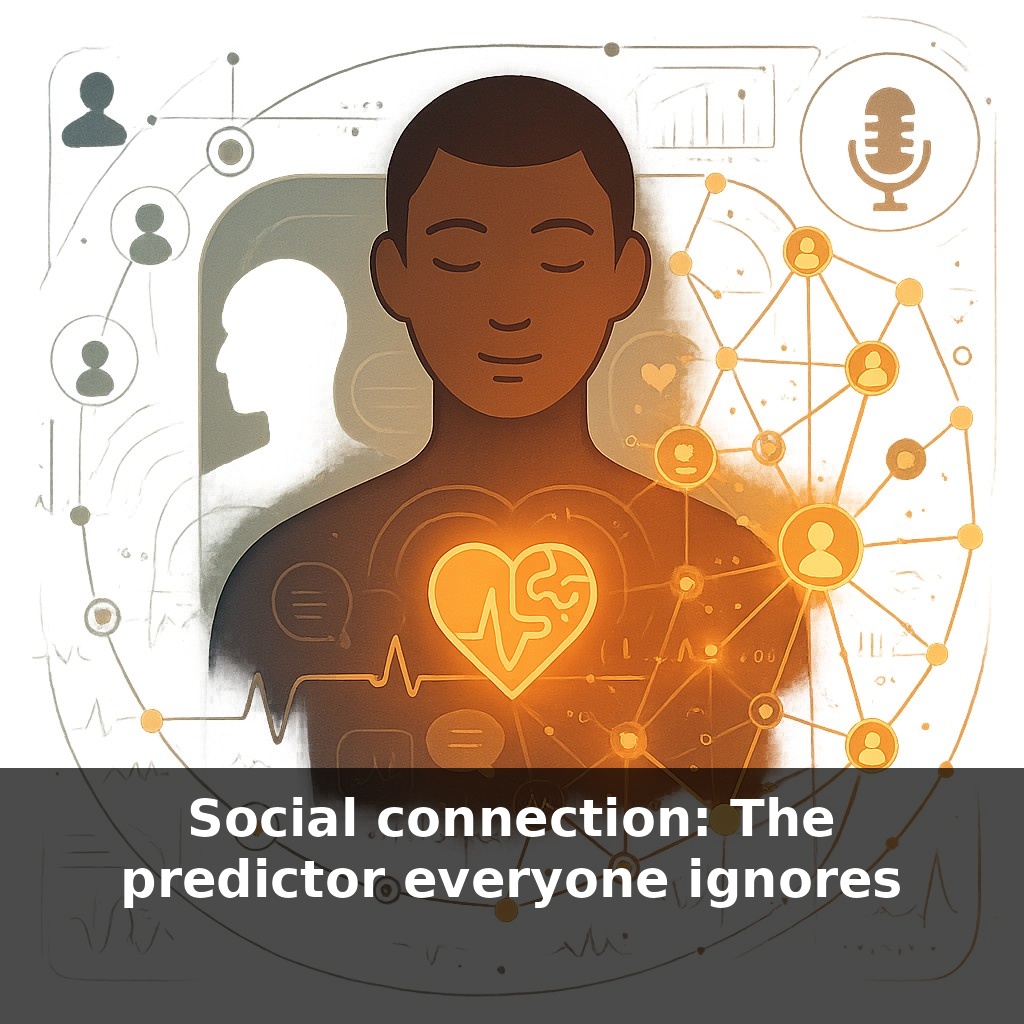
Your risk of dying early jumps by about a third—not from smoking, not from junk food, but from lacking strong social ties. You can track your steps, your sleep, your heart rate. But here’s the paradox: the quiet habit that rivals all of them is whether you regularly talk to anyone.
Here’s the twist: your body is already keeping score of your relationships, whether or not you are. Blood pressure edging up in traffic but dropping during a walk with a friend; immune cells dialing down inflammation after a warm conversation; your brain’s threat circuits going quiet when someone has your back. These aren’t poetic ideas—they’re measurable shifts, as real as a change in cholesterol.
Yet most health plans look like a solo project: optimize your diet, your workout, your sleep. It’s like trying to perform a duet as a one-person band—possible, but you’re missing half the music. If connection is this biologically powerful, the question changes from “Do I have friends?” to “How is my body responding to the relationships I practice every day?” In this episode, we’ll treat your social life like a vital sign—and show you how to tune it with the same precision you bring to your biomarkers.
Here’s the part most people miss: your health doesn’t just respond to *whether* you see people, but to the microclimate of every interaction. A rushed check-in that leaves you tense lands very differently in your body than a five-minute, undistracted chat where you feel genuinely heard. Think of your day as a timeline dotted with “green” and “red” moments—subtle cues of safety or strain. Was that meeting collaborative or covertly hostile? Did dinner feel like a team huddle or a silent performance review? Over weeks and years, those tiny emotional temperatures quietly rewrite your health trajectory.
Here’s where the data gets uncomfortably concrete. In the big meta-analyses, “social connection” isn’t some fuzzy vibe—it breaks down into three levers you can actually adjust: **structure**, **support**, and **satisfaction**.
**Structure** is the skeleton of your relational life: how many roles you occupy and how regularly they put you in contact with others. Spouse or partner, coworker, neighbor, teammate, sibling, fellow volunteer—each role is a separate “node.” People who span more of these roles don’t just report feeling better; they show lower chronic inflammation and are less likely to catch infections in the first place. It’s not about collecting people—it’s about not putting all your relational eggs in one basket.
**Support** is what those roles *do* under pressure. When something goes wrong—a health scare, job shock, or just a bad Thursday—who responds, and how quickly? Studies find that it’s the *perceived* availability of help that tracks most strongly with longevity: knowing “someone would show up if I needed them.” That expectation changes how your body appraises threat in real time. Interestingly, even small, specific forms of help—someone who reliably drives you to appointments, or a colleague who always reviews your slides—predict lower physiological wear and tear.
**Satisfaction** is the quiet deal-breaker. Two people can both be married, both see friends weekly, both attend gatherings—yet have dramatically different health trajectories. The difference often lies in whether interactions feel emotionally safe and reciprocal. High-conflict or chronically critical relationships are associated with higher markers of systemic stress than being single. In some cohorts, a hostile marriage predicted cardiac events more strongly than classic lifestyle risks.
Here’s the overlooked twist: weak ties matter too. The barista who knows your order, the neighbor you wave to, the coworker you only chat with before meetings—these “lightweight” connections are linked to better mood regulation and sharper cognitive function, especially later in life. They don’t replace depth, but they smooth the edges of isolation in ways your nervous system registers.
When you zoom out, a clear pattern emerges: it’s not one heroic relationship that protects you; it’s a *portfolio*—diverse, dependable, and, above all, genuinely nourishing.
Think about the last week: not the headline moments, but the in‑between ones. The neighbor you helped carry groceries. The friend who sends memes when you’re quiet for a few days. The colleague who always loops you in on opportunities without being asked. Each of these is a different “channel” your body learns to rely on.
Research on disaster recovery shows that people with overlapping circles—work, neighborhood, hobby groups—rebuild faster after shocks, even when income and age are the same. It isn’t because they’re more optimistic; it’s because information, practical help, and emotional steadiness arrive from multiple directions.
You can see the same pattern in small, ordinary choices: joining a weekly class instead of a one‑off event; starting a standing coffee with a sibling instead of “catching up sometime.” In music terms, you’re not hunting for a single perfect soloist; you’re quietly assembling a small ensemble that can keep playing, even when one instrument drops out.
Cities, clinics, even algorithms may start treating your relationships like critical infrastructure instead of background noise. Zoning codes could favor “social corridors” the way they now protect traffic flow: benches, pocket parks, shared courtyards that invite lingering. Hospitals might prescribe group visits or choir rehearsals alongside medication. As AI tools map who actually shows up in your week, your “relational pattern” could become as actionable—and adjustable—as a sleep report.
So the experiment isn’t to become “more social,” but to design a life where support shows up almost by default. Think less about fixing loneliness, more about installing tiny social habits—like seasoning scattered through a meal. Over time, those patterns can reshape what your body expects from the world: less siege, more backstage crew, always setting the stage for repair.
Before next week, ask yourself: 1) “Whose name came to mind during this episode—the person I miss, worry about, or feel quietly distant from—and what is one specific question I could ask them (not ‘How are you?’ but something like ‘What’s been the highlight of your week?’) that would invite a real answer?” 2) “Where in my day do I already bump into people—on my commute, at the gym, in a Slack channel—where I could turn a quick interaction into a 60-second ‘micro‑connection’ by offering a genuine compliment or sharing one honest sentence about how I’m really doing?” 3) “If I treated social connection like sleep or exercise—a non‑negotiable health behavior—what 10-minute ‘connection appointment’ could I add to my calendar this week, and who will I choose to call, text, or voice note during that exact time?”