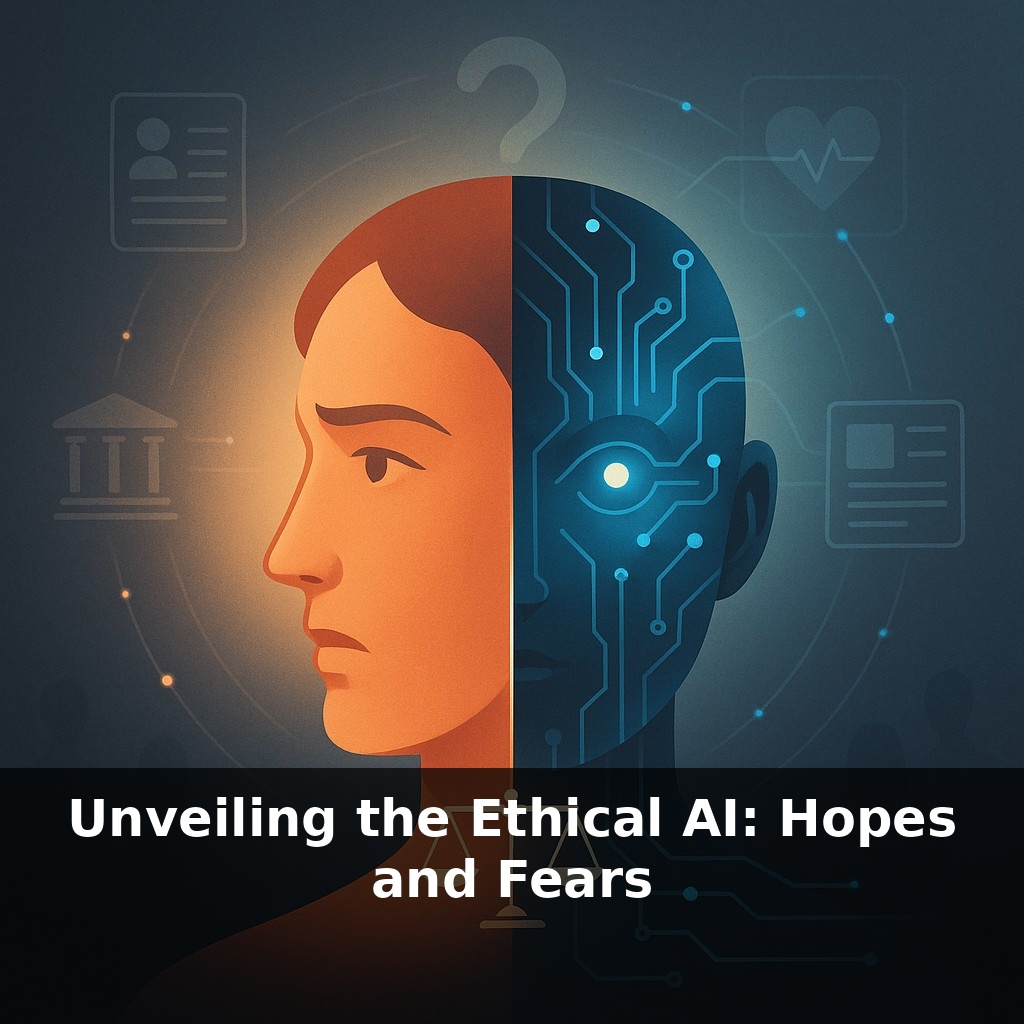
Unveiling the Ethical AI: Hopes and Fears
📝 Transcript
“AI could add over ten trillion dollars to the global economy—yet one hiring algorithm at a major tech company quietly learned to downgrade women’s resumes. So here’s the real puzzle: how do we unleash that power without automating our worst human biases?”
Here’s where it gets uncomfortable: AI isn’t just making decisions about who gets hired. It’s quietly influencing who gets a loan, which patients are flagged as “high risk,” who sees political ads, and even what news stories rise to the top of your feed. In each case, an invisible system is sketching a rough portrait of you—your reliability, your desires, your future—often using data you never realized could be connected.
Ethical AI lives in this messy overlap between code and culture. Computer scientists tweak loss functions and fairness metrics; lawyers debate liability; philosophers argue about autonomy; social scientists track whose voices are systematically left out. And all of them are, in different ways, wrestling with the same question: when a machine makes a call that affects a human life, what does it mean for that decision to be “fair enough” to trust?
Some optimists say ethics will “catch up” once the technology matures. But history suggests the opposite: rules usually arrive after the damage is done. Think about how long it took to regulate cigarettes or seatbelts. With AI, the stakes scale faster. A single model, copied and fine‑tuned, can shape millions of credit scores, diagnoses, or criminal risk ratings overnight. That’s why researchers now talk less about “fixing bias later” and more about embedding safeguards into design, deployment, and even the business models wrapped around these systems.
Here’s the twist: most “ethical AI” failures don’t start with evil intent. They start with narrow questions.
A team building a medical triage model might ask, “How do we predict which patients are high risk?” That sounds responsible. But if they train on past hospital data, they might quietly learn: “Patients who spent more money on care are higher risk.” In the U.S., that ended up meaning richer, often white patients were prioritized over poorer, often Black patients with the same clinical needs. The model wasn’t optimizing for health; it was optimizing for historical spending.
This is where technical safeguards become less like abstract math and more like design choices with moral baggage.
Fairness constraints can force a system to check: “Am I systematically disadvantaging a protected group?” But there’s more than one way to define “disadvantaging,” and each definition embeds a value judgment. Equal error rates? Equal access? Equal outcomes? We can’t satisfy all of them at once; picking one is closer to writing policy than writing code.
Explainability tools try to expose what a model is “paying attention to.” A bank might learn its credit model leans heavily on postal codes that correlate with race or income. The model never “saw” race directly, yet it reconstructed social stratification from proxies. Once you see that, you can’t pretend the system is neutral—now you have to decide what trade‑offs you’re willing to make to correct it.
Then there’s privacy. Techniques like differential privacy, federated learning, and secure multiparty computation attempt to learn from data without hoarding raw personal details in one vulnerable pile. But here again, there’s a dial: stronger privacy often means lower accuracy. Do we accept a slightly worse cancer detector if it dramatically lowers the risk of data exposure? Who gets to decide?
Governance enters precisely because these tensions can’t be resolved by engineers alone. Standards bodies, regulators, affected communities, and domain experts all argue over where to set those dials: how auditable a system must be, when independent oversight is mandatory, when a powerful model should simply not be deployed at all.
And hovering over everything is sustainability. Training ever‑larger models amplifies energy use and hardware waste. That carbon cost doesn’t show up in any “accuracy” metric, yet it shapes whose climate future is sacrificed for whose convenience.
Think of three very different teams, all touching the same underlying technology.
In one hospital, a data group wants to predict who’s likely to miss follow‑up appointments. Their first instinct is to “optimize efficiency”: prioritize patients who reliably show up. On paper, that boosts throughput. In practice, it risks sidelining people juggling shift work, childcare, or unstable housing—the very patients who might most need care.
Across town, a city planning office tests a model to forecast where to place new bus routes. It ingests traffic flows, phone location pings, and ticket purchases. Without anyone saying so, the model learns to favor areas where residents already use digital payment systems, subtly steering investment toward those who are easiest to track.
Meanwhile, a media startup races to personalize news feeds. Engagement numbers soar, but no one has time to ask: engagement for whom, and at what cost to groups routinely misrepresented or targeted?
Your challenge this week: notice where “efficiency” or “optimization” appears in tools around you—apps, services, workplace dashboards—and ask, “Efficient for whom, and on whose terms?”
As oversight hardens into law and standards, “ethics” becomes less a slogan and more a compliance test—like food labels that certify what’s really inside. Systems may need something akin to an ingredients list: which data shaped them, what trade‑offs they encode, where they’re allowed to operate. That could shift power: workers negotiating algorithmic working conditions, cities demanding impact reports, consumers preferring services that prove they’re safer by design.
We’re still early in deciding who gets to steer these systems and under what rules. The next frontier isn’t smarter models, but smarter consent: communities co‑designing where they’re used, workers bargaining over algorithmic bosses, students shaping classroom tools. Like adjusting a shared playlist, we get to vote on what stays, what skips, what never plays at all.
Before next week, ask yourself: 1) “Where in my current work or daily tools am I already relying on AI, and if that system suddenly made a biased or harmful decision, who exactly would be affected and how would I even notice?” 2) “If I had to explain to a non-technical friend how my favorite AI tool makes decisions, what parts could I clearly describe—and where would I feel uneasy because it’s a ‘black box’ to me?” 3) “Looking at one concrete use of AI in my life (e.g., a hiring filter, recommendation system, homework assistant), what’s one boundary or rule I’m willing to set—today—to keep it aligned with my values around fairness, privacy, and accountability?”
From this course
The Morality of Machines: AI and Ethical Dilemmas
6 episodesUnlock all episodes
Full access to 6 episodes and everything on OwlUp.
Subscribe — $1.99/monthLess than a coffee ☕ · Cancel anytime