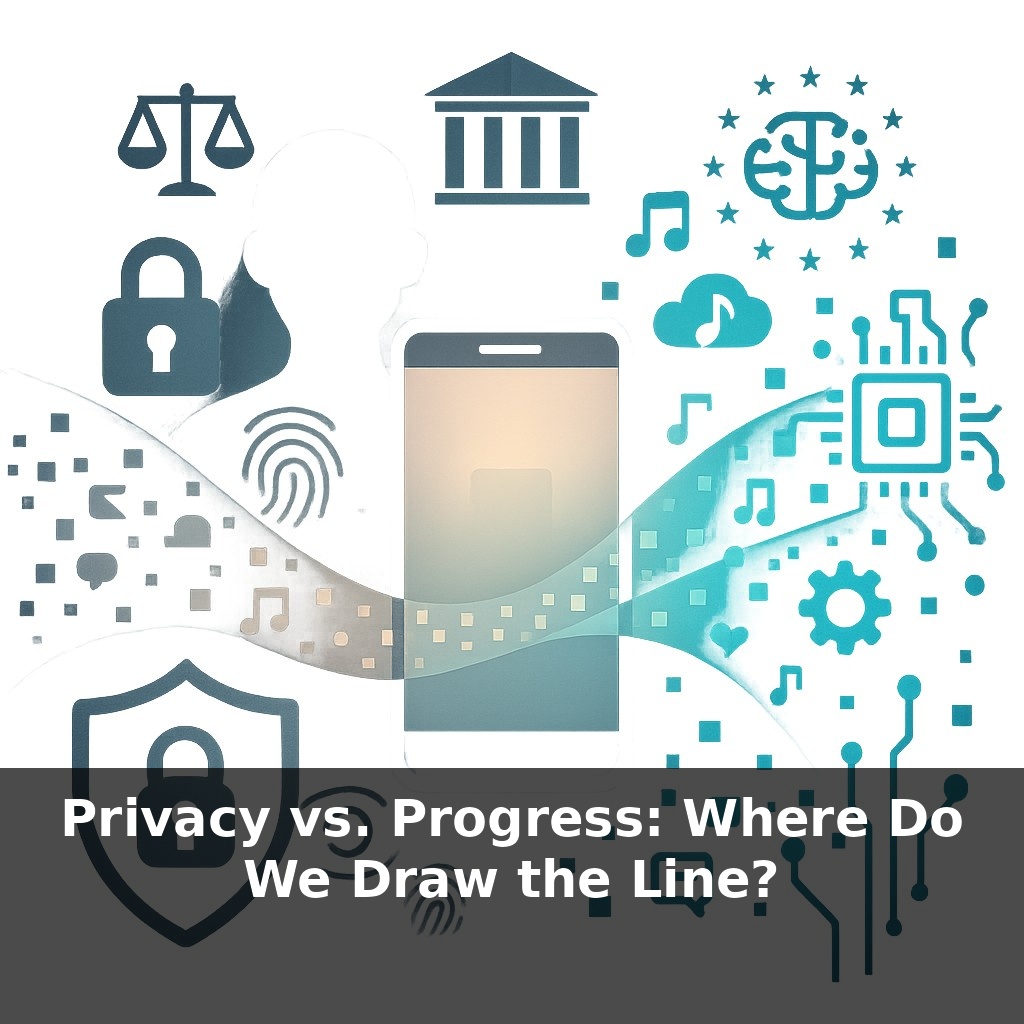
“About two-thirds of people online feel they’ve lost control of their own data—yet our smartest machines learn by devouring more of it every day. You’re unlocking your phone, streaming music, sending a message… and silently voting on how much privacy you’re willing to trade for progress.”
Governments have noticed this quiet trade, too—and they’re starting to push back. The EU’s GDPR has already led to billions in fines, not just for shady data brokers, but for household-name tech giants that treated personal data as an endless free resource. At the same time, some companies are racing the other direction: Apple now runs huge numbers of Siri requests directly on your device, trying to learn from patterns without sucking every raw detail into the cloud. Meanwhile, firms like Clearview AI built massive face-recognition datasets by scraping tens of billions of photos from the public web—provoking lawsuits, bans, and public outrage. We’re watching, in real time, a tug-of-war between “collect everything first, ask forgiveness later” and “prove you deserve even a sliver of my data.”
Lawmakers, engineers, and ethicists are now wrestling with a deeper question: what *kind* of progress are we willing to accept as the price of reduced privacy? AI systems promise medical breakthroughs, smoother cities, even personalized education, but many of these gains depend on patterns hidden in intensely intimate traces of our lives—location histories, biometrics, private messages. New tools like differential privacy, federated learning, and homomorphic encryption try to square the circle: keep data useful in the aggregate while shielding individuals, like blurring a crowd photo so no single face can be cleanly picked out.
Here’s the strange twist: privacy and progress are often framed as mortal enemies, but the most interesting work in AI right now treats them as co‑workers who argue a lot—and still ship products together.
Start with the assumption many companies quietly make: *more data automatically means better AI*. History keeps proving that wrong. Clearview’s enormous photo trove triggered bans and lawsuits that scared off potential partners; some hospitals sat on valuable datasets because patients simply didn’t trust how they’d be used. In both cases, “progress” stalled—not because the tech failed, but because the social license to use it evaporated.
That’s why the most durable advances are looking less like land-grabs and more like negotiated treaties. Health projects that let patients audit when their records were accessed have seen higher participation rates. Finance firms building fraud-detection models increasingly separate who sees *raw transactions* from who sees *model outputs*, so no single team holds the full picture of a person’s life. Governance, in practice, becomes another design layer: you don’t just ask “Can we model this?” but “Who can query it, under what rules, with which logs?”
Legal frameworks are starting to harden those questions into obligations. New AI regulations talk about “high‑risk” systems—credit scoring, biometric ID, hiring tools—that must pass through impact assessments, documentation, and human oversight. Think of it as a pre‑flight checklist for algorithms: if you’re going to touch someone’s livelihood or body, you don’t get to say, “Trust us, it’s proprietary.”
The paradox is that constraints can spark creativity. Apple’s push to keep more processing on-device forced engineers to optimize models for limited hardware—and those optimizations now benefit everyone building smaller, faster systems. The DP‑3T approach to contact tracing showed governments that they could coordinate on standards without demanding centralized name-and-location registries.
All of this nudges us toward a new baseline norm: progress isn’t just accuracy metrics and revenue; it’s whether people can live with the systems around them without feeling constantly watched. Privacy becomes less a brake and more a steering wheel—shaping *where* AI is allowed to go, and how long the public will tolerate the ride.
A useful way to test the boundary is to watch who *benefits* from crossing it. When a hospital trains a diagnostic model on decades of scans but returns faster, more accurate results to the same community—and lets patients opt out—that’s one kind of deal. When a social app mines private chats to nudge you toward ads, with no real way to say no, that’s another. The technical stack can look similar; the moral math does not.
Some transit agencies now simulate crowd flows using synthetic passengers—statistical stand‑ins shaped like real riders, but not tied to any one commuter’s trip. Credit‑scoring startups experiment with “data diets,” deliberately shrinking the number of signals they ingest and publishing what they *refuse* to collect. And a few messaging platforms open‑source their encryption designs so outside researchers can probe for weaknesses.
Training AI on personal data without safeguards is like a chef raiding every shelf—including your roommate’s medicine cabinet—to make a soup: the dish might be extraordinary, but using undisclosed, sensitive ingredients can poison trust and health. Responsible chefs read labels, ask permission, and measure carefully—mirroring privacy‑preserving design in AI.
Laws and PETs are only half the story; the rest is cultural. If we treat data like a joint bank account, “shared by default” becomes risky once more devices start logging mood, gait, or subtle biometrics. New habits will matter as much as new chips: firms publishing model nutrition‑labels, cities pledging “data‑light” services, schools teaching kids to spot stealthy tracking. The line we draw won’t be a single rule, but a moving frontier we renegotiate in public.
Maybe the real frontier isn’t “privacy vs. progress” at all, but who gets to set the terms. As AI spreads into hiring, housing, and health, the line we draw will decide whose risks are tolerated and whose voices count. Like zoning rules for a rapidly growing city, the choices we codify now will quietly shape which futures can be built—and which never break ground.
Here’s your challenge this week: Pick one app or service you use daily (like Google Maps, TikTok, or a health-tracking app) and go into its settings to turn off at least three data-hungry features (such as precise location, ad personalization, or background data sharing). Next, visit the “Download your data” or “Privacy dashboard” for one major platform you use (Google, Apple, Meta, or Amazon) and actually request and open your data export to see what’s being stored about you. Finally, talk to one friend or family member and compare what each of you discovered, then decide together on one platform you’ll both use in “privacy-max” mode for the next 7 days.