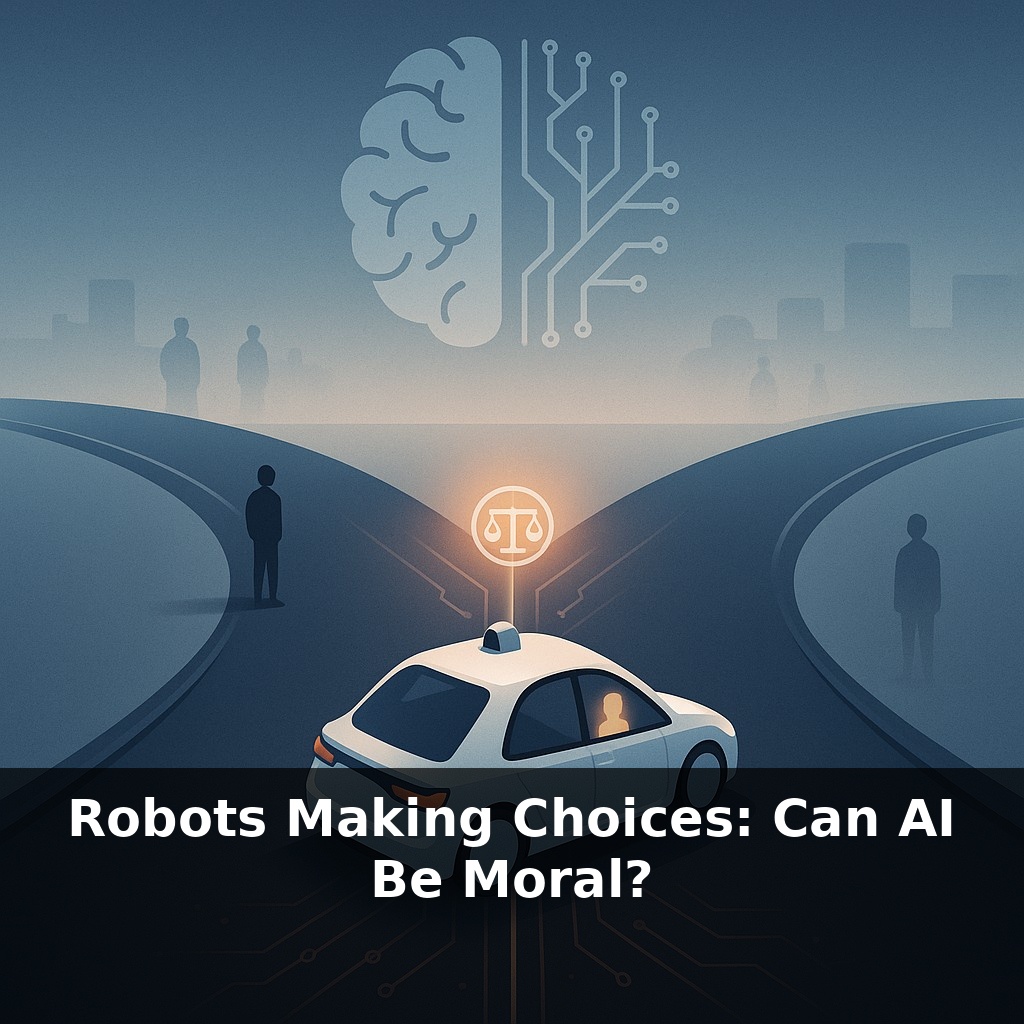
A car with no driver faces a split-second choice: brake hard and risk the passenger, or swerve and risk a pedestrian. The code decides. Here’s the twist: many of us say robots must be moral—yet we also insist they’re just tools. So who’s actually choosing in that moment?
Here’s where it gets uncomfortable: that life-or-death line of code didn’t appear by magic. It was written, reviewed, and approved by people—engineers, managers, maybe lawyers—each bringing their own mix of caution, ambition, and bias. Some pushed for safety, others for speed to market, others for legal defensibility. Then those trade-offs got frozen into software and shipped into the world. The robot’s “choice” is really a compressed history of human meetings and compromises. And this doesn’t just apply to dramatic crash scenarios. It shapes which jobs hiring algorithms favor, which neighborhoods delivery drones serve first, and even which posts your feed quietly hides. The question isn’t only “can AI be moral?” but “whose morals are we silently scaling up—and who gets left out?”
Think of AI less as a single “mind” and more as a crowded committee baked into silicon. Philosophers, policy teams, safety engineers, shareholders, regulators, and users all tug on different corners of its objective: maximize efficiency, avoid harm, respect rights, protect profits. Those aims don’t always align, yet they all end up encoded as goals, constraints, or loss functions. That’s why a navigation system might privilege faster routes while a content filter quietly downranks risky posts: each system is pursuing a carefully negotiated slice of our clashing values.
Here’s the unsettling twist behind all this: when people talk about “ethical AI,” they’re often talking about four very different things, all mashed together.
First, there’s **hard rules**: explicit “don’t do X” constraints. Medical triage software can be blocked from recommending treatments that violate established clinical guidelines, no matter what the statistics say. This is crude but powerful: you draw fences around certain actions and tell the system they’re off-limits.
Second, there’s **value-shaped optimization**: you don’t just tell a system to “win,” you tell it what winning means. A delivery route planner might be tuned not only to minimize cost, but also to reduce emissions and avoid school zones at certain hours. Those priorities get baked into the objective it’s relentlessly chasing.
Third, there’s **learning from human judgment**. Instead of only optimizing numbers, systems like reinforcement learning from human feedback train on our approvals and disapprovals. Moderation tools, for instance, learn patterns from what reviewers flag as harassment or hate speech, then generalize to new cases. They’re not “feeling” why something is harmful; they’re inferring boundaries from our collective red lines.
Fourth, there’s **keeping humans in the loop**. High‑stakes decisions—parole risk scores, welfare eligibility, some military targeting systems—often require a person to sign off, override, or annotate the algorithm’s suggestion. The machine narrows the field; the human is supposed to carry the moral burden.
Notice what’s missing in all four: there’s no inner voice, no genuine understanding of what it’s like to be harmed, protected, or treated unfairly. The system is mapping inputs to outputs according to structures we’ve supplied. It can outperform us on consistency, but it can’t *care* when it gets things wrong.
An ethics research group might design a rule set barring an autonomous drone from entering certain coordinates. A safety team might use formal verification to prove it can’t violate that rule under specified conditions. But if a new situation arises just outside those conditions, the system doesn’t “hesitate” or “reflect.” It just follows the path that still satisfies its math.
Programming machine ethics is like writing a cooking recipe: you must specify every ingredient and every step. Forget to say “turn off the heat,” and the dish keeps burning—not because the stove is malicious, but because it’s obedient.
A Waymo car gliding through city traffic isn’t “being careful” in any human sense—it’s juggling thousands of tiny priorities its designers chose. Yielding to cyclists, easing off near crosswalks, respecting speed limits: each behavior reflects a line somewhere in the code that quietly says, “In this kind of situation, prefer *this* outcome over *that* one.” The proof that this matters isn’t abstract. Waymo’s 20‑plus million miles without an at‑fault fatality hints at how far meticulously coded priorities can go in practice—yet those miles say nothing about edge cases the system has never “seen.”
Now contrast that with lethal autonomous weapons. Here, public discomfort shows up in numbers: 42% of Americans don’t think machines should ever get kill authority. That resistance is its own moral data point, pushing militaries toward strict constraints, human confirmation steps, or outright bans. In both traffic and combat, it’s not that the machine “has ethics”; it’s that our tolerance for risk, harm, and responsibility gets frozen into silicon.
Hospitals, courts, and cities are quietly becoming test labs for moral code. An AI might soon rank transplant candidates, schedule police patrols, or decide which power grid to shut down first in a blackout. The danger isn’t just “bad” code, but thousands of tiny, opaque nudges that slowly reshape how we see fairness and responsibility. As machine judgment scales, our real task is deciding which hard choices must *never* be outsourced, no matter how efficient the system becomes.
So the real frontier isn’t asking if AI “has” ethics, but deciding where we’ll let its judgment stand in for ours. Each new system is less like a hammer and more like a quiet policy change, baked into code. Your challenge this week: pick one AI system you rely on and trace who chose its goals—and who never got a seat at that table.