Only about one in ten people keep their New Year’s resolutions—yet productivity apps still promise total life overhaul. You download one on a Sunday night. By Thursday, your “system” is a graveyard of half-set-up boards and overdue tasks. So why does the collapse feel inevitable?
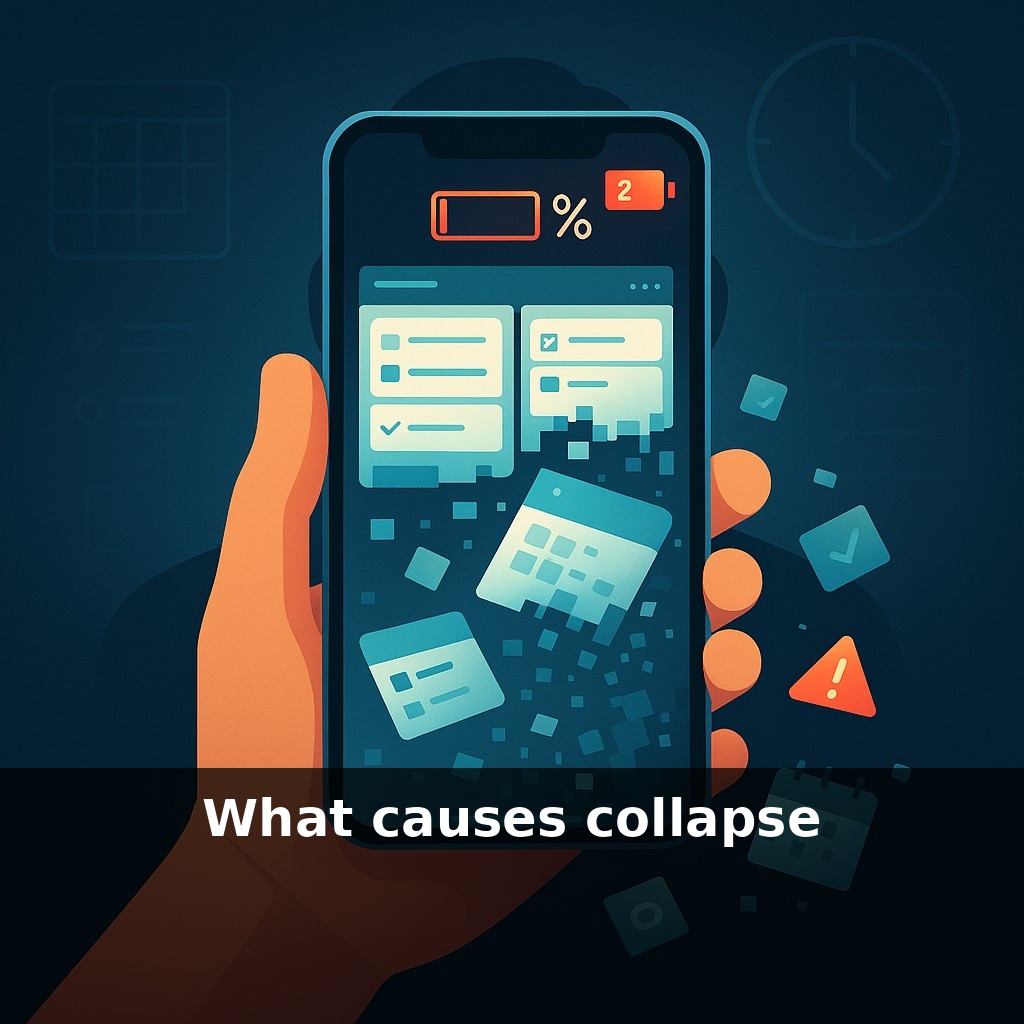
You probably didn’t “fail” your last system; it was more like trying to run desktop software on a phone with 2% battery. The software isn’t evil, but the hardware simply can’t support what it’s being asked to do. Most productivity setups are designed as if your brain were a quiet office with perfect Wi‑Fi and unlimited power. In reality, it’s more like a crowded café: notifications buzzing, emotions fluctuating, context constantly shifting. Your working memory can only juggle a handful of moving parts before it starts dropping them, yet many systems demand constant tagging, sorting, prioritizing, and reviewing. Each small decision drains a bit more mental energy, until the interface that once felt “empowering” becomes another inbox you’re quietly avoiding—right beside the one labeled “life admin” that’s already overflowing.
We also underestimate how unstable our days really are. A calendar that looks calm at 8 a.m. can feel like a train-station departures board by noon—meetings delayed, priorities rerouted, emergencies “arriving on platform 3.” Most systems quietly assume the tracks stay fixed and the trains run on time. They need you to remember recurring steps, maintain tags, and obey rules even when your kid is sick, your boss pings you, or your mood crashes. The result isn’t dramatic failure; it’s slow drift. You stop updating one piece, then another, until the whole thing no longer reflects the day you’re actually living.
When a system collapses, it usually looks personal on the surface: “I got lazy,” “I stopped being disciplined,” “I just couldn’t stick with it.” Underneath, the mechanics are far more structural.
Start with sheer volume. Studies on to‑do lists show that nearly half of what we write down gets rolled forward, day after day. That rollover isn’t just annoying; it quietly trains your brain that your own plans are negotiable. Every unchecked box becomes a tiny vote for “this system does not describe reality.” After enough votes, you stop consulting it with any seriousness. You might still open the app or flip the notebook, but it has already lost authority.
Layer on decision fatigue. Roy Baumeister’s work suggests that after roughly a hundred real decisions in a day, the quality of your choices starts to slide. Most modern tools multiply those choices: Do I star this? Flag it? Defer it? Break it into subtasks? Add it to a project? When a Kanban board takes a team several hours a week just to keep current, that “productivity” layer is quietly competing with the actual work it’s supposed to support. You feel this as friction, not failure: one more thing to maintain before you can do anything.
Context then finishes the job. Marketing tells a story of linear improvement—set up once, and your life slots into place. But your attention, energy, and responsibilities move in waves. A system that can’t flex with those waves becomes brittle. The first time you hit an unusually chaotic week, all those carefully structured lists and boards freeze. By the time the chaos passes, the gap between what’s written down and what actually matters is so wide that restarting feels harder than rebooting from scratch.
No wonder 60% of people abandon a new tool within three months. The promises were made for an idealized version of you in an idealized week. The reality is closer to a musician trying to follow a rigid practice schedule through tour dates, jet lag, and a surprise flu: the plan that doesn’t allow for fluctuation ends up ignored.
So collapse rarely comes from one dramatic moment. It’s the cumulative result of rollover eroding trust, micro‑decisions draining will, and rigid structures snapping under real‑world variability.
Think about three people you might know. First, there’s the manager who proudly rolls out a detailed weekly planning ritual—color codes, categories, the works. For two weeks, the team plays along. Then a big client fire hits, and the ritual quietly shrinks to “scroll inbox, react to whatever shouts loudest.” The structure didn’t vanish overnight; it just lost the negotiation with chaos and never quite recovered.
Then there’s the freelancer who adds every idea, lead, and “someday” task into one master list. It feels responsible—until scanning that list becomes a low‑grade anxiety trigger. They stop opening it before bed, then stop opening it at all, and start keeping “real” priorities in their head.
Finally, a startup founder copies a famous CEO’s routine: 5 a.m. starts, time‑blocked days, weekly reviews. It works—until investor meetings move, a launch slips, and sleep debt shows up. The routine was imported like a prewritten score, but their life is more like jazz: it needs something that can bend without breaking.
Most tools will soon do far more than tidy lists. As AI observes your patterns, it may start quietly reshaping your workload—surfacing three crucial items like a playlist of “today’s essentials,” hiding clutter until you’re ready, and timing prompts for when you typically have slack. That sounds helpful, but it also shifts power: whoever designs those defaults is, in effect, editing your future attention. The frontier isn’t smarter software; it’s negotiating how much steering we’re willing to outsource.
So the question isn’t how to “never collapse” again, but how to design for graceful failure—like a tent that sways in the wind instead of snapping. That means systems that can be paused without guilt, restarted without overhaul, and adjusted without ceremony. The more your tools expect fluctuation, the less they punish you for simply being human.
Before next week, ask yourself: “Where in my life am I currently over‑optimizing for growth (more income, more projects, more ‘scale’) in a way that, if stressed, could actually cause a collapse instead of making me stronger?” “Which single ‘keystone’ support (a person, habit, backup system, or savings buffer) would most reduce the fragility of my current situation if things suddenly went wrong—and what’s one concrete step I can take today to start shoring that up?” “Looking at a recent setback, how could I redesign that part of my life or work so it behaves more like an antifragile system—improving when stressed rather than just barely surviving?”