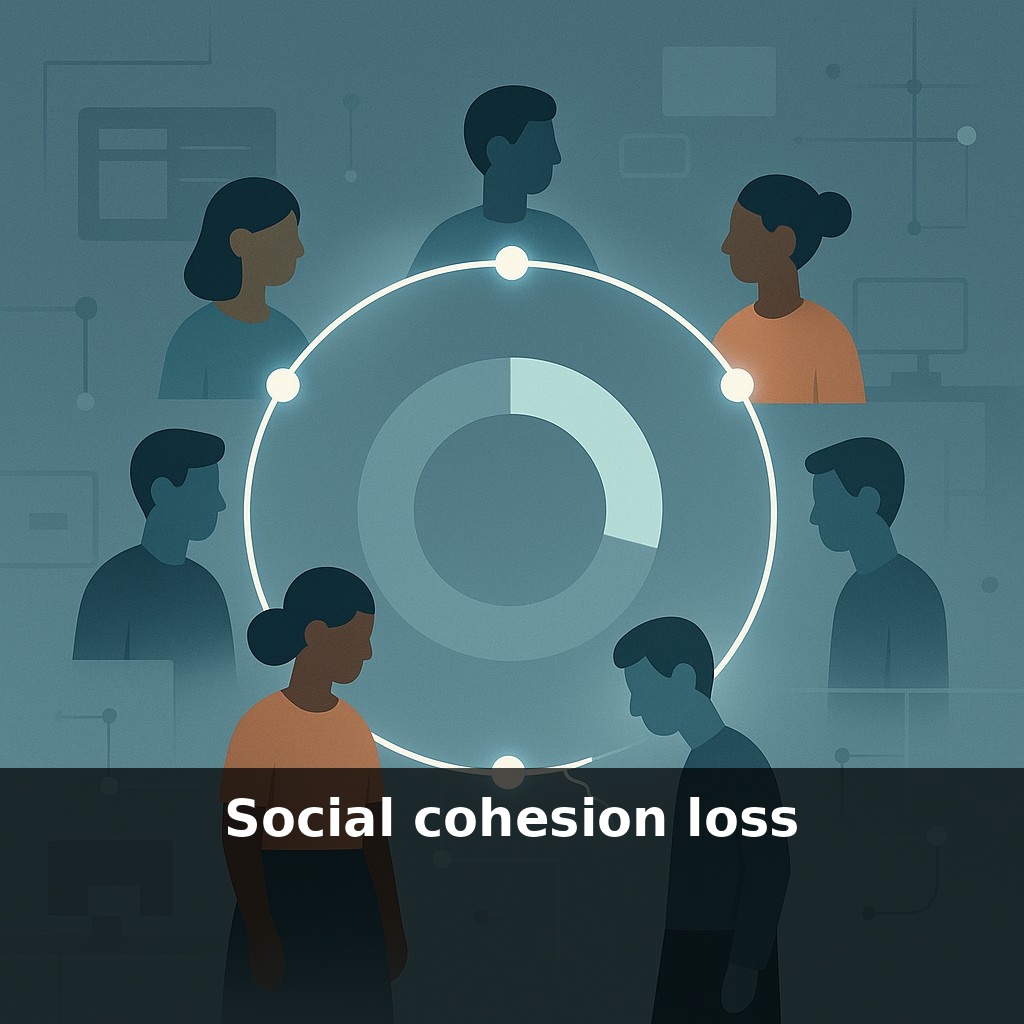
A single missing ingredient at work can quietly erase about a fifth of your team’s output. Not a new tool, not a smarter plan—just a slow leak in how connected people feel. In this episode, we step into that leak and ask: when cohesion frays, why does everything suddenly feel harder?
Here’s the twist: when cohesion starts to thin out, people rarely say, “We have a social problem.” They say, “We need better tools,” “We need clearer processes,” or “We need to hire smarter people.” In other words, we misdiagnose a broken social fabric as a broken system—and then keep throwing technology and strategy at what is, at its core, a relational failure.
Research keeps pointing to the same hidden mechanism: as trust drops, the “tax” on every interaction rises. Status updates get longer. Approvals take more steps. Slack threads multiply, but useful information shrinks. People hoard expertise as a form of self-protection. The organization may look busy—meetings, dashboards, KPIs—but the real work moves through molasses. In this episode, we’ll trace how that invisible tax accumulates, and why even brilliant individuals can’t outwork a fragmented collective.
In most organizations, the first signals of social cohesion loss don’t show up as drama; they show up as tiny hesitations. A message you rewrite three times. A question you no longer ask because “it might be taken the wrong way.” A meeting where no one wants to be the first to disagree. These micro-moments rarely hit a dashboard, but they accumulate like grit in an engine. Over weeks, people start routing around one another, building shadow processes and private backchannels. Work still gets done, but the official structure becomes a kind of polite fiction everyone pretends to believe in.
When cohesion weakens, the first visible cracks are rarely emotional—they’re architectural. The way decisions move through the system starts to warp.
Watch how a simple decision travels. In a healthy group, a designer pings an engineer, they hash it out, ship a change, and inform stakeholders. In a frayed group, that same decision now needs a Jira ticket, two managers in the loop, a standing meeting “to keep everyone aligned,” and three follow-up emails “for transparency.” No one calls this distrust; they call it “good governance.” But structurally, the system has admitted: “We don’t quite believe each other anymore, so we’ll use process as a crutch.”
Multiply that across hundreds of micro-decisions a week and you don’t just get slower work—you get different work. People choose safer tasks with fewer dependencies. They trim ambition from proposals because every additional stakeholder is another potential conflict. Roadmaps converge on what is easiest to coordinate, not what is most valuable.
The research numbers are striking, but what matters day to day is where they hit: attention, risk-taking, and learning speed. Weak ties aren’t just a health risk; they reduce the number of people you feel you can safely “bother” with a half-baked idea. That shrinks the surface area for serendipity. Fewer collisions, fewer breakthroughs.
Psychological safety, in practice, shows up less in grand gestures and more in how quickly bad news travels. In cohesive teams, uncomfortable truths move fast and sideways. In brittle ones, information climbs the hierarchy, gets sanitized, and often arrives too late to matter. Leaders then assume the issue is tooling—more dashboards, more real-time metrics—when the real bottleneck is whether people feel it’s worth the social risk to speak up early.
Remote and hybrid work often expose, rather than create, these dynamics. In-person, charisma and hallway chatter can mask structural drag. Online, it becomes starkly obvious which teams have lightweight, trusting coordination and which need three meetings to do what one DM could have settled.
The uncomfortable implication is this: you can’t “install” collaboration with software on top of a fraying social core. The org chart, the workflows, even the strategy slowly reconfigure themselves around whatever level of cohesion actually exists.
Consider a product launch where every discipline technically “collaborates,” but marketing rewrites specs in its own deck, sales maintains a private objection list, and support logs patterns no one else reads. Nothing is overtly hostile, yet the launch underperforms—not because the work is bad, but because the insights never quite meet each other in time.
A more instructive contrast: Netflix’s famous “culture of candor” deliberately lowers the social friction of saying, “This isn’t working.” That’s not about being nice; it’s about preserving speed when stakes are high. By normalizing direct feedback and clear ownership, they reduce the invisible drag of second-guessing who’s allowed to speak.
Or take a small open-source project: when maintainers respond quickly, credit contributions, and share rough roadmaps, new developers orient faster and take on bolder issues. The codebase improves not just from genius commits, but from dozens of contributors who feel it’s worth the effort to plug their local knowledge into a shared system.
When cohesion thins, algorithmic “assistants” quietly reshape who talks to whom. Recommendation engines decide which colleagues you see, which updates surface, which questions get buried. Over time, your working world narrows to familiar names and safe channels. The risk isn’t just slower work; it’s strategic myopia. Problems that span functions or cultures become harder to even perceive, so they’re solved piecemeal—or not at all.
Your challenge this week: run a live experiment against that narrowing. For five working days, pick one decision or sticky problem per day and deliberately route it through someone outside your usual orbit: a different office, discipline, seniority band, or cultural background. Don’t ask for “approval”; ask, “What am I not seeing?” Track not just the answers, but how long it took, how it felt, and what changed. By week’s end, you’ll know exactly how expensive—or surprisingly easy—it is to reopen those closed paths.
As digital tools multiply, it’s tempting to treat frayed relationships as a software bug, patchable with another platform. But code can’t substitute for people choosing to re-engage. The next frontier isn’t smarter dashboards; it’s rebuilding the thin, human bridges they depend on—brief check-ins, shared jokes, tiny favors—the “small talk” that quietly keeps big systems alive.
Before next week, ask yourself: 1) “Where in my daily life do I most clearly feel ‘social cohesion loss’—is it in my neighborhood, my workplace, my online communities—and what specific moments from this past week prove that to me?” 2) “Whose perspective in my immediate world (a neighbor I disagree with, an older relative, someone with a different background) have I quietly written off, and what’s one honest, curious question I could ask them in our next conversation to better understand how they see things?” 3) “If I picked just one ‘micro-community’ I’m already part of (a group chat, local club, faith group, parent group), what is one concrete way I could make it feel a tiny bit more cohesive this week—like initiating a shared ritual, starting a check-in question, or inviting two unconnected people to talk?”