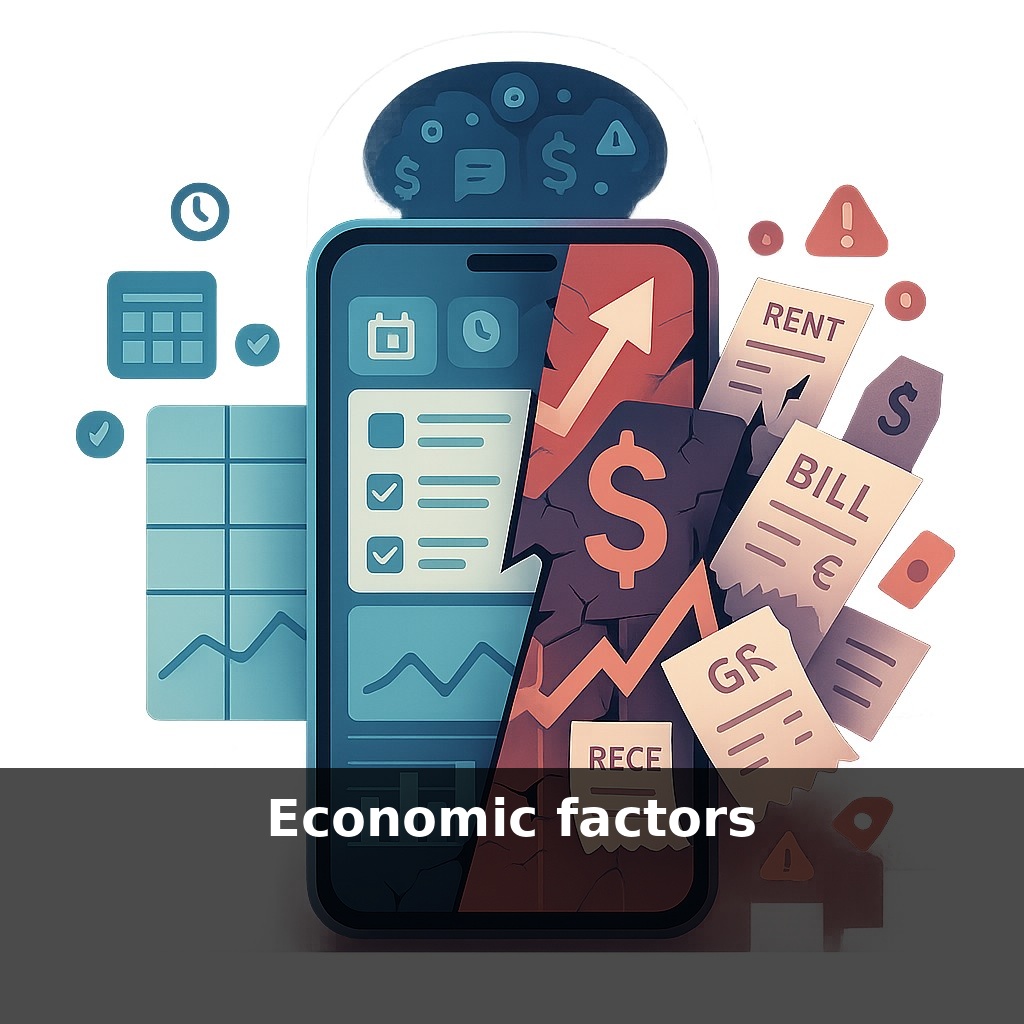
Right now, most productivity apps are built on a hidden assumption: that your life, your job, and your paycheck are relatively stable. But let’s drop into a week where rent jumps, hours get cut, and prices spike. How well does your favorite system survive *that* kind of chaos?
Your calendar doesn’t know that eggs cost 40% more than last year or that your landlord just hinted at a “necessary adjustment” to rent. But your brain does—and it quietly rewrites your priorities. That perfectly color‑coded week can vanish the moment you wake up to an overdraft notice, a layoff rumor, or a sudden medical bill. Now your “deep work block” competes with scanning job boards, renegotiating payments, or doing gig work at odd hours. When the ground under your income and expenses keeps shifting, long-term goals start to feel abstract, even indulgent. You’re no longer optimizing; you’re triaging. And here’s the twist: most systems treat that shift as a personal failure—“you broke the routine”—instead of what it really is: an economic shock hijacking the same focus and willpower those systems depend on to function.
Here’s the part we rarely say out loud: your “willpower problem” might actually be a macroeconomic problem wearing a self‑help mask. When prices jump or layoffs loom, your brain quietly shortens its planning window. Long‑term projects lose emotional gravity; urgent survival tasks gain it. World Bank and Gallup data show stress spikes alongside unemployment, and that stress isn’t abstract—it eats the same executive function you’re told to spend on habits. So when a system stops working, the real question isn’t “What’s wrong with me?” but “What just changed in the economy around me?”
Stress researchers talk about “allostatic load” — the wear and tear from constantly adapting to threat. That’s not just a medical curiosity; it’s the invisible tax on every carefully designed workflow you try to run.
Under stable conditions, your brain has surplus capacity for things like evaluating options, sequencing tasks, and sticking to abstract goals. That’s what executive function is for. But when unemployment ticks up or prices jump, that same circuitry gets reassigned. It’s suddenly busy scanning for risk: *Will my contract renew? Can I cover next month? What happens if the car dies now?*
Those questions run in the background all day. They don’t show up on your to‑do list, but they quietly drain the fuel your system relies on. The APA money‑stress data and the 13‑point executive function drop aren’t just numbers; they describe the exact functions most productivity methods assume you have on tap: working memory, impulse control, and the ability to hold a plan in mind when something shiny—or scary—appears.
You can see this at the household level. In a boom year, someone might batch‑cook on Sundays, time‑block side‑project hours, and auto‑save for a course six months out. When a recession hits that same household, evenings get repurposed into delivery shifts, kids’ schedules flex to match cheaper childcare, and “someday” projects are raided to cover groceries. The system didn’t suddenly become bad; the constraints changed faster than it could update.
And consistency—the core ingredient in habit research—is exactly what economic volatility shreds. If your work hours, commute, or energy swing week to week, the repetition loop keeps breaking. Instead of the classic 66‑day glide into “automatic,” every restart feels like day one. People misread this as laziness, then double down on discipline, which backfires because it ignores the real bottleneck: unstable inputs.
A more honest view treats your setup as conditional. It’s not “this works or I’m broken,” but “this works *at this level of economic turbulence*.” When turbulence rises, the task isn’t to push harder inside the same design; it’s to redesign around shorter horizons, fewer moving parts, and lower cognitive overhead—so your system bends with the pressure instead of snapping every time the economy flinches.
A useful way to see this is in the tiny, practical edits people make when money gets tight. Someone who once followed a strict morning routine might start stacking tasks: listening to interview prep while riding the bus to a second job, answering messages in the grocery line, batch‑handling “life admin” during a kid’s practice instead of reserving a pristine weekend slot. Another person might shrink their system’s scope: instead of weekly review plus detailed project plans, they keep a single “stability list” of tasks that protect housing, income, and health, and let everything else live in a looser, opportunistic list.
Think of a jazz trio on tour: when the sound system fails, they don’t cancel the show; they strip back, improvise around what still works, and save the complex arrangements for venues with better equipment. Economic pressure asks you for the same move—less reliance on perfect conditions, more on modular riffs you can play even when the lights flicker.
If tools keep evolving in this direction, “being organized” may start to look more like risk management than neat calendars: apps quietly flag tasks sensitive to price swings, nudge you toward gigs that smooth volatility, or suggest swapping a course for a certificate with faster payback. Like a band reading the room mid‑set, your system could learn to sense financial tension and automatically downshift into a lighter, crisis‑ready mode instead of waiting for you to burn out.
So instead of asking, “Why can’t I stick to this system?” a sharper question is, “What version of my system fits *this* volatility?” That opens space for micro‑commitments—five‑minute moves toward security, like tuning an instrument between songs. Over time, those tiny retunings can matter more than any single grand plan drawn in calmer weather.
Before next week, ask yourself: Where in my current budget or spending could rising interest rates or inflation hit me hardest, and what specific bill, subscription, or habit could I change today to soften that impact? If my job or income depends on a few key industries, how exposed am I to a possible slowdown, and what concrete skills or side-income option could I start exploring this week to diversify my risk? Looking at my savings and debt, how would a sudden change in the broader economy (like a recession or policy shift) affect me in the next 6–12 months, and what’s one practical move I can make now—such as adjusting my emergency fund target or refinancing a loan—to be better prepared?