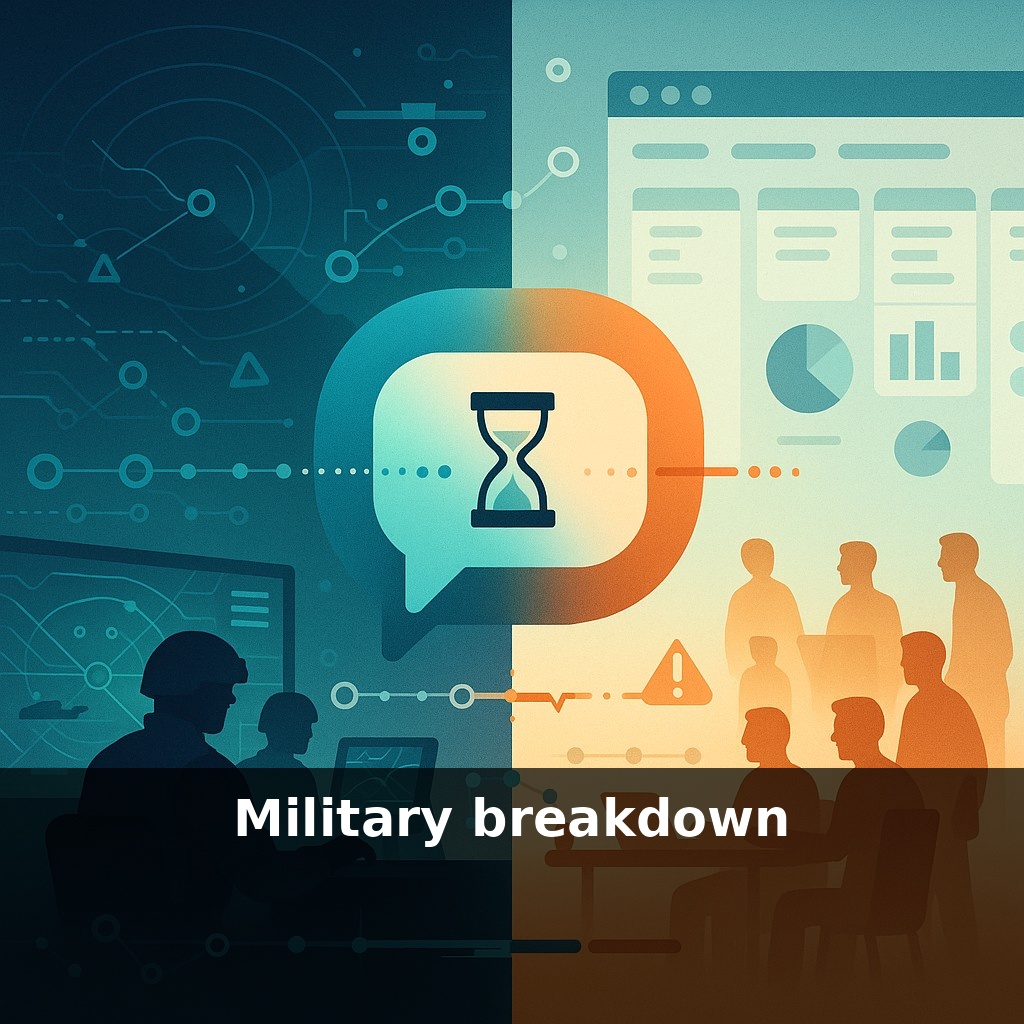
A modern army exercise ends in failure—not because they lacked firepower, but because one key message arrived minutes too late. Now jump to your last big project at work. Different world, same problem: the real enemy wasn’t effort or talent, but the invisible gaps between them.
In military after-action reviews, the pattern is brutal: missions don’t crumble all at once—they unravel in tiny, almost boring ways. A missed update here, a delayed decision there, a leader waiting for approval instead of acting. By the time anyone realises what’s happening, the damage is already locked in.
Your productivity system often fails the same way. Not from one dramatic mistake, but from dozens of micro-failures: a status doc no one checked, a task that “everyone assumed” someone else owned, a risk flagged once and then quietly forgotten.
Militaries learned to treat these not as personal flaws, but as design flaws in the system: how information moves, who’s allowed to decide, where backup options exist—or don’t. That’s the lens we’re going to borrow: not “work harder,” but “engineer fewer ways to fail.”
In high-stakes units, commanders obsess over something most offices barely notice: tempo. Not speed for its own sake, but the rhythm at which information turns into action. Too slow, and reality outruns your plans. Too fast, and you’re just generating chaos in neat formatting. That same tension lives in your tools and workflows. Calendars, chat, dashboards—they promise control, but often create noise that drowns out what actually matters. The question isn’t “Do we have a system?” It’s “Does our system help the right people notice the right change early enough to do something useful about it?”
Modern militaries cope with uncertainty by assuming two things will *always* be true: the plan is incomplete, and the picture is blurry. So they don’t just write better plans; they build structures that expect distortion.
One of the most powerful is decentralised command. Not chaos—clear intent from the top, flexible execution at the edge. A commander states, “Secure this crossing so the brigade can move by 0600,” then lets junior leaders decide how to adapt when the bridge is weaker than expected or the weather turns. The metric of success isn’t “Did we follow the plan?” but “Did we protect the intent under bad conditions?”
Translate that to knowledge work: most teams still behave as if reality will politely match the roadmap. Every exception, every surprise, has to climb a hierarchy for approval. By the time a decision comes back down, the opportunity is gone or the risk has grown teeth. The issue isn’t intelligence or goodwill; it’s that the *permission structure* is designed for a world that doesn’t exist.
Militaries also treat communication as a weapon system, not a background utility. They assume messages *will* be delayed, corrupted, or lost—so they build redundancy into how information is shared and confirmed. Critical orders are repeated back. Multiple channels are used for the same essential update. The goal isn’t more chatter; it’s more certainty about what truly matters.
Most workplaces do the opposite. They rely on a single channel for crucial updates (“It was in the doc,” “I posted it in the channel”) and then act surprised when people miss it. You don’t need more tools; you need deliberate choices about which information must be unmissable, and how many independent ways you’ll use to make that true.
Finally, serious units normalise continuous risk assessment. Not an annual workshop, but a rolling habit: every level keeps asking, “What just changed? What does that break? What can we still save?” Your tools should make that question easier to answer, not hide the answers under dashboards and vanity metrics.
A famous example: during the 2003 invasion of Iraq, some U.S. units carried satellite radios *and* old‑school map boards with grease pencils. High-tech situational tools were great—until dust, battery issues, or bandwidth limits hit. The “primitive” backups kept decisions moving when screens went dark. In your world, that might look like a single-page “mission order” for a project that fits on paper and can survive tool outages or notification floods.
Another: elite units run brief “commander’s intent checks” mid-mission—quick huddles where each team lead states how their next move serves the larger goal. Try a lightweight version: once a week, have each subteam explain in one sentence how their current focus advances the main objective. If they can’t, you’ve located hidden drift.
A small startup I advised cut their core status meeting from 60 to 15 minutes by adopting a “last known truth” document: one concise, continuously updated page that trumped all other sources when conflicts arose. That single artifact became their operational anchor.
In a few years, your tools won’t politely wait for you to decide; they’ll act first and ask later. The real question becomes: who checks the checker? As AI agents route tasks, approve spend, or re‑prioritise work in milliseconds, you’ll need “circuit breakers” and reality checks baked in—like requiring a quick human confirmation when multiple systems disagree, or setting hard bounds on what autonomous tools can change without a clear, recorded trail of why.
Treat your setup less like office software and more like a field laboratory: you’re constantly testing how work behaves under stress. Swap “set and forget” for “tune and probe.” When a tool, ritual, or rule survives crunch time without creating new blind spots, keep it. If it fails loudly, don’t patch it—refit it, then rerun the experiment.
Before next week, ask yourself: 1) “Where in my daily life am I still ‘on deployment’ mentally—hypervigilant, braced for impact, or scanning for threats—and what’s one specific situation (like driving, grocery shopping, or being at home with family) where I can safely practice lowering my guard by 5%?” 2) “When I hit my version of ‘military breakdown’—the anger, shutdown, or numbness—what are the 2–3 early warning signs my body gives me (tight jaw, shallow breathing, pacing, needing isolation), and what could I experiment with in that exact moment instead (e.g., a 3-minute walk, cold water on my face, stepping outside)?” 3) “Who in my current support circle (a buddy from my unit, a partner, a therapist, a chaplain) could actually handle hearing the unfiltered version of what’s going on, and what’s one honest sentence I’m willing to say to them this week about where I’m really at?”