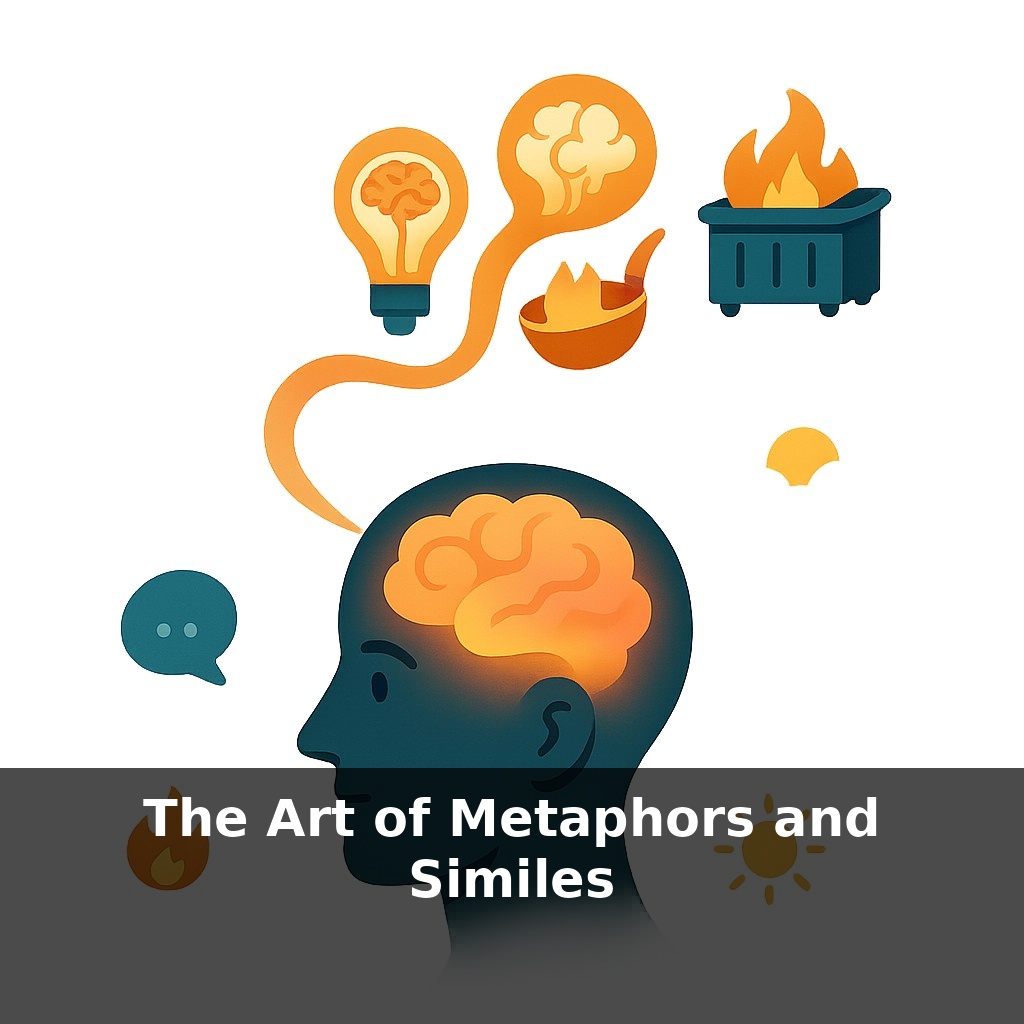
The Art of Metaphors and Similes
📝 Transcript
Metaphors slip into our speech about every couple dozen words—most of the time, we don’t even notice them. You’re stuck in traffic, scrolling your phone, and someone says, “My brain is fried.” No pan, no fire—yet you feel it. How does that tiny phrase rewrite your reality?
Now zoom out from that one tired commute and notice how often language quietly steers your mood. A friend texts, “Today’s a dumpster fire,” and suddenly the whole day feels smoky and irredeemable. Someone else says, “I’m slowly climbing out of this hole,” and your mind shifts to effort, progress, gravity, struggle. Same basic situation—stress, exhaustion, problems—but completely different emotional landscapes.
These quick verbal snapshots don’t just color what’s happening; they offer a script for what might happen next. “Stuck in a rut” suggests wheels spinning, no exit. “At a crossroads” suggests choice, agency, direction. In both cases, you’re overwhelmed—but one story keeps you parked, the other puts you on a map.
When we start to notice these tiny story-frames, we can do more than admire a clever turn of phrase; we can choose which mental movie to step into.
Those quick phrases don’t just decorate experience—they quietly set rules for it. Call a deadline a “tidal wave,” and you’ve cast yourself as someone who can only brace or be crushed. Call it a “mountain,” and effort suddenly feels relevant: you can train, pace, climb. Cognitive research shows these tiny shifts matter; people primed to see an issue as a “war” favor attack-and-defend solutions, while those who hear it as a “puzzle” look for patterns and clues. The words you reach for can tilt your choices before you notice you’ve chosen, like a compass you never remember picking up.
If you zoom in on the language people reach for under pressure, you’ll notice two main moves. One is the clean swap: “This meeting is a circus,” “My inbox is a graveyard.” The other is the explicit comparison: “It’s like juggling knives,” “I feel as if I’m walking through mud.” On the surface, that’s the metaphor / simile split—but under the hood, they behave differently in your mind.
Metaphors tend to hit faster and sink deeper. They don’t announce themselves as comparisons; they just *are* the new frame. “Time is money” doesn’t invite discussion, it sets a rule. You suddenly “spend” hours, “waste” afternoons, “invest” weekends. A simile—“Time is *like* money”—leaves a little more daylight. It lets your brain hold both ideas at once, which often makes it easier to use when stakes are high or clarity really matters.
That’s why polished speeches, novels, and ad campaigns lean hard on metaphors: they’re stickier, more immersive. But when scientists, therapists, or teachers explain something tricky, they often reach for similes: “Think of anxiety *like* an overactive smoke alarm,” “Treat this variable *as if* it were fixed.” The “like” and “as if” function as safety rails, signaling that this is a tool, not a literal truth.
Novel turns of phrase amplify this effect. An unexpected line—“My calendar is a game of Tetris played on hard mode”—forces a tiny mental pause while your mind builds the scene. That extra beat can make the idea memorable hours later. Overfamiliar lines—“swamped with work,” “drowning in email”—slide past with less friction. They’re still doing quiet framing, but they rarely surprise you into rethinking anything.
There’s also a social layer. Shared metaphors and similes create in-groups: fandoms, workplaces, subcultures. A startup that always jokes about “debugging our culture” or a team that calls tough projects “boss-level quests” isn’t just being cute; it’s reinforcing who “we” are and how “we” deal with challenges. Switch the images, and the culture often shifts with them.
Your challenge this week: eavesdrop on your own language in one recurring situation—say, mornings, workouts, or meetings. In that single context, deliberately test-drive three new comparisons: one punchy metaphor, one clear simile, and one slightly unusual, vivid line. Notice which one changes how the moment *feels* and which one other people pick up and repeat.
Shakespeare didn’t just decorate his plays with pretty lines; he built whole emotional engines out of them. “Juliet is the sun” doesn’t tell you her personality; it yanks her into a cosmic scale of warmth, danger, orbit. No “like,” no hedge—just a new gravity in the scene. Modern lyricists do the same on smaller stages. When Frank Ocean sings, “I’m a forest fire,” he doesn’t say he *feels* intense; he becomes a spreading, uncontrollable force, and the relationship suddenly looks flammable rather than sad or sweet.
You can watch brands do this in real time. Duolingo calls its streak “on fire” and turns practice into a heat meter, not a chore chart. Calm doesn’t say “we sell an app”; it invites you into “a sanctuary in your pocket,” shifting a rectangle of glass into portable shelter. Even in tech support forums, users talk about “ghost processes,” “zombie servers,” “orphaned tasks”—tiny horror stories that make invisible code feel haunted, fragile, in need of care rather than just commands.
Metaphor-heavy AI might flood feeds with shiny but shallow comparisons, so the real edge will be *editing*—training yourself to spot which lines genuinely sharpen a point. In global teams, clashing images can quietly derail alignment: a manager selling “war-room strategy” to colleagues whose cultures prize harmony may trigger hidden resistance. Meanwhile, therapists already tweak client metaphors—nudging “I’m broken” toward “I’m in repair”—turning tiny shifts in wording into long-term changes in self-story.
Treat your comparisons as tiny prototypes: test, tweak, retire, remix. Swap “I’m swamped” for “I’m running a marathon without a finish line” and notice which one nudges you to change pace, not just complain. Over time, the images you default to become a quiet design system for your days—subtle, but powerful enough to redraw what “possible” feels like.
Here’s your challenge this week: pick one everyday object in your room (like your coffee mug, keyboard, or plant) and craft 10 fresh metaphors and 10 similes that compare it to unexpected things (e.g., “My mug is a small moon orbiting my morning”). Then, choose your 3 favorite images and expand each into a 3–4 sentence mini-paragraph that shows, not tells, the comparison in action. Finally, share one of those paragraphs with a friend (or online) and ask them which image stuck in their mind most—and why.
From this course
The Playfulness of Words
5 episodesUnlock all episodes
Full access to 5 episodes and everything on OwlUp.
Subscribe — $1.99/monthLess than a coffee ☕ · Cancel anytime