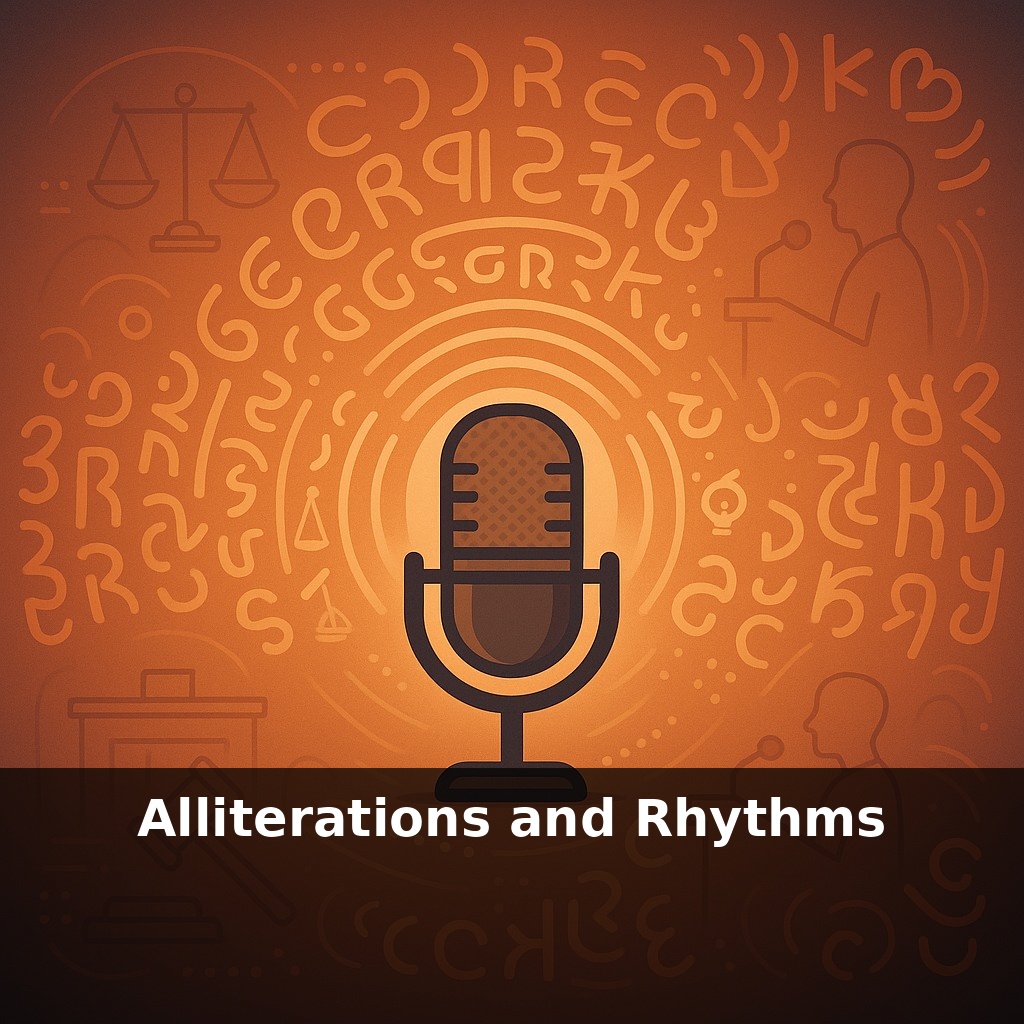
A single repeated sound can boost how persuasive you seem by roughly a fifth. Now, drop into this scene: a lawyer speaking in steady, chiming phrases. Same evidence, same facts—yet the jury leans in closer. Why do tiny echoes in language bend big decisions?
Poets aren’t the only ones playing this game. Politicians slip sound twins into speeches; advertisers pack product names with tiny chimes; even sports commentators lean on subtle beat and bounce when a moment matters. Your ear registers these patterns before you consciously do—like noticing the groove of a song before you catch the lyrics.
We often mistake this pull for “good arguments” or “catchy ideas,” when part of what we’re feeling is simply the pleasure of smooth processing. Rhyme, beat, alliteration: they grease the rails of thought, letting words slide into memory with less friction.
That raises thorny questions: where’s the line between craft and manipulation? Can we use these tools to clarify rather than to mislead? And how much rhythm is enough before prose starts sounding like a jingle you can’t turn off?
Listen closely to places where words *have* to work: courtroom summations, political slogans, startup pitches, nursery rhymes. You’ll notice a pattern—the moments designed to stick are rarely the ones with the most data; they’re the ones with the most deliberate sound-shaping. Cognitive researchers call this “processing fluency”: when language feels easy to take in, we tend to trust it more, remember it longer, and repeat it to others. That doesn’t mean style replaces substance, but it does mean style quietly steers which bits of substance survive the trip through someone else’s mind.
Take a closer look at how sound shows up in writing you’d never call “poetic.” Legal scholar: “if it doesn’t fit, you must acquit.” Tech slogan: “move fast and break things.” Academic title: “Priming, Perception, and Political Preference.” None of these are accidents. They’re micro‑design choices: small sound patterns nudged into place to make dense ideas feel a bit more graspable.
Crucially, what repeats is the *sound*, not the letter. “Crazy court case” alliterates; “psychic symbol” does too, even though the consonants don’t match on the page. Your reader’s ear doesn’t care how the word is spelled; it cares how quickly the mouth *could* say it. This is why revising out a clunky consonant can have more impact than adding another adjective.
Rhythm works the same way at the sentence level. Prose that lands with a satisfying “thump” at key points tends to balance: - a build‑up (longer, looser clauses), and - a snap (short, stressed closure).
Consider: “After months of failed prototypes, late‑night debugging, and budget meetings that left everyone exhausted, we shipped.” The stress piles up, then drops on “shipped.” You feel completion before you evaluate the content.
Writers who use this deliberately often: - Put crucial words in naturally stressed positions (sentence ends, one‑syllable verbs). - Alternate longer, wandering lines with shorter, decisive ones, creating a subtle pulse. - Trim filler (“really,” “actually,” “sort of”) that muddies the beat.
There’s also genre calibration. Children’s authors lean heavily on steady patterns so new readers can predict what’s coming. Brand writers dial the pattern up just enough that a tagline is easy to echo aloud. Essayists usually keep things looser, saving concentrated soundwork for thesis statements, transitions, and final lines.
The risk isn’t “too much beauty”; it’s predictability. When every sentence marches to the same drum, readers stop noticing the march. Strategic variation—plain next to patterned, rough next to smooth—gives the ear contrast, so the crafted moments actually register.
Watch how this plays out in the wild. Brand teams don’t just chase cleverness; they A/B test what people *repeat*. “PayPal, Pay in 4.” “Click, Pay, Done.” The winning lines often share a tight cluster of consonants or a steady pulse that feels good to say aloud. You can hear similar tuning in political lines that spread: they’re built for chant as much as for sense.
Authors do it at the micro scale. Zadie Smith will run a draft aloud, swapping one near‑synonym for another because the new consonant snaps better next to its neighbors. Rap writers obsess over this: not only end‑word chiming, but the way internal consonants drum against the bar line.
Even in technical writing, subtle patterning earns its keep. Compare: “Nonlinear models need more data and better care.” vs. “Nonlinear models demand more data and more diligence.” Same claim; the second stacks stresses and consonants so your tongue almost wants to march through it.
Soon, “sound‑savvy” tools may reshape drafting the way spellcheck reshaped spelling. Expect editors that flag flat sections and suggest livelier options, a bit like budgeting apps nudging you toward smarter spending choices. As readers grow used to richer audio—podcasts, smart speakers, AR layers—the silent page will compete with spoken style. Writers who can *hear* their sentences will craft texts that feel native both on screen and in someone’s earbuds.
Treat your drafts like playlists in progress: some tracks calm, some punchy, some strange enough to wake you up. Read a paragraph aloud; when your voice stumbles, that’s a clue, not a failure. Tweak syllables the way a cook adjusts seasoning. Over time, you’ll feel where language wants to dance—and where it needs a rest.
To go deeper, here are 3 next steps: 1) Grab a short poem packed with alliteration—like Gerard Manley Hopkins’ “God’s Grandeur” (free on PoetryFoundation.org)—and highlight every repeated starting sound, then read it out loud three times to feel the rhythm in your mouth and breath. 2) Open a free metronome app (like Soundbrenner or MetroTimer), set it to 80–100 BPM, and practice speaking one paragraph of your own writing in time with the clicks, tweaking word order until the rhythm feels smooth and musical. 3) Study a master of alliterative rhythm by reading the first two pages of *Beowulf* in Seamus Heaney’s translation (print or audiobook), and then mimic its pattern by drafting 4–6 lines of your own “modern Beowulf” about a normal task (commuting, doing dishes) using strong alliteration in each line.