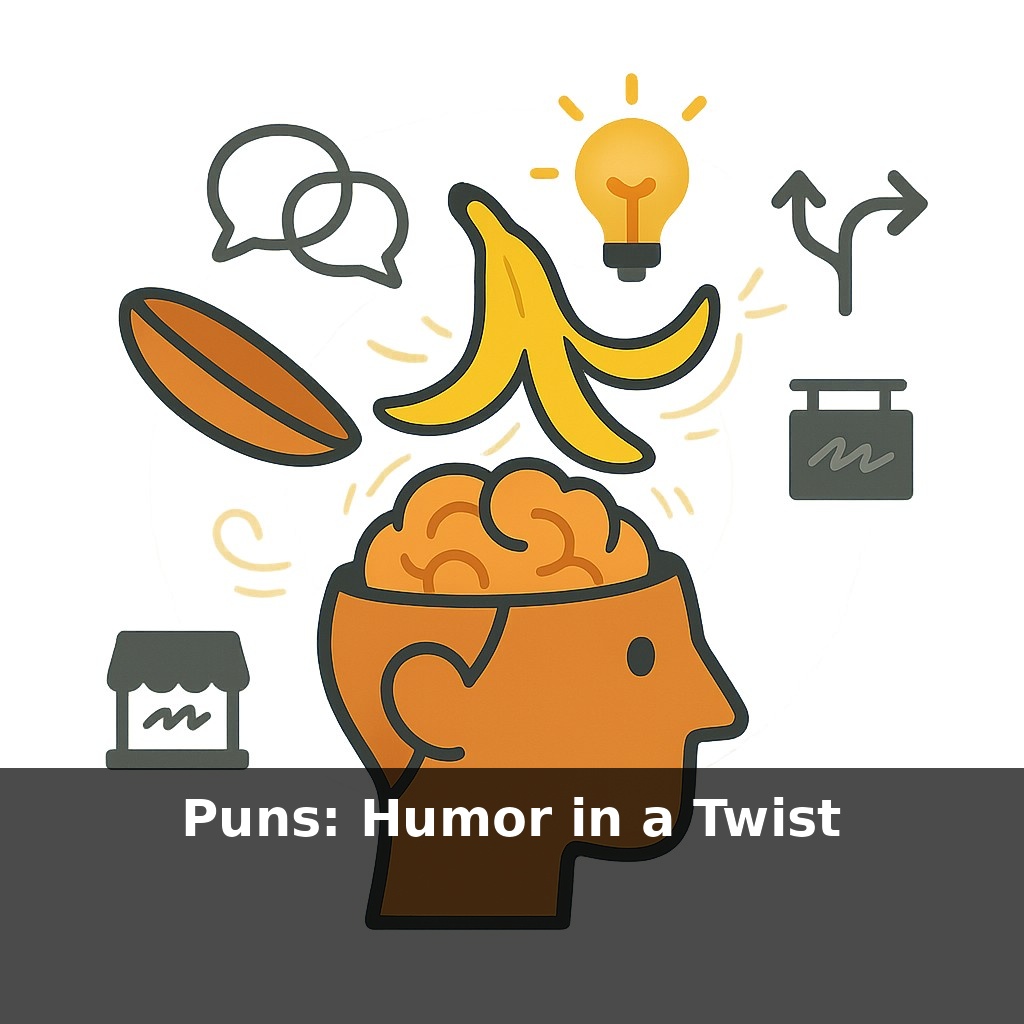
A single word can make your brain slip on a banana peel. In one moment you’re sure what it means; in the next, it flips, and you burst out laughing—or groaning. Why does your mind enjoy being tricked like that? And what does that tiny twist reveal about how language really works?
Some of the most famous puns hide in plain sight: on shop signs (“Sole Man” for a shoe repair), café boards (“Espresso Yourself”), even in serious news headlines (“Fed Raises Rates, Hopes Economy Gets the Hint”). We skim past them, smirk, and move on—but each one is a tiny stunt in mental gymnastics. They ask your mind to hold two realities at once: the message the writer *had* to say, and the mischief they *chose* to add. That little detour isn’t just for laughs; it quietly trains your attention to notice patterns, coincidences, and shortcuts in everyday speech. In this episode, we’ll zoom in on how puns are built, why some feel clever while others feel cheap, and how playing with them can sharpen your creativity far beyond “dad joke” territory.
Think of today’s conversation as stepping backstage at a comedy club where every performer is a sentence, quietly rehearsing double lives. Some lines earn a full laugh, others a reluctant eye-roll, and a few land in that sweet spot where you admire the trick even as you groan. What changes the reaction isn’t just the wordplay itself, but timing, context, and audience—like seasoning in a dish, a pinch too much or too little breaks the effect. We’ll look at how writers, marketers, and everyday texters deliberately tune that balance, and how you can start spotting the hidden “second script” in what you read and hear.
If you zoom in on a really satisfying pun, you’ll usually find three moving parts: a setup that steers you in one direction, a pivot where a key word can suddenly be re-read, and a payoff where both readings click into place at once. That pivot is where different *types* of puns hide—and understanding the types makes them much easier to both spot and invent.
Start with homophonic puns, built on sound-alikes. These are the classics of greeting cards and headlines: “Sole Man” for a cobbler, “Grape Expectations” for a vineyard review. The spoken version and the “serious” version share a pronunciation, so your attention can slip between them with almost no friction. That ease is why advertisers love them: your mind does the extra work, then rewards itself with a tiny burst of delight.
Homographic puns lean on spelling instead of sound. Think of the word “bass” on a music poster featuring a fish, or “lead role” printed next to a pencil. Even before you say anything aloud, the written form invites a second reading when it appears next to an unexpected partner image or phrase. Designers often exploit this by pairing a single ambiguous word with a visual cue that forces a twist.
Then there are polysemous puns, where one perfectly ordinary word quietly carries more than one related sense. “The genie denied my first three wishes, so I felt a little *disenfranchised*” piggybacks on “franchise” as business license and as commercial film series. These often feel more “intellectual” because they don’t rely on silly sound coincidences; they depend on your knowing that a word has a whole small family of meanings.
Compound and portmanteau puns go one step further: they splice pieces from separate words into something new. When people talk about “infla-dating” (going on cheaper dates during inflation) or a “hangry” customer, they’re not just being cute; they’re compressing a situation into a single, sticky label. Stand-up comics and political commentators use this constantly to frame events in a memorable way. The new term spreads precisely because the pun makes it easy to recall and repeat.
Once you start sorting examples into these families, you notice that different situations favor different tools. Headlines prize short, sharp homophones; brand names lean on portmanteaus; dry academic jokes often sneak in polysemy. The trick isn’t to memorize jargon, but to feel which style fits the tone and medium you’re working in.
A useful way to explore this is to treat each type of pun like a different “tool” you might pull from a kitchen drawer, each suited to a slightly different dish. Homophonic puns are your salt: sprinkle them on everyday conversation and they dissolve almost instantly—“cereal” vs. “serial,” “knight” vs. “night”—simple, fast, and hard to overthink. Homographic ones are more like chili flakes: they sit there looking innocent until a context clash—like “wound” as noun vs. verb—suddenly kicks in and you feel the sting. Polysemous puns resemble layered sauces, rewarding people who linger long enough to taste the extra notes (“charged” particles vs. “charged” fees in a science joke). Portmanteau puns are your food processor: toss in two ingredients—say, “breakfast” and “lunch”—and you get “brunch,” a compact blend people adopt without even labeling it a joke. Watch political commentary, tech blogs, or café menus and you’ll see writers deliberately choosing among these “flavors” to match how playful or serious they want to sound.
Nigel Richards riffing between Scrabble moves and Punderdome crowds roaring point to a future where quick-fire twists become a social *skill*, not just a party trick. As voice search spreads, brands may sound more like witty radio hosts than static logos, seasoning answers with gentle quips that users remember. In classrooms, bilingual kids could spar in “translation duels,” racing to bend near-miss phrases across languages, like financial arbitrage—but with attention as the currency and laughter as the yield.
When you start noticing these twists, bus ads become scavenger hunts and menus read like inside jokes. That curiosity can spill into other areas: debugging code, spotting loopholes in contracts, even catching plot hints in shows. Your challenge this week: collect three real-world puns and rewrite each one twice—once sharper, once subtler—and see which versions people remember.