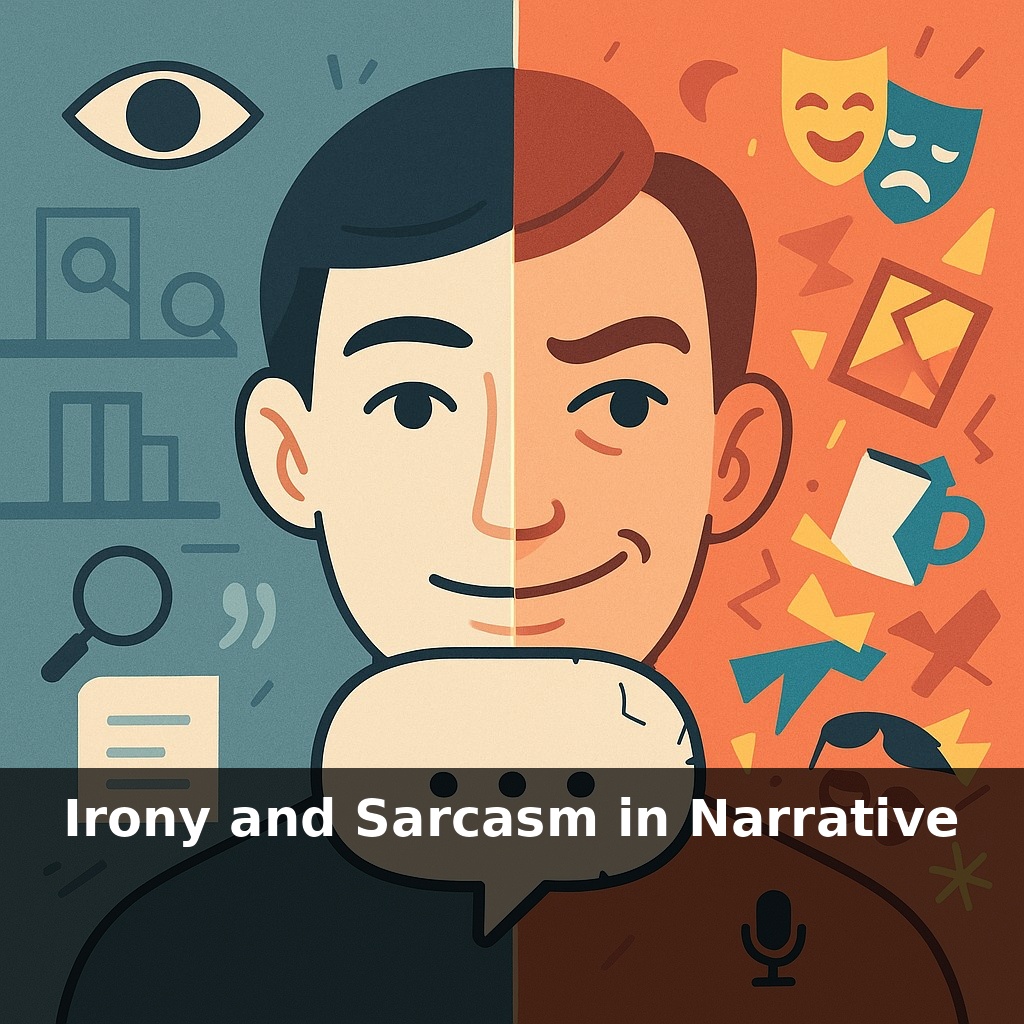
“People who use sarcasm are more creative,” says one Harvard study—yet machines still miss it a lot of the time. A character says, “Great job,” after a disaster. Is that comfort, cruelty, or comedy? In this episode, we’ll pull apart that tone—and learn how writers bend it.
“Dramatic irony can increase reader suspense by up to 25%,” suggests one eye-tracking study—meaning readers literally stare longer when they know more than the characters do. That gap between what’s said and what’s true, or what’s known and what’s hidden, is where narrative electricity lives.
Today, we’re moving from one-liners to architecture: how irony shapes entire scenes, not just snappy dialogue. Think of a dinner table where everyone smiles politely, but the reader knows one guest plans to betray the host before dessert. Every toast, every joke, every silence starts to vibrate.
We’ll explore how to cue that double vision for your reader without underlining it in neon, how to keep sarcasm from souring a scene, and how to make your subtext do the heavy lifting so you don’t have to explain what your characters can’t yet admit.
Readers are better at catching irony than any algorithm we’ve built, which tells you something important: you’re writing for human pattern-hunters. They don’t just decode words; they weigh timing, history, and tiny social cues. That’s why the same line—“Nice work”—lands differently from a rival, a lover, or a boss who controls your paycheck. On the page, you don’t get vocal tone or raised eyebrows for free; you have to choreograph them. The good news: narrative gives you extra levers—scene framing, viewpoint, and tiny mismatches between what’s said and what’s done—that let you steer those double meanings with precision.
If irony is about the gap, this is where we start playing with *how* that gap is built and revealed.
Begin with **who owns the mismatch** between words and reality. In **situational irony**, the story world itself delivers the twist: the firefighter is terrified of fire; the marriage therapist files for a messy divorce. Characters may be utterly sincere; the contrast sits in circumstances. This form works well when you want quiet humor or a slow-blooming sense of “oh, that’s not how this was supposed to go.”
In **cosmic or structural irony**, the entire setup conspires against a character’s expectations. The promotion that ruins someone’s freedom, the long-saved vacation that triggers a breakup. Here, the irony isn’t a punchline but a pattern: choices that seem logical keep tightening the noose. Use this when you want readers to feel the weight of inevitability.
Verbal quips are flashy, but these broader forms let you **seed irony early** and let it ripen. A throwaway line in chapter one—“At least this town is peaceful”—can become darkly funny in chapter ten after three scandals and one riot. The line wasn’t sarcastic when spoken; *time* turns it ironic.
Now add **point of view**. In close first person, you can let the narrator be wrong in ways the reader can spot: “I could tell he was being totally honest with me.” The scene’s details—averted gaze, evasive answers—quietly argue otherwise. In limited third, you can cut away just before crucial info lands, creating a rhythm where readers sense the gap but don’t have all the data yet.
Irony also interacts powerfully with **character arcs**. Early in a story, an optimistic character may constantly say things that later read as painfully naive. You’re not mocking them; you’re letting past versions of them echo against what they’ve learned. That contrast can make growth feel earned instead of announced.
Used well, irony becomes less about cleverness and more about **moral focus**. By highlighting contradictions—between ideals and actions, promises and outcomes—you quietly tell readers what matters without preaching. It’s not just “this is funny” or “this is sad,” but “look closely here; this is where the story’s conscience lives.”
Put two lines on the page:
1. “You always pick the *nicest* restaurants,” she says, staring at the flickering neon above a greasy booth. 2. “You always pick the nicest restaurants,” she says, running a finger along crystal glassware.
In line 1, the mismatch is blatant: “nicest” hits the grime and bounces. Readers feel the edge even before you tag it. In line 2, the praise aligns with the setting; if there’s a hidden sting, it has to come from context you’ve already built—a fight in the car, a pattern of control, a bill she can’t afford.
Tiny shifts in **supporting detail** tilt the meaning. Add: “She folds the paper napkin into a tight square.” Now the line may carry judgment. Or: “She leans back, shoes off under the table.” The same words soften into warmth.
One analogy, to keep it concrete: treat each compliment like a bank transfer. Is it paying off a social debt, disguising a withdrawal, or investing in trust? The numbers—your literal words—might match, but the account history (previous scenes) decides whether it’s generosity or theft.
In algorithm-shaped reading habits, irony acts like a stress test for attention. As skim-reading becomes default, layered cues risk sliding past untouched, like faint harmonies under a loud beat. Yet that also turns them into a quiet filter: readers who catch the slant become your real long-term audience. In mixed-reality stories, you can literally position knowledge in space—hide a crucial reveal behind a door only some players open, letting irony depend on where they choose to look.
On the page, this isn’t just cleverness; it’s a quiet contract with your reader. Each sly misalignment becomes a promise: pay attention and you’ll glimpse the story’s hidden budget—who’s overdrawn on trust, who’s hoarding secrets. As you revise, ask where a straight line could bend, not to obscure meaning, but to let it refract.
Start with this tiny habit: When you finish any scene or paragraph, add just one line that *slightly* contradicts what the character or narrator just said—something that hints they don’t fully believe it. For example, after “I couldn’t be happier to see him,” add a short beat like, “my jaw, apparently, hadn’t gotten the memo.” Do this once per writing session, even if you only touch a single sentence. Over time, you’ll train yourself to naturally layer irony and sarcasm into your narrative voice without forcing it.