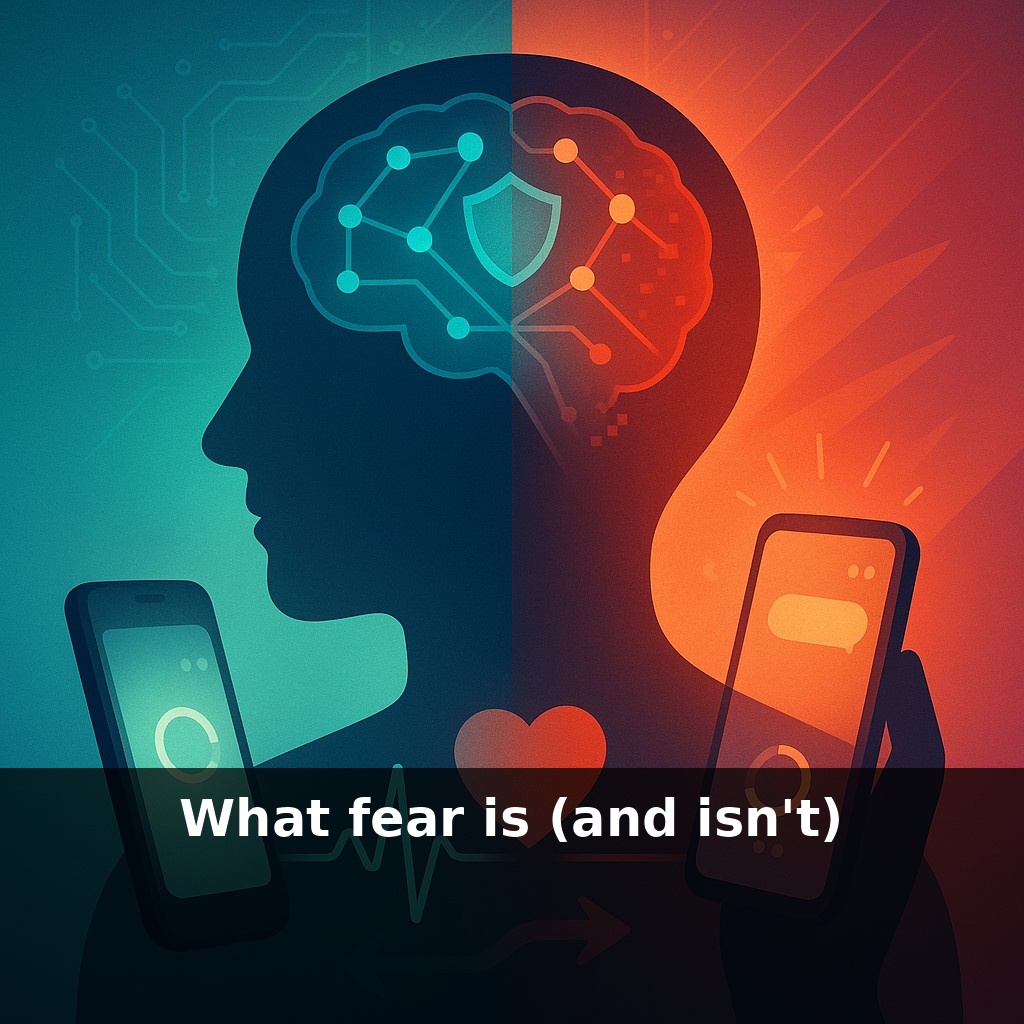
Your heart can leap faster in a single breath than your phone can load a webpage. In one moment, you’re calmly scrolling; in the next, your body is secretly preparing to fight or run. Here’s the twist: that ancient reaction might fire even when there’s no real danger at all.
Fear is not your enemy; it’s your oldest safety expert. Long before you could name what you were feeling, your brain was running rapid risk assessments in the background: “Is this safe? Is this not?” That snap judgment isn’t random drama—it’s rooted in hardwired circuits humans share with other animals, from lab rats to wild deer. But here’s where things get interesting: the brain doesn’t just flip a single “panic” switch. It runs a layered system, distinguishing between “something is happening right now” and “something might happen soon.” Modern life constantly blurs those lines. A sharp noise in the next room, a boss’s email subject line, a car stopping too close at a crosswalk—they all jostle for a response. Understanding which of these truly counts as fear—not just general unease—is the first step to changing how much control it has over your day.
Fear’s story starts in the body. Long before a thought like “I’m scared” appears, your pupils widen, muscles tense, breathing shifts. It’s as if your nervous system quietly flips from “idle” to “high alert.” Neuroscientists can watch this transition in real time: activity surging in the amygdala, signals cascading to the brainstem and heart, posture stiffening by a few subtle degrees. Yet subjectively, you might label all of this as “stress,” “nerves,” or “I’m just off today.” Getting precise—asking “Is there a clear, present threat right now?”—is how we start to separate genuine fear from everything else.
Fear, in the strict scientific sense, needs three ingredients: a clear threat, proximity, and a sense that it could hurt you now. Miss any one of those, and you’ve drifted into neighboring territory—anxiety, worry, or stress—related, but not the same circuit in full swing.
Researchers often use very concrete setups to pin this down. In a lab, a person might see a shape on a screen that occasionally predicts a mild electric shock. When the shock is about to happen, that’s fear: heart rate spikes within seconds, palms sweat, startle reflex intensifies. When the person is just waiting, uncertain if a shock will come this time or not, that’s closer to anxiety: a slow, tense simmer rather than a sudden jolt.
This timing difference matters. Fear tends to be brief and phasic—rising sharply when the threat appears, dropping when it’s gone. Anxiety is more tonic, hanging around in a background hum. If you jump when a dog lunges and barks right next to you, that’s fear. If you spend the next month avoiding every street where a dog might be, that’s anxiety building on top of that episode.
Biologically, these states recruit overlapping but not identical networks. The amygdala is central for rapid threat detection, but sustained apprehension pulls in regions like the bed nucleus of the stria terminalis (BNST) and prefrontal cortex. Those areas influence how long the alarm stays on and how you interpret what just happened: “That dog was dangerous” versus “That was scary, but rare.”
Genetics and learning tweak the sensitivity of these systems. Some people, like carriers of the short 5-HTTLPR allele, show stronger fear conditioning: their bodies learn faster and more intensely from bad experiences. Others acquire powerful fear responses through single-trial learning—a one-time accident, assault, or medical emergency can imprint a durable pattern that reactivates in similar contexts.
Crucially, fear is not just “in your head.” Hormones, immune activity, even digestion shift in coordinated ways. Nor is it purely harmful: people in emergency medicine, aviation, and elite sports often train to use sharp, situation-appropriate fear as a focusing tool, then deliberately dial it back once the moment has passed. The skill isn’t to erase fear, but to match it to reality—and then let it go when the threat is over.
Think about the last time a car swerved too close to you in traffic. For a second or two, everything else dropped out: maybe you yanked the wheel, braked hard, or snapped into perfect focus. That clean, time-limited jolt is fear in its purest form. Contrast that with replaying the moment all evening, checking traffic apps, or feeling tense before your next drive—that’s the lingering “what if” layer on top.
We also see this split in social situations. Someone shouts your name sharply from behind: your body flinches before you know who it is. Seconds later, you’re laughing with a friend. But if you spend the weekend dreading the next confrontation at work, your mind is now feeding a different beast.
Clinicians track these patterns in specific phobias—like flying or needles—where a clearly defined trigger flips the switch almost every time. Interestingly, exposure therapy doesn’t aim to switch fear off entirely; it teaches your brain to update its odds: “This feels dangerous, but the actual risk is low.” Over repeated trials, that recalibration sticks.
Fear literacy could quietly reshape how we design technology, healthcare, even cities. If we can reliably detect the body’s “fear signature” from wearables, apps might downshift your digital load—muting alerts, dimming screens—when you’re already on edge. Therapists could get objective fear data the way cardiologists read EKGs. And as gene-editing tools inch toward rewriting fear memories, we’ll face a social choice: reduce suffering, yes—but how much fear can we safely erase?
Treat fear less like a villain and more like a fast, opinionated consultant. Its verdicts aren’t always right, but they’re rarely random. You can countercheck them with context, evidence, and practice—much like a pilot trusting instruments over gut in rough weather. Your challenge this week: notice one “false alarm” and gently test it against the facts.