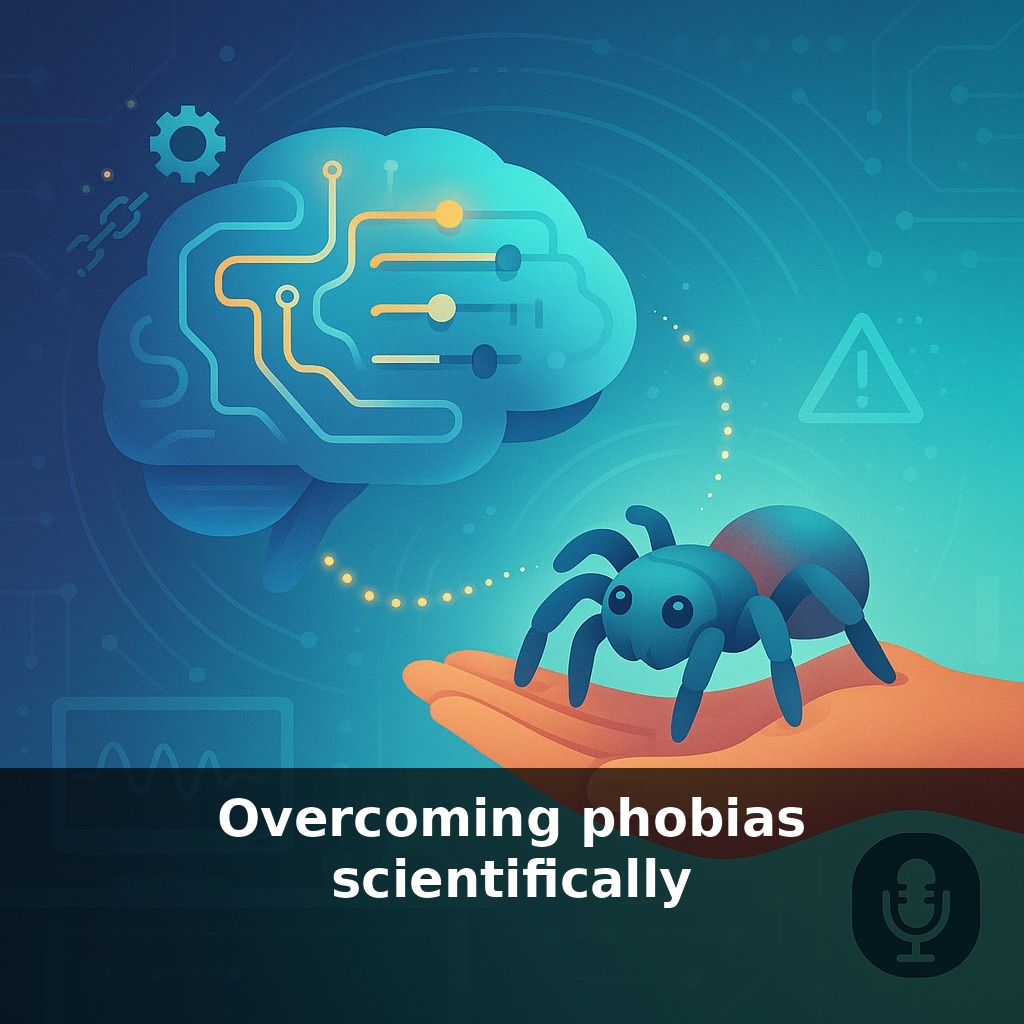
Right now, somewhere in the world, a person with a fierce spider phobia is walking into a lab—and calmly letting a tarantula crawl on their hand. No hypnosis, no magic. Just a few hours of training that literally rewires how their brain responds to fear. How is that even possible?
That lab scene isn’t a party trick—it’s a small window into one of the most optimistic findings in modern psychology: fear is not a life sentence, it’s a modifiable setting. And specific phobias turn out to be one of the most “hackable” problems in mental health.
Across huge international surveys, people often live around two decades with an untreated phobia—flying, needles, dogs, elevators—quietly organizing their lives around things they can’t face. Yet when they finally get evidence-based help, many see major improvement in just a handful of sessions.
In this episode, we’ll trace what scientists have learned about how to dial that fear response down: from stepwise exposure, to virtual reality rigs that let you “board a plane” in a therapist’s office, to experimental pills that may speed the process. And we’ll look at what all of this means if you—or someone close to you—feels ruled by a very specific fear.
Here’s the twist: the very fears that feel most irrational are often the most scientifically “treatable.” Simple phobias respond better to intervention than almost any other anxiety problem, yet people still walk extra blocks to avoid dogs, decline promotions that require flying, or delay medical care because of needles—sometimes for decades. In this episode, we’ll zoom in on what makes these fears so sticky and yet so changeable, and how labs are turning that insight into practical tools you can hold in your hand—like tuning a radio until the static of panic becomes a clearer signal you can work with.
For scientists, the turning point came from watching what happens in the brain when someone *stays* with fear instead of fleeing. On a scan, the first seconds of contact with a phobic trigger light up deep alarm circuits. But if the person remains in that situation long enough, something quieter and more strategic starts to kick in: regions involved in context, prediction, and self-control begin to talk back to the alarm system. The same stimulus, the same body, but a different internal story about what it means.
A key detail: this is not about “being brave” in the Hollywood sense. People who do well in treatment aren’t fearless; they’re willing to feel afraid on purpose, under carefully controlled conditions, and to repeat that process until their nervous system gets bored. The emotional spike matters less than what you *do* while it’s spiking—whether you lean in or shut it down.
This is why simple avoidance quietly cements the problem. Each time you skirt around a dog, skip a vaccine, or take the stairs to dodge an elevator, your brain logs a tiny data point: “We escaped. Avoidance worked. Threat confirmed.” Over months and years, those micro-decisions stack up into a rigid rule set: *don’t even get close*. The world shrinks, and the fear feels more “true.”
Treatment flips that learning on its head. Instead of collecting “I escaped” memories, you collect “I stayed and nothing catastrophic happened” memories. At first, those new experiences feel flimsy compared to years of practiced dread. But repetition shifts the balance. Neuroimaging studies show that as people rack up these corrective experiences, the alarm response not only drops in intensity, it starts sooner and ends faster—like a reflex that’s being retuned.
Technology is making this process far more flexible. Someone who can’t get on a real plane can rehearse in a simulated cabin, complete with engine noise and takeoff. Apps can guide micro-exposures in daily life, turning a routine commute or lunch break into a training ground. And in parallel, researchers are probing molecules that might temporarily boost the brain’s ability to consolidate these new safety memories, so fewer sessions are needed to tip the scales.
If you strip away the clinical jargon, the core discovery is disarmingly simple: when it comes to phobias, your brain updates not from what you *think* about your fear, but from what you repeatedly *do* in the presence of it—and survive.
A fear of flying might start with just watching a plane on video, then sitting in a parked aircraft, then doing a short flight with a trusted friend. At each step, the “rule” in your head quietly shifts from “planes = catastrophe” toward “planes = intense, but doable.” Therapists often script these steps in surprising detail: choosing a seat, planning what you’ll say to the crew if panic hits, even deciding which song you’ll play during takeoff so your brain has a familiar anchor.
VR setups take this further. Someone terrified of heights can “stand” on a glass bridge, lean over the rail, then repeat the sequence until their pulse stops spiking. A musician might appreciate the logic here: you don’t master a piece by thinking about it, you loop the hard bar slowly until your hands stop fumbling. In clinics, that looping can be compressed into an intensive single day, or stretched over weeks, woven into real life with app-based prompts that nudge you toward tiny, deliberate confrontations instead of automatic detours.
An overlooked ripple effect: as tools sharpen for intense, targeted fears, they’re quietly redrawing where “normal” anxiety ends and “treatable” begins. AI systems that adjust difficulty like a smart coach could turn short, personalized sessions into standard care, not a luxury. Think of clinics less as last resorts and more like travel hubs—brief stopovers where people update their internal maps, then re‑enter daily life with wider routes and fewer no‑go zones.
So the real frontier isn’t just lab gear; it’s how you use it in the wild—on the bus, before a meeting, in a waiting room. Progress is often quiet: choosing the cramped seat, letting your pulse climb, staying anyway. Over time, your “no way” zones become side streets you’ve actually walked, like adding new pins to a map you thought you’d never visit.
Before next week, ask yourself: 1. “If I imagined watching a 10‑second video of my specific phobia (e.g., a spider on a wall, standing on a balcony, boarding a plane), what exact moment does my anxiety spike—and what tiny, concrete version of that could I safely expose myself to today for just 1–2 minutes?” 2. “When my fear kicks in during that brief exposure, what physical sensations and catastrophic thoughts show up first—and if I stayed with them without escaping, what evidence would I get about how long they actually last and whether they really overwhelm me?” 3. “If I repeated this same tiny exposure every day for a week, turning down avoidance just 5–10% each time, what would ‘slightly braver me in seven days’ be able to do that ‘today me’ can’t yet?”