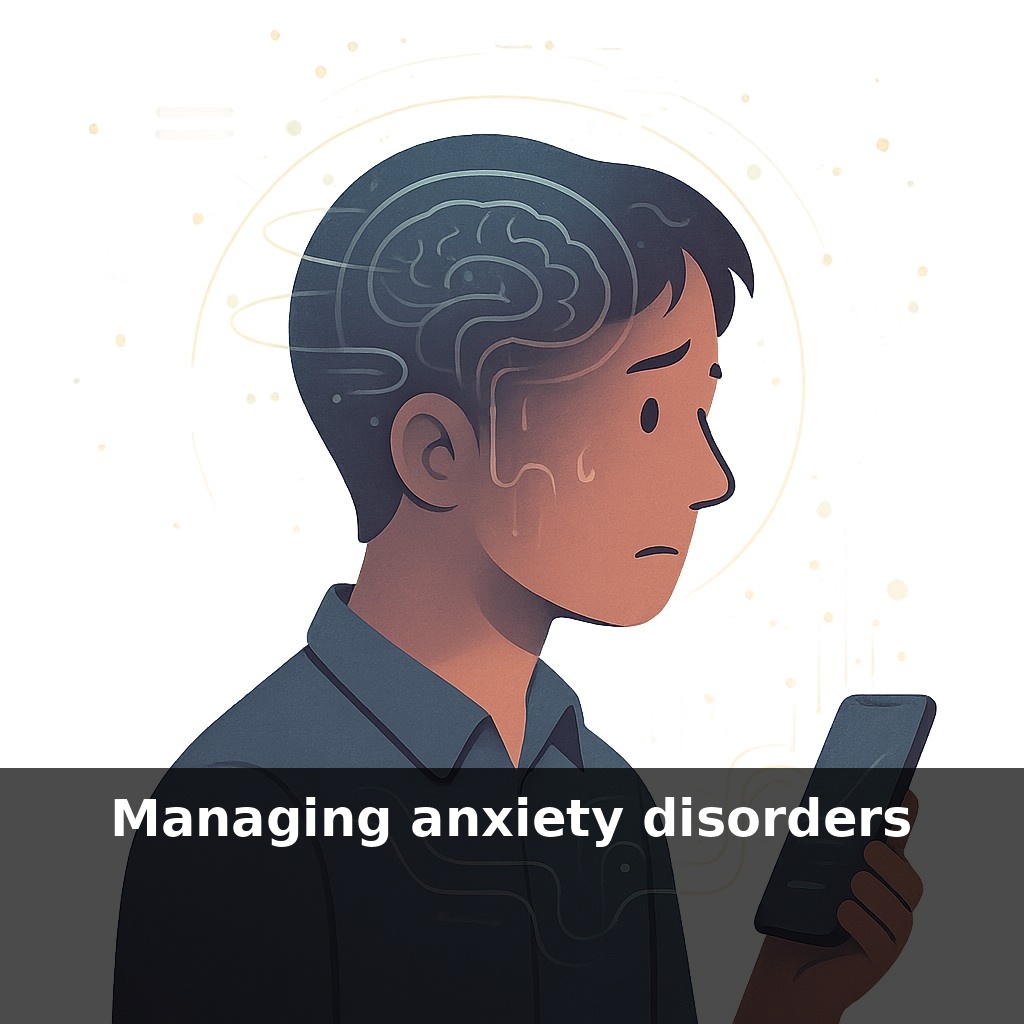
Right now, more people live with an anxiety disorder than with any other mental health condition on the planet—yet most never get treatment. You’re walking into work, phone buzzing, mind racing, but nothing’s actually wrong. So why does your body insist that everything is on fire?
Anxiety doesn’t only show up in therapists’ offices or on prescription charts; it quietly rewrites daily life. Meetings get scheduled around “what ifs.” Commutes become tactical routes to avoid crowded trains. Sleep turns into a negotiation with your own thoughts. On the surface, it can look like “being responsible” or “high achieving,” but under the hood there’s a nervous system running at unsafe speeds, like a car engine redlining on an empty highway.
What’s changed in the last decade is not just how common this is, but how many new ways we have to interact with it. Your phone can now deliver a breathing coach, a CBT exercise, or—less helpfully—a late‑night doomscroll. Wearables can flag rising heart rate before you even notice you’re tense. But more tools doesn’t automatically mean better outcomes; it raises a harder question: which inputs actually calm the system, and which secretly keep it wired?
Part of the confusion is that anxiety isn’t just “in your head”—it’s also in your wiring and your habits. Genetics can tilt the odds, early experiences can quietly train your brain to over‑prepare for danger, and certain personality styles (perfectionistic, approval‑hungry, hyper‑responsible) pour fuel on the fire. Then modern life adds its own accelerants: constant notifications, performance metrics for everything, and news that feels like a 24/7 siren. The result is a feedback loop where biology, biography, and technology keep nudging your threat system to stay slightly “on call” all the time.
Forty‑two billion dollars a year. That’s the estimated U.S. price tag of anxiety disorders when you add up healthcare, lost productivity, and all the subtle ways worry shrinks people’s lives. Yet the real cost is often paid in tiny, invisible decisions: the job interview declined, the social event “rescheduled,” the long‑haul flight never booked.
One under‑appreciated pattern is how anxiety quietly trains your attention. Your brain becomes a highly sensitive “danger radar,” scanning for anything that might go wrong. Over time, this bias means you notice every raised eyebrow in a meeting but miss half the neutral or positive signals. On social media, that same bias locks onto critical comments and worst‑case headlines, reinforcing the sense that the world is hostile and you’re always one misstep away from catastrophe.
Technology can amplify this cycle or interrupt it. A late‑night scroll through health forums after a minor symptom can escalate into hours of catastrophic self‑diagnosing. Location‑sharing with friends can morph from convenience into compulsive checking—“Are they home yet? Why aren’t they moving?” Fitness trackers, meant to motivate, can become anxiety triggers when every heart‑rate spike is interpreted as danger rather than normal fluctuation.
But the same devices can be repurposed as allies if used deliberately. Some CBT‑based apps now embed “attention training,” nudging you to practice noticing non‑threat cues in your environment—a relaxed shoulder here, a friendly message there. AI tools can help you write a difficult email you’ve been avoiding, or rehearse how to say no without over‑explaining. Even simple calendar reminders can be structured as prompts for micro‑exposures: five‑minute tasks that gently stretch what you’re willing to face.
Think of it a bit like adjusting medication doses in a hospital: the very same substance that heals at one level can harm at another. Notifications, metrics, and connectivity aren’t inherently good or bad; their impact depends on the “dose” and the timing, especially when your mind is already tuned toward potential threats.
Your challenge this week: use one piece of technology you already own to make a tiny, specific move *toward* something anxiety usually talks you out of. That might mean setting a 3‑minute timer to start a task you’ve been procrastinating on, scheduling a short call you’ve been dreading, or using a notes app to script the first two sentences of a conversation you’ve been avoiding. The goal isn’t to feel calm while you do it; it’s to prove—through action—that anxiety doesn’t get the final vote on what you’re allowed to attempt.
A useful way to experiment with tech and anxiety is to treat your apps like band members in a studio: each can play louder or softer depending on the “song” you’re trying to record that day. For example, someone with social anxiety might lower the volume on messaging apps by pinning only three essential chats and muting the rest during working hours. Another person, prone to health worry, could move symptom‑checker sites off the phone’s home screen and give a “reality‑check” note from their doctor that prime spot instead. A student who spirals around grades might turn off real‑time score notifications, but schedule a weekly “results review” block when they’re rested. You can also add one “counter‑app” for every “trigger‑app”: if you keep Instagram, pair it with a values‑focused journaling app; if you track news, pair it with a gratitude log. The experiment isn’t minimalism; it’s intentional sound‑engineering for your digital environment.
Soon, anxiety management might feel less like “going to treatment” and more like maintaining a personalized toolkit. Instead of a single app, you could have a small “dashboard” that quietly coordinates your sleep data, calendar load, and social rhythms, nudging you *before* you hit overload. School platforms might flag rising avoidance in students the way plagiarism tools flag suspicious text. The risk: a world where your inner life is legible to systems that don’t always have your consent or your best interests in mind.
Managing anxiety with tech is less about finding a magic app and more about learning which tools play well with your mind. Think of it like curating a playlist: some tracks energise, some soothe, some you skip. Over time, noticing which “songs” you reach for in stress—news feeds, games, chats—can reveal patterns, and patterns are the doorway to choice.
Before next week, ask yourself: 1) “When I notice my anxiety spike (like before a meeting, while checking email, or trying to fall asleep), what exactly is running through my mind—and if I treated those thoughts like ‘predictions’ instead of ‘facts,’ how would I test them in real life?” 2) “Looking at my week, which specific situation do I usually avoid because of anxiety (a phone call, social event, tough conversation), and what is the smallest, clearly defined version of facing it that I’d be willing to try for two minutes?” 3) “When my body first starts sending anxiety signals (tight chest, racing heart, shallow breathing), what simple 60-second routine—like a particular breathing pattern, grounding with five things I can see, or relaxing my shoulders—am I willing to practice once a day even when I’m not anxious, so it’s ready when I need it?”