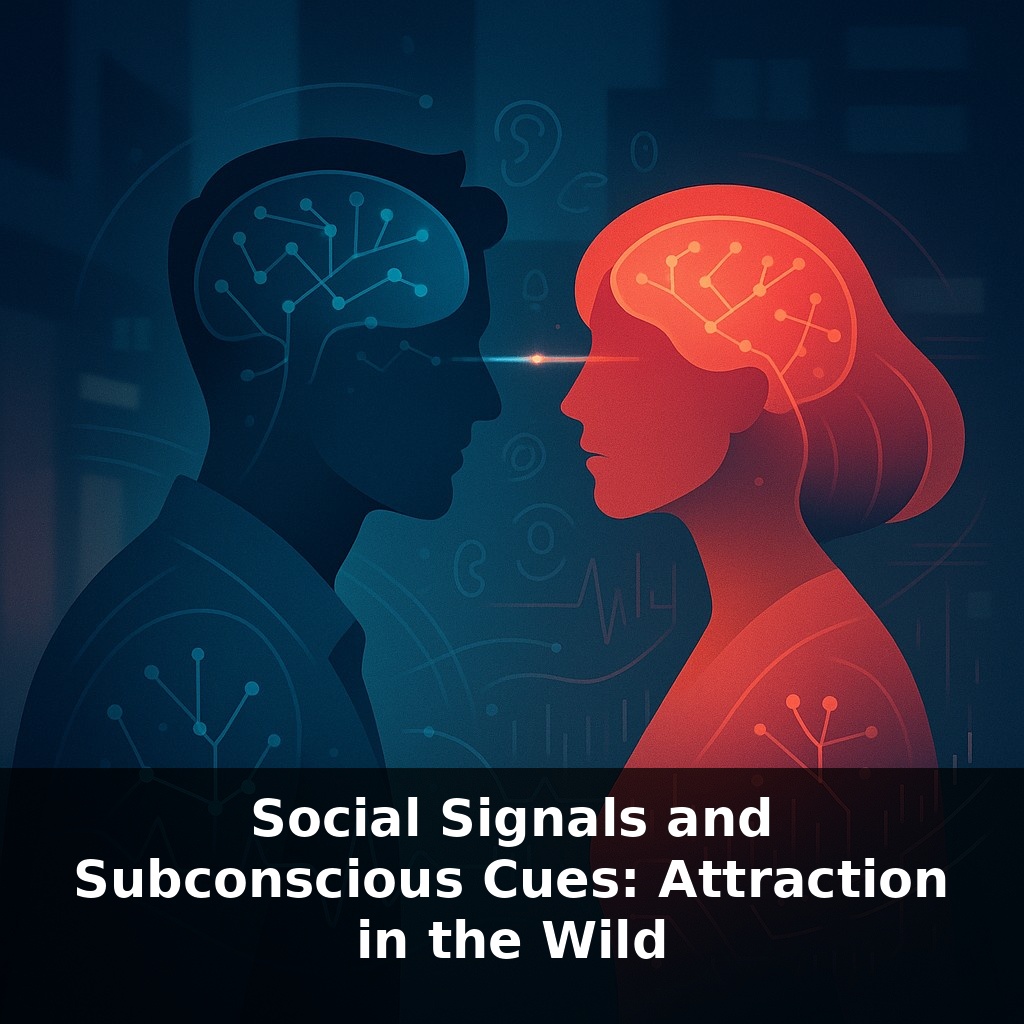
You decide in less than a blink whether you’re drawn to someone or want to walk away—and your brain does it before you even know you’ve looked. Two strangers pass on the street, trade a glance, a tiny shift in posture, a hint of scent… and an invisible verdict has already been cast.
You’ve already seen how quickly your brain makes up its mind about someone; now we zoom in on *how* it’s doing that in real time, out “in the wild.” Attraction isn’t just a look or a vibe—it’s a layered stream of signals: the way someone’s shoulders relax toward you, the warmth or sharpness in their “hey,” the almost imperceptible shift in their pupils when you step closer. Meanwhile, your own body is broadcasting too: your scent subtly changes with stress or confidence, your voice softens or tightens, your feet angle toward the person you’re most engaged with. None of this waits for your conscious approval; your ancient reward circuits are running a rapid-fire evaluation, long before any deliberate “Do I like them?” thought appears. In this episode, we’ll unpack those micro-moments so you can notice them without trying to script them—because forcing it usually breaks the spell.
In crowded, noisy spaces—bars, conferences, subway platforms—your brain leans even harder on these fast signals. Research shows that under cognitive load (like music, chatter, or phone notifications), people rely more on “thin slices” of behavior: tiny samples of how someone moves, laughs, or orients their body in a group. Instead of tracking every detail, your mind flags patterns: who consistently leans in when you speak, whose voice softens when using your name, who keeps finding reasons to re-enter your orbit. These subtle consistencies often predict real compatibility more than any single dazzling moment.
Think of this part of the story as zooming the camera in from “overall vibe” to specific channels your brain is sampling and weighing.
Start with eyes. Beyond simple eye contact, your brain tracks *how* someone looks at you: quick glances and look-aways during conversation, tiny squints that signal real focus, that barely-there eyebrow lift when you speak. Lab studies find that an interested gaze often comes in brief “bursts”—a second on your eyes, a slide to your mouth or hands, then back—rather than a flat, unblinking stare. Your own eyes respond too: Hess’s work on pupil dilation showed that your pupils quietly expand more when you’re looking at someone you’re into, which in turn can make *you* look warmer and more open to them.
Then there’s voice. Beyond what’s said, attraction often shows up as subtle shifts in pitch, rhythm, and melody. People tend to “tune” to each other: matching speech rate, softening consonants, adding more vocal warmth on each other’s names. In several studies, both men and women rated slightly more varied, sing-song patterns as more engaging and flirtatious than flat delivery—even when they couldn’t say why. Under stress, the opposite happens: the voice tightens, pitch jumps unpredictably, laughter gets sharper. Your nervous system is reading those changes as clues about safety and mutual interest.
Scent works more quietly, but it’s not just sweat. Your baseline odor reflects hormones, immune markers, even diet. Wedekind’s famous T‑shirt experiment, where many women favored the smell of men with different MHC genes, hints at why a partner’s “natural smell” feels either grounding or subtly off. Importantly, this isn’t about heavy cologne; strong artificial scents can actually mask the information your brain is hunting for and turn the volume down on this channel.
Behavioral “micro-moves” stitch these channels together. Someone shifts so their torso is just slightly more squared to you than to the group, or they time their jokes to your laughter more than anyone else’s. Feet that stay pointed toward you while their head turns to answer others, fingers that briefly mirror how you’re holding your glass, a lean-in that matches your own: these are low-intensity, low-risk bids that gradually signal, “I’m oriented to you more than to the room.” Over minutes, your nervous system tallies these little investments and updates that fast gut sense—not as a single dramatic moment, but as a running score.
You’ve probably noticed how some people just *feel* easy to be around in a crowd, while others leave you oddly tense. Often, the difference is in tiny “coordination moves” your brain tracks without reporting back. For example, two people at a noisy party might start laughing at slightly different moments; as they grow more attuned, their reactions sync up, like dancers gradually finding the same beat. That sync—matching pauses, shared smiles that rise and fade together—quietly signals mutual interest to both nervous systems.
Context shifts matter too. Someone who’s relaxed and playful in a small group but turns clipped and guarded one‑on‑one may trigger a subtle pullback in you, even if you can’t name why. Your brain is comparing “versions” of them across situations. Technology adds another twist: a person whose texts feel witty and warm but whose in‑person timing, touch on the arm, or way of standing near you doesn’t line up can create a low‑level dissonance that cools initial excitement before you consciously decide anything is wrong.
Algorithms are starting to notice these cues before we do. Wearables already log heart rate spikes and tiny shifts in breathing; pair that with cameras tracking gaze and facial tension, and a future dating app could flag “hidden chemistry” like a fitness app flags overtraining. Your subconscious might feel crowded: you’re chatting, while a system nudges, “Talk to them again.” The paradox is huge—outsourcing intuition could sharpen choices, but also dull the very instincts it’s built to decode.
Your challenge this week: treat daily interactions like a field study. Choose one setting—a café, meeting, or commute—and quietly track three things: how people adjust distance, how often their voices “tune” to each other, and when someone orients their body toward one person more than the group. Notice how your own signals shift in response.