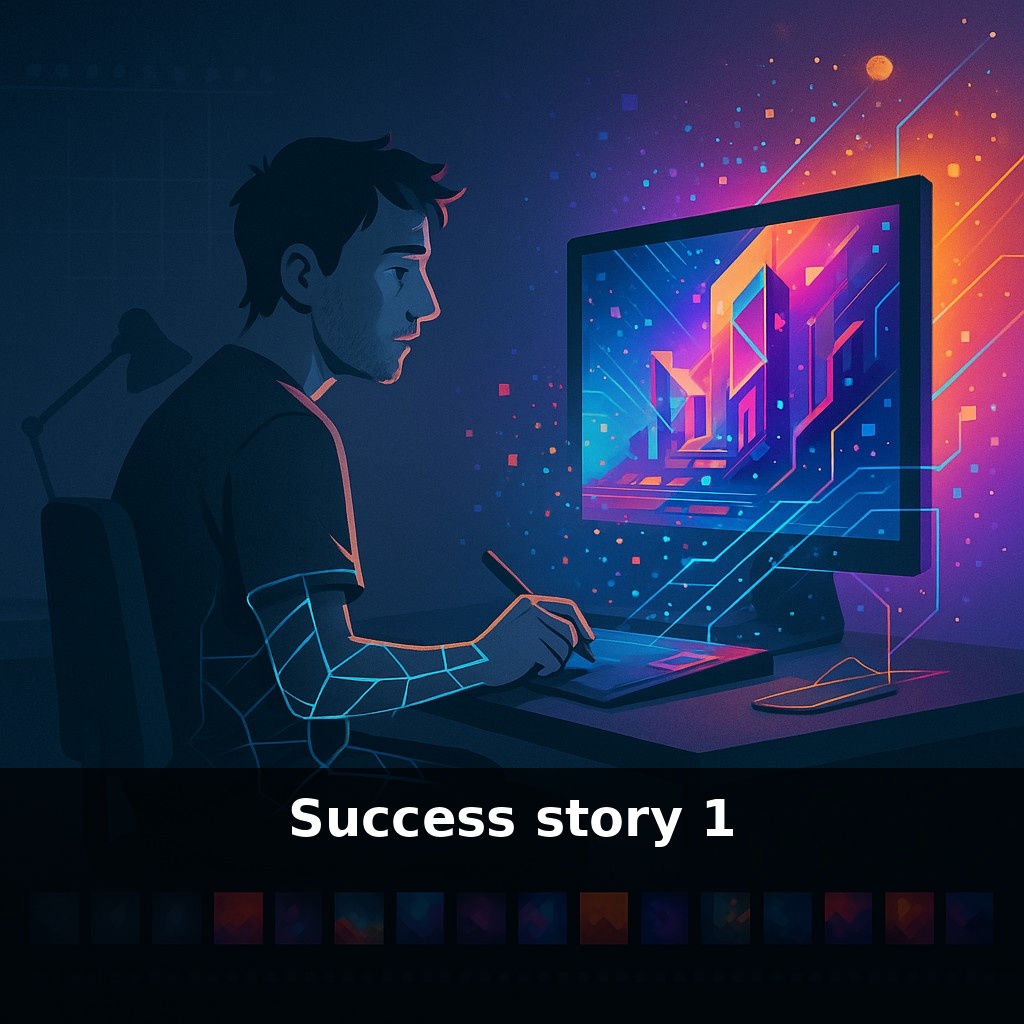
Boredom helped create a digital artwork that sold for about seventy million dollars. A sleepy weekday, a burned‑out graphic designer, a personal dare to post one new image every single day. No investors, no grand plan—just one decision that quietly rewired his entire career.
Beeple didn’t just fill a dull evening; he quietly built a creative exoskeleton. Day after day, he strapped himself into a routine most of us would abandon the first busy week. Think of it like a musician committing to record a rough demo before bed, no matter how messy the day was. Over years, those “throwaway” demos become an unexpected archive—a map of evolving taste, skill, and risk‑taking. Beeple’s archive just happened to be public, timestamped, and brutally consistent. That consistency did something boredom alone never could: it turned unfocused restlessness into a visible signal. A signal to collaborators, collectors, and eventually an entirely new technology that was looking for exactly this kind of obsessive, trackable output to latch onto and revalue.
Some nights Beeple barely had time. He stole two, maybe three hours between client work and sleep to push out a single frame. Most of those images never went viral, never sold, never even earned more than a few likes. But each one added a date‑stamped tile to an expanding timeline. That timeline became proof: of effort, of direction, of priorities when no one was watching. Years later, when NFTs emerged, that trail functioned like a lab notebook in science—messy, complete, impossible to fake in hindsight—and suddenly collectors could trace, and price, the whole arc instead of a single moment.
On the blockchain side, something equally odd was happening. Ethereum wasn’t designed for art; it was built for programmable money. But creative developers realized you could write a tiny contract that says, “This specific token represents this specific piece of work, and here are the rules forever.” Suddenly, ownership became a line of code rather than a line in a filing cabinet. You didn’t own the JPG itself; you owned the cryptographic receipt that everyone could verify and no one could quietly edit.
For someone with thousands of timestamped pieces already online, that shift was explosive. Most artists drop a new series, then maybe a follow‑up. Beeple had a back catalog that behaved more like a genome: variations, mutations, clear phases, all laid out in public. When NFTs arrived, he wasn’t scrambling to make “blockchain art.” He was packaging a body of evidence that already existed, then binding it to a technology designed to track provenance and payment with machine precision.
Christie’s entry into the story added a second translation layer: from niche crypto experiment to legacy art market. Auction houses thrive on proof—authenticity, scarcity, history. The chain of blocks recording each token transfer gave them a clean, automated provenance trail. A smart contract could even bake in a perpetual royalty, so if a collector flipped a piece years later, Beeple automatically received a cut without hiring lawyers or chasing invoices.
There’s also a psychological twist. Traditional art buying often means trusting a small circle of experts. Here, anyone could click a block explorer and see the entire transaction history. Scarcity wasn’t enforced by locked vaults, but by shared math. To some collectors, that transparency felt safer than opaque gatekeeping.
Think of it this way: in medicine, a single lab result is interesting, but a decade of bloodwork is powerful—you can see trends, catch anomalies, predict risk. Beeple’s long archive functioned like longitudinal data. The NFT was just the lab report that made those years of quiet, almost boring measurements legible—and suddenly, highly valuable—to a new kind of market.
Think about how athletes treat training logs. Most entries look trivial—split times, heart rates, tiny notes like “felt flat today.” But string thousands together and you get a performance fingerprint that scouts, coaches, and data analysts obsess over. Beeple’s daily images played a similar role: a huge, granular record that tech and markets could suddenly read in a new way once NFTs existed.
The same pattern shows up in other fields. Indie game developers who ship a tiny prototype every week slowly accumulate worlds, mechanics, and experiments. When a new platform appears—say, a VR headset or a subscription service—they’re not starting from zero; they have shelves of half‑finished ideas ready to be remixed and re‑released in a format the new system can reward.
Your own “Everydays” might not be visual at all. A musician posting short loops, a programmer committing tiny tools to GitHub, a teacher sharing one mini‑lesson a day—those trails become searchable inventories the moment some new distribution channel demands proof of past work rather than polished portfolios alone.
Success in this new landscape may look less like a single “break” and more like compounding traces of curiosity. As tools like AI, AR, and decentralized platforms mature, they reward makers who leave long, weird trails behind them. Think of your experiments as seeds scattered across future soil: you don’t know which climate will arrive, only that ecosystems form around what’s already growing. Today’s side‑quest project could become tomorrow’s credential, dataset, or even collaborative playground.
Your challenge this week: pick one tiny domain—sketches, code snippets, voice memos—and ship a single rough piece into the world every day. Treat each one like a breadcrumb, not a masterpiece. By week’s end, notice which crumbs attract comments, questions, or collabs. That quiet feedback loop is often where the next market—or medium—first whispers.