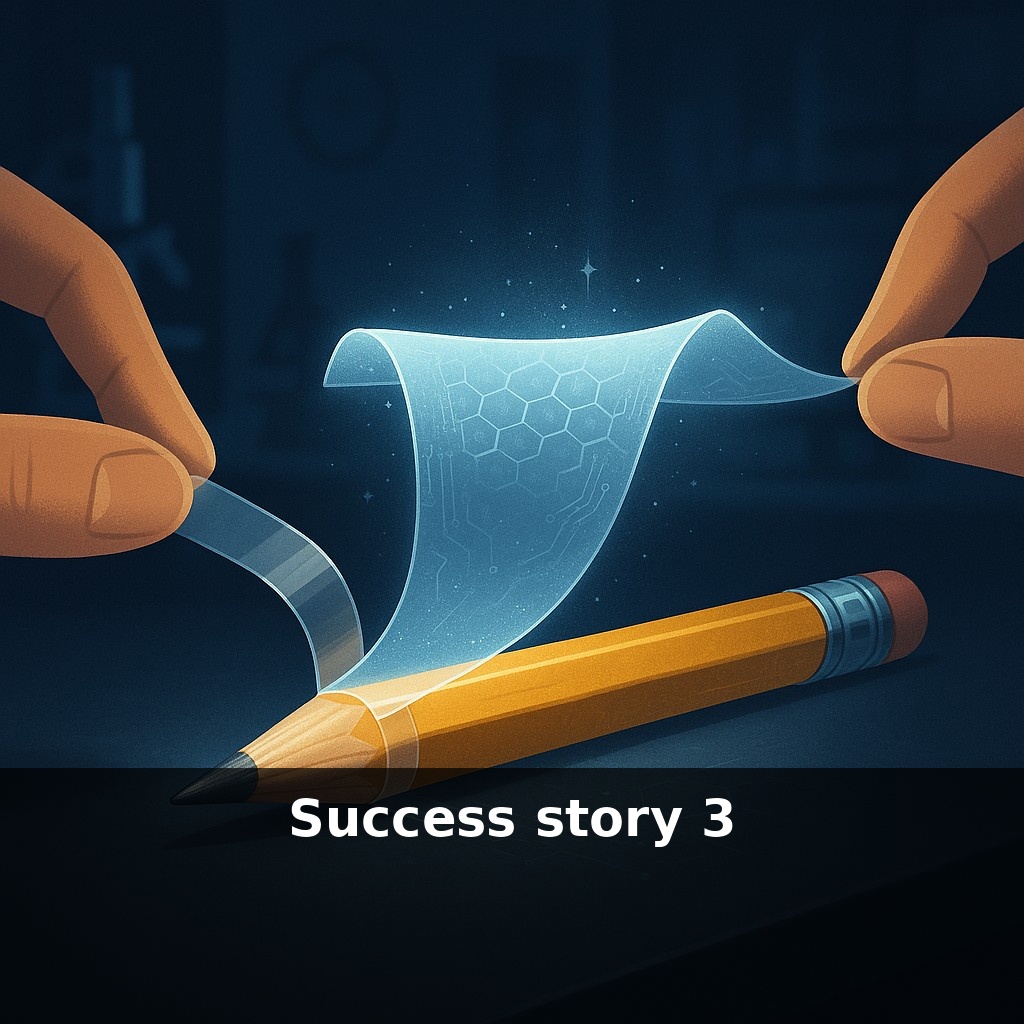
On a quiet Friday night in a nearly empty lab, two physicists start peeling at a lump of pencil lead with plain Scotch tape. No grant, no grand plan—just boredom. By the time they’re done, they’ve stumbled onto a material strong enough to rewrite whole industries.
Most of us are trained to treat boredom like a malfunction: if you’re not “on task,” you’re wasting time. In high‑stakes research, that pressure is even louder—every minute should serve a grant, a deadline, a publication. Yet some of the biggest breakthroughs begin in the exact moments that look the least productive. What happens when a curious mind finally runs out of official work and starts to drift?
In that Manchester lab, the drift wasn’t toward Netflix or social media; it was toward playful “what ifs,” the kind you idly test on a slow evening. That small act of experimental doodling—no agenda, no roadmap—quietly cracked open a new frontier in physics. Not with a billion‑dollar machine, but with attention, patience and tools already on the bench. This episode is about that hinge point: when boredom stops being a void and becomes a portal.
In most jobs, that Friday‑night drift gets crushed long before it turns into discovery. Inbox pings, performance dashboards, “quick syncs”—they all conspire to keep your attention narrowly tethered to what’s measurable right now. In Geim and Novoselov’s lab, there was just enough slack in the system for curiosity to wander off‑script. That slack is not laziness; it’s cognitive free space. Just as a jazz musician needs a few unclaimed bars to improvise, researchers need unassigned time and low‑stakes tools to follow hunches that don’t yet fit any official project or KPI.
They didn’t start that evening trying to revolutionize anything. The “official” work of the week was done. What slipped in next wasn’t a grand hypothesis, it was a tiny, almost throwaway question: how thin can we go?
First came the low‑tech mischief: pressing and peeling, pressing and peeling, watching the shiny flakes smear and split. Only later did the serious tools roll in. Under an atomic‑force microscope, those nearly invisible specks resolved into terraces, then into a single, razor‑flat plateau: carbon arranged in a perfect hexagonal lattice, just one atom thick. Raman spectra confirmed it; transport measurements showed electrons racing across it with astonishing ease.
This is the key: the lab already owned those instruments. The breakthrough wasn’t a new gadget; it was a new, slightly silly use of an old one, provoked by an unplanned question. In many labs, anything that looks that unstructured gets quietly edited out. Here, it was tolerated long enough to become data.
Once the sheet was real, the “boredom project” snapped into focus. How strong is it? How flexible? How fast can charge move? Each answer surfaced a new puzzle: a sheet so light it’s almost not there, yet with a theoretical strength that makes steel look fragile; electron mobility that turns copper into the underachiever; transparency plus conductivity in the same film.
The ripple effects moved quickly from novelty to platform. Clean‑room teams began carving tiny Hall bars and transistors into these films, probing how they behaved under magnetic fields and voltages. Other groups stacked different atom‑thin crystals on top, like carefully chosen musical notes, to create layered structures with tuned properties: one layer for conduction, another for light emission, another for sensing chemicals or strain.
Notice the order: first came an unplanned, low‑stakes poke at an ordinary material; only after that did the formal programs, funding and industrial roadmaps pile on. The billion‑dollar visions—faster chips, flexible displays, ultralight composites—are all second‑order consequences of a question that, on paper, looked like a distraction from “real work.”
In industry, the same pattern shows up in places that never see a lab coat. At 3M, an engineer frustrated with a weak adhesive—a “failed” glue that wouldn’t properly stick—started tinkering with it during off‑hours. That misfit material eventually became Post‑it Notes, a product no focus group was asking for but nearly every office now treats as essential infrastructure. At Adobe, early experiments with a side‑project image editor for in‑house use evolved, through years of casual tinkering and internal play, into Photoshop—a tool that reshaped design, photography and film.
Your own version doesn’t require exotic gear. A programmer pokes at a throwaway script to automate a tedious log file check and stumbles onto a dashboard their whole team adopts. A nurse tweaks the layout of a supply cart between rounds and quietly cuts minutes off every procedure. Like an unexpected detour on a familiar commute that reveals a faster route, those off‑task wanderings can redraw the map of what’s possible, but only if they’re given room to run.
A lab trick born from “let’s just see” now nudges entire industries to rethink how they treat idle time. When tools sit ready and people have permission to tinker, strange questions become testable. The frontier ahead isn’t just lighter planes or faster chips; it’s workplaces where a quiet afternoon is treated like R&D fuel. Your calendar could function less like a factory shift plan and more like a jazz score, leaving deliberate gaps where improvisation is expected, not excused.
When you next hit that restless lull—staring at code, a whiteboard, a spreadsheet—treat it less like a dead end and more like fresh snow no one’s walked through yet. Nudge one question a bit too far, repurpose one tool the “wrong” way, follow one hunch past what’s billable. The world doesn’t need more filled time; it needs more of those unscheduled detours.
Before next week, ask yourself: 1) “If I borrowed just one strategy from Success Story 3—like how they blocked ‘deep-work hours’ or handled client outreach differently—what’s the exact version that would actually fit my current schedule this week?” 2) “Where in my day am I still doing the ‘busywork’ they deliberately cut out (like endless tweaking, over-researching, or waiting for perfect conditions), and what will I consciously stop doing tomorrow so I can copy their focus on revenue-producing or impact-building tasks instead?” 3) “When I imagine myself having reached the same milestone they did (e.g., landing that signature client / hitting that income level / finishing that big project), what is one uncomfortable conversation, email, or pitch I’m currently avoiding that they would absolutely do—and when, specifically, will I do it this week?”