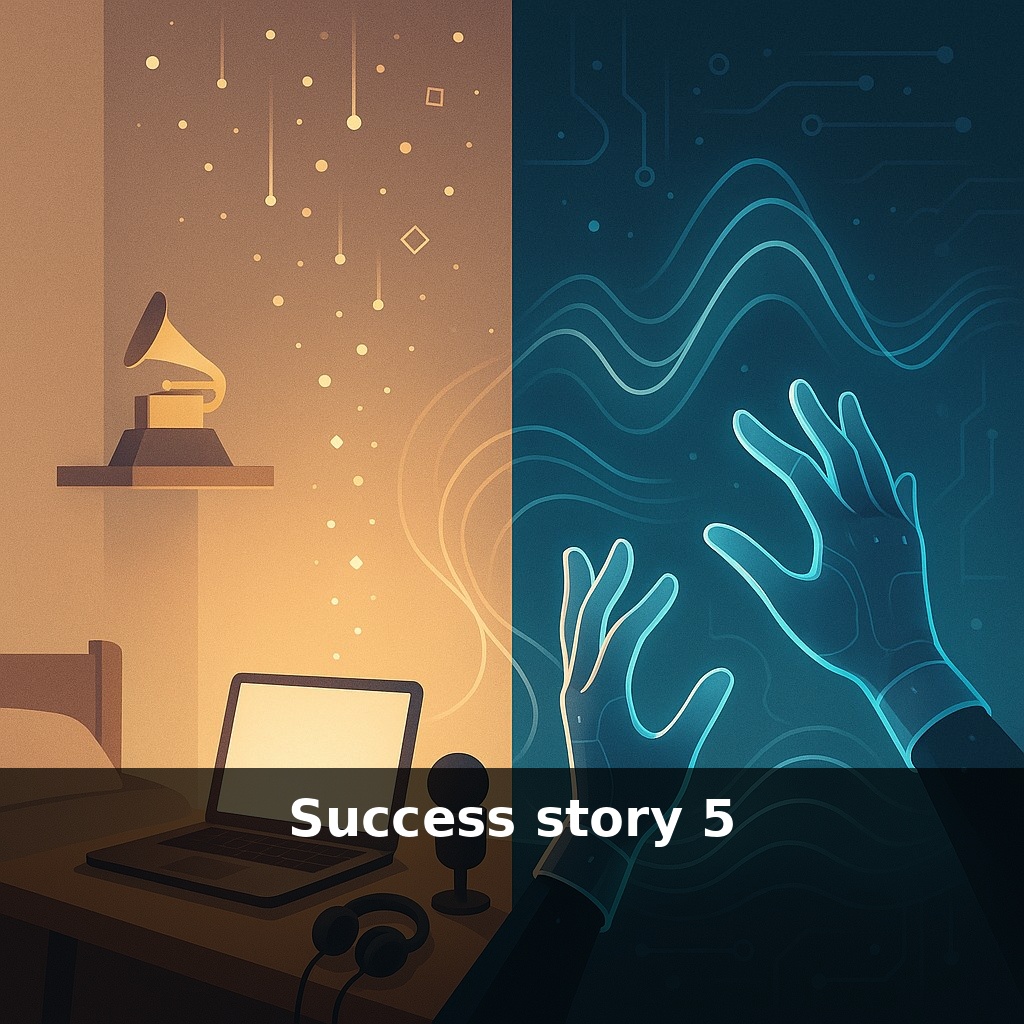
A Grammy‑winning album was born in a cramped bedroom, not a million‑dollar studio. At the same time, a British artist was so bored with her mouse and keyboard that she built musical gloves to control sound in mid‑air. Boredom, it turns out, might be our most underrated creative tool.
Billie Eilish’s bedroom albums and Imogen Heap’s mid‑air performances aren’t just quirky success stories; they’re signals of a deeper shift in how technology catches our ideas when they fall out of the sky. For most of music history, a wave of inspiration without studio access was like spotting a perfect wave with no surfboard nearby—you just had to watch it crash and disappear. Now, a laptop, a cheap USB mic and a DAW mean that a lazy Sunday afternoon hum can evolve into a fully‑scored track by dinner. Those “wasted” hours scrolling, pacing, or looping the same four bars become pressure valves where experiments sneak in: a weird vocal harmony here, an accidental chord there, a plugin pushed too far just to see what breaks. Under the surface, boredom plus accessible tech is quietly rewiring who gets to experiment—and what counts as a studio.
Now the “studio” quietly hides in everyday objects: a cracked‑screen phone running a voice‑note app, a laptop balanced on a kitchen table, a pair of motion‑tracking gloves mapping a hand wave to a bass drop. The gear isn’t just cheaper; it’s more obedient to fleeting whims. A half‑baked rhythm tapped on a train window can be captured, stretched, layered and warped by dinner. And because tools like sensor wearables and AI plugins respond instantly, they tempt you to poke at the edges of your habits whenever your mind starts to drift.
The shift shows up in the details of how people actually work. When Imogen Heap first hacked together what became the Mi.Mu gloves, she wasn’t trying to make a sci‑fi prop; she was trying to escape the stop‑start friction of traditional control surfaces. Twisting a plastic knob to shape a vocal swell felt like filling out paperwork. Bending her wrist to “grab” the sound mid‑phrase felt like performance. That difference matters: when there’s less mental lag between “I wonder what this would sound like” and hearing it, you try ten ideas instead of two.
That same compression of distance between impulse and outcome is what lets Billie Eilish and Finneas stack vocal harmonies, sub‑bass rumbles and ASMR‑level whispers inside a square of floor space smaller than some drum kits. A take that would have required booking a booth and an engineer can now be re‑recorded between bites of cereal. The boredom of yet another overdub becomes tolerable precisely because the friction is so low—and because every tiny variation is audible instantly.
At the far extreme sits Jacob Collier, whose Logic projects famously balloon past 500 vocal tracks. That density isn’t just overkill; it’s what happens when “maybe I’ll try one more harmony” stops being a logistical decision and becomes a reflex. His experimental multitrack harmoniser plugin (reportedly passing ten thousand licences in its first year) bakes this reflex into software: sing a line, hear it blossom into stacked intervals you might never have considered if you had to score them by hand.
Zoom out, and there’s an economic engine behind these private experiments. A global DAW market heading toward USD 4.1 billion means competition between tools to be more responsive, more playful, more “what if?” friendly. Features like generative chord suggestions or AI‑driven drum tightening aren’t just convenience; they’re invitations to push further when a loop starts to feel stale. In the same way a surgeon’s finely tuned instruments allow micro‑adjustments that were impossible with cruder tools, modern music tech turns tiny fidgets of curiosity into audible, sharable changes—and some of those end up sounding like the future.
A folk producer in Reykjavik sets a timer for 20 minutes and opens a blank project with no samples loaded. As the cursor blinks, she forces herself to build a sound world from whatever lies at arm’s reach: a mug tapped with a pen, radiator hiss, sea wind muffled by double glazing. A contact mic and a granular plugin turn that tiny inventory into pitched choirs and ghostly drums. A hip‑hop beatmaker in Lagos does something similar: he records motorbikes outside, market calls, a friend laughing off‑key, then slices them into percussion and hooks. Neither session looks “inspired” from the outside; it’s just tinkering with nearby noise until something clicks. Their habits echo game modders who open level editors with no plan, nudging sliders, dropping objects, abusing physics until an unexpected mechanic appears. In both cases, the toolkit is less a palette and more a playground: constraint on the front end, wild abundance on the back end, with curiosity steering the whole loop.
As interfaces keep softening, your playlist may start to feel less like a museum and more like a group chat. Listeners could “stitch” a verse onto a favourite track, flip stems like photo filters, or co‑write in real time with artists halfway across the world. Genres might splinter faster, but also recombine as easily as dragging folders together. Your commute jam could exist in thousands of subtly different versions—each one a tiny fingerprint of the crowd that shaped it.
So the next quiet afternoon might be less “lost time” and more like wandering into an empty playground after dark: swings still, lights buzzing, space waiting. The tools in your laptop, or even your phone, are closer to a half‑tuned band than a static app—nudging you to join in, add a small twist, and leave behind a version of a song that couldn’t exist without you.
Before next week, ask yourself: “Where in my business am I still ‘doing everything myself’ instead of building a simple system like [the one they described for handling inbound leads], and what’s the very first step I could take today to delegate or automate just that piece?” “When I look at how they niched down to serve [their specific type of client], what would it look like for me to commit to one clear ‘who’ and one clear ‘problem’ for the next 30 days, and what would I need to stop offering to make that real?” “Thinking about how they tracked only a few key numbers (like [their weekly revenue target and number of qualified calls]), which 2–3 metrics would actually move the needle for me, and how can I quickly set up a simple way—spreadsheet, CRM, or even a sticky note—to review those numbers every single day this week?”