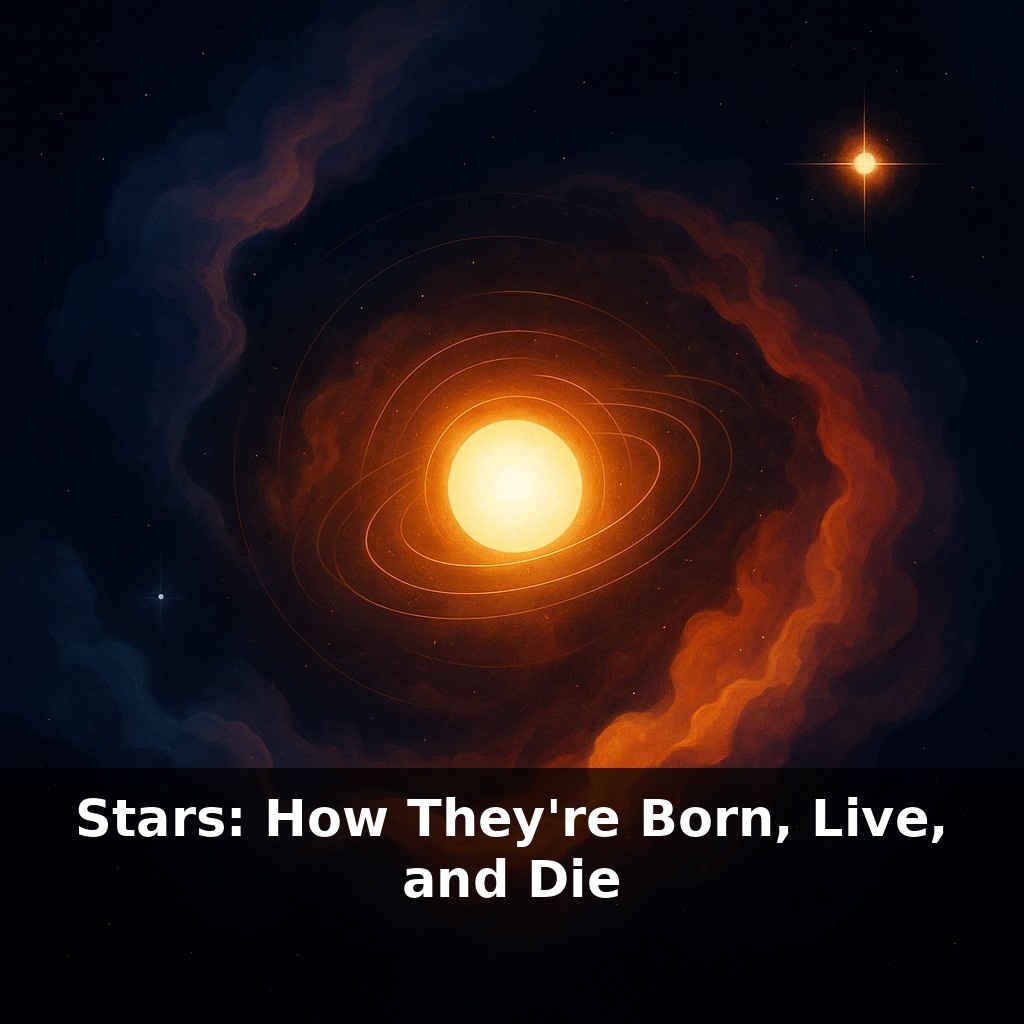
Right now, in the time it takes you to blink, somewhere in our galaxy a new star has just switched on. Not with a gentle glow, but with the power of millions of Earths. Yet its story began in darkness, inside a cloud so cold and quiet you’d never guess it was alive.
Some of those newborn suns will barely glow; others will roar into existence and start tearing themselves apart from the moment they light up. The difference comes down to one number: how much material they manage to grab before the chaos settles. That single number secretly decides almost everything about their future—how bright they’ll shine, what they’ll build in their cores, and how dramatically they’ll exit the stage.
Mass is the universe’s triage doctor: it “reads” a young star and quietly assigns it to a fate—ultra-long, quiet life or brief, catastrophic ending. A star with just a little mass will glow steadily for trillions of years, so thrifty with its fuel that it outlives entire galaxies’ current shapes. A heavyweight, though, burns with such intensity that it will race through its entire life cycle in a fraction of that time, seeding space with the elements for worlds like ours.
As those futures unfold, temperature and pressure quietly become the scriptwriters. Deep inside, they decide which nuclear “recipes” are even possible. Low-mass objects never get hot enough to cook beyond simple hydrogen changes; they stay with the cosmic equivalent of a slow simmer. More massive cores, though, climb through fusion “courses”: first helium, then carbon, oxygen, and beyond. Each step demands harsher conditions and runs faster than the last. All the while, light and particles leak outward, shaping surrounding space, nudging nearby gas, and even sculpting where the next generations of stars can arise.
At first, many newborn objects never quite “make it” as full stars. Some clumps stall before their cores get hot enough for sustained fusion; they end up as brown dwarfs—too massive to be planets, too underpowered to join the main stellar population. They glow weakly in infrared, slowly leaking the heat of their collapse, like embers that never caught proper flame.
Those that do ignite settle into a long stretch of stability. Outward energy flow balances inward gravity so precisely that a mature star barely changes for millions to billions of years. Inside, though, conditions drift. As easy fuel in the core is used up, the balance tips. The center contracts, the outer layers respond, and the whole structure quietly starts rearranging itself.
Low-mass stars respond gently. Their outer layers swell and cool, and they move into a phase where their surfaces redden and expand. The core, now more compact, starts new kinds of fusion while the envelope becomes loosely bound. Pulsations and stellar winds strip that envelope away over time, building a glowing shell of gas around a hot, exposed core. That core cools into a white dwarf: dense, Earth-sized, and slowly fading over billions of years as its stored heat radiates away.
More massive stars follow a more frantic script. As central fuel types change, the core successively hosts faster and more extreme fusion stages. Each new core layer forms inside the ashes of the last, creating an onion-like structure of elements. Near the end, the innermost region can become so dense that no known pressure can stop its collapse. When that support fails, the inner material plunges inward while the outer layers crash down onto it, rebound, and are blasted outward in a titanic explosion.
That outburst not only reshapes the star’s surroundings; it leaves behind a compact remnant. If the core mass is moderate, matter is crushed into a neutron star, where a spoonful would outweigh a mountain. If it’s higher still, gravity wins completely and a black hole forms, hiding its interior behind an event horizon yet continuing to influence its neighborhood with formidable pull and, often, powerful jets.
Out in the Milky Way, regions like the Orion Nebula act as busy “factory floors,” where dozens of developing systems share one vast reservoir of material. One collapsing clump might end up with enough to someday host rocky planets; another, just next door, stays too meager and leaves only a swarm of icy debris. The fallout from older, more violent neighbors matters too: astronomers have found radioactive fingerprints in ancient meteorites showing that, before our Solar System solidified, a nearby stellar explosion dusted it with freshly forged elements.
Those ashes quietly set the budget for everything from iron in a planet’s core to calcium in a future creature’s bones. Observatories such as Chandra and JWST actually watch shock fronts and hot bubbles from powerful deaths ramming into colder surroundings, compressing them, and sometimes triggering new collapses. Over millions of years, these overlapping waves turn once-smooth gas into a tangled patchwork of dense knots and empty cavities—a constantly edited draft from which later generations of systems must take their cues.
Some of the next breakthroughs may come from “listening” rather than just “looking.” Neutrino and gravitational-wave detectors can catch fleeting shivers from distant blasts that light alone cannot trace. As new surveys map how often such signals occur and where, they can reveal which neighborhoods are still actively forming heavy elements. Over time, that census may show why some regions grow rich in potential for rocky worlds while others stay comparatively barren.
In the end, these distant furnaces are also quiet archivists, filing away each reaction in the universe’s long memory. Their migrations, mergers, and collisions shuffle that record like cooks trading recipes, changing what’s possible on the “menu” of future worlds. Follow their stories, and you’re really tracing the family tree of matter—including you.
Start with this tiny habit: When you step outside after dark, spend 10 seconds finding just one bright star or planet and quietly say its “life stage” to yourself—“newborn cloud,” “main-sequence like the Sun,” or “dying giant/supernova.” If you can’t see stars, look up a picture of a nebula, a star cluster, or a supernova remnant on your phone and do the same thing. Over time, you’ll start linking real points of light in the sky to where they are in the star life cycle you heard about in the episode.