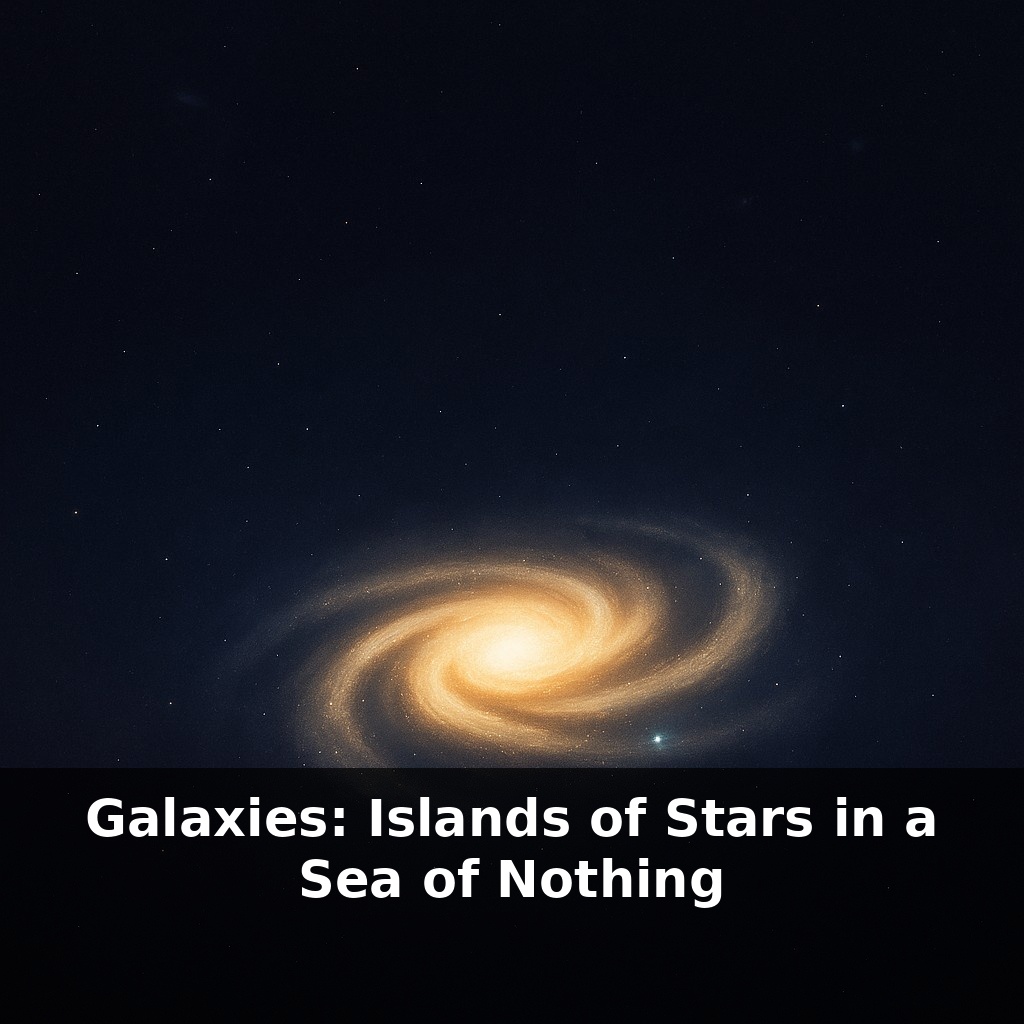
Right now, most of the universe is… empty. Yet scattered through that vast nothing are islands so dense with stars that night never truly falls. You’re standing on one. In this episode, we’ll zoom out until the Milky Way itself feels small—and then keep going.
Two trillion. That’s a rough estimate of how many galaxies may live in the observable universe—so many that if you tried to count one per second, you’d run out of time long before you ran out of galaxies. And yet, for all that abundance, each one is a fragile balancing act between gravity pulling together and expansion trying to pull apart.
In this episode, we’re leaving our home spiral behind to meet its relatives: smooth, swollen ellipticals packed with old stars; chaotic irregulars still scarred by past collisions; and newborn systems JWST is catching just a few hundred million years after the Big Bang. We’ll see how dark matter quietly scripts their growth, how supermassive black holes can both feed and starve them, and how, on the largest scales, they gather into clusters and filaments that redraw our sense of “structure” in the cosmos.
Galaxies aren’t just star containers; they’re time machines. Look across space and you also look back across billions of years, catching galaxies at every life stage: some just switching on their first generations of stars, others faded and “retired.” Their shapes trace that history. Spirals tend to be lively, rich in gas and ongoing star birth. Giant ellipticals are often the end-products of repeated crashes and mergers. With tools like JWST and ALMA, astronomers now watch gas streaming in, stars igniting, and violent interactions reshaping galaxies in real time across cosmic history.
If you could freeze the expansion of the universe and lay out all the galaxies on a grid, the first surprise would be how *un-gridlike* things are. Galaxies huddle together in groups of a few members, or in massive clusters of thousands, with long chains of systems threading between vast empty regions. The second surprise: almost none of them are quietly minding their own business.
On galactic scales, gravity is social. Nearby galaxies tug on each other, pulling out long tidal tails of stars and gas, warping disks, even ripping whole systems apart. The graceful spirals we’re used to seeing are often temporary arrangements, easily disturbed by a passing neighbor. Many galaxies show faint stellar streams—ghostly arcs and shells—evidence of smaller companions that were shredded and absorbed. The Milky Way has several such stellar streams, and surveys keep finding more.
Collisions, despite the violent name, are mostly encounters of empty space. Stars themselves rarely hit each other; galaxies are too diffuse. But their gas does collide and compress, and that matters. When gas clouds are squeezed, they can collapse and form new stars in bursts. Some of the brightest, bluest systems we see are merger-triggered starbursts, briefly forming stars hundreds of times faster than the Milky Way before exhausting or expelling their fuel.
Here’s where feedback comes in. Massive stars live fast and die as supernovae, stirring and heating the gas around them. Central black holes can launch jets and winds that blow material out of their host. Too much of this feedback, and a galaxy’s star formation can shut down; too little, and gas cools so efficiently that it collapses into dense clumps instead of an extended disk. Getting “just enough” feedback is one of the main challenges in modern galaxy simulations.
Those simulations now try to follow billions of particles of dark matter and gas over billions of years. Give them the right physics, and familiar structures emerge: thin rotating disks, puffed-up spheroids, lopsided dwarfs. Change the rules—for example, remove dark matter entirely—and galaxies either don’t form correctly or fall apart. Observational tests back this up. In systems like the Bullet Cluster, and in careful measurements of how stars orbit within individual galaxies, the visible matter’s gravity simply isn’t enough. Some additional, unseen mass must be there, shaping every orbit and merger.
Not all galaxies live in crowded neighborhoods. Some “field” galaxies drift in relative isolation, evolving more gently. Others are dwarfs, with just a few million stars and shallow gravity wells that make them extremely sensitive to every supernova and outflow. These small systems are especially useful laboratories: with little mass and simple structure, they reveal how starlight, gas, and dark matter interact without the confusion of huge populations and complex histories.
Even among spirals, there’s rich variety. Bars—straight, bright structures cutting across the center—can funnel gas inward, feeding bursts of star formation or activity around the central black hole. Outer rings may trace recent encounters or resonances where orbital motions line up. Some disks barely show arms at all; instead, they display patchy, “flocculent” structures that grow and fade as local instabilities come and go. The clean, symmetric spirals on posters are often the exception rather than the rule.
And then there are the genuinely odd cases: ultra-diffuse galaxies with Milky Way-like sizes but only a hundredth the stars; compact “red nuggets” that seem like frozen relics of the early universe; galaxies apparently stripped of most of their dark matter by past interactions. Each outlier is a stress test for our theories. When a galaxy looks strange, astronomers ask: is our physics incomplete, or did this system just live an especially dramatic life?
That’s part of what makes galaxies such powerful probes. They are not simple objects; they’re the integrated result of environment, initial conditions, and billions of years of chaotic interactions. Yet across all that complexity, clear patterns emerge—massive galaxies tend to quench their star formation; denser environments host more ellipticals; disks align statistically with their surrounding large-scale structure. Any successful model of the cosmos has to reproduce not just one kind of galaxy, but this entire, messy, structured menagerie.
A galaxy’s “personality” shows up in the details. Take star formation: in some dwarfs, a single episode of starbirth can rearrange the whole system, puffing it up and leaving it scarred with shells and holes. In massive systems, the same level of activity barely registers, adding a subtle blue tint to one spiral arm. Astronomers map these differences using spectral fingerprints—spreading a galaxy’s light into colors to read off ages, motions, and chemical elements. Metals (anything heavier than helium) tend to pile up toward the centers, where generations of stars have lived and died, while outskirts stay more pristine. In galaxy clusters, fast-moving members can be “stripped” as they plow through hot intracluster gas, leaving behind long, glowing “jellyfish” tails of newly forming stars. One cooking analogy fits: some galaxies simmer slowly, enriching their “broth” over eons; others get flash-fried in a dense environment, transformed in just a few close passes.
Some galaxies act like ecological records, locking in traces of past star “generations” and mergers. By sampling many types—from dim dwarfs to ultra-diffuse ghosts—astronomers reconstruct how cosmic environments changed over billions of years. That history shapes where heavy elements, and eventually rocky planets, can arise. Galaxies also serve as precision weights on the cosmos: their motions, distortions, and subtle alignments help test gravity itself and may hint at new physics beyond current theories.
Each galaxy is not just an island but a laboratory, quietly running experiments in gravity and time. Some harbor fragile disks where star nurseries coexist with ancient stellar fossils; others host tidal bridges, like frozen ocean waves between partners mid-merge. Your night sky is a tiny weather report from this ongoing cosmic climate, still unfolding.
Before next week, ask yourself: - When I look up at the night sky, can I pick one faint patch of “milky haze” and really imagine it as an entire galaxy of billions of stars—how does that change the way I feel about my own place in the universe? - If our Milky Way is just one “island” in a cosmic sea, what does that suggest about how seriously I should take my daily worries compared to the vast timescales of galactic rotation and evolution? - Next time I see a dark sky (or even an astronomy photo of Andromeda or a deep-field image), what specific question about galaxies—like how spiral arms form or how black holes shape them—am I most curious about, and how will I go find a clear answer to that one question this week?